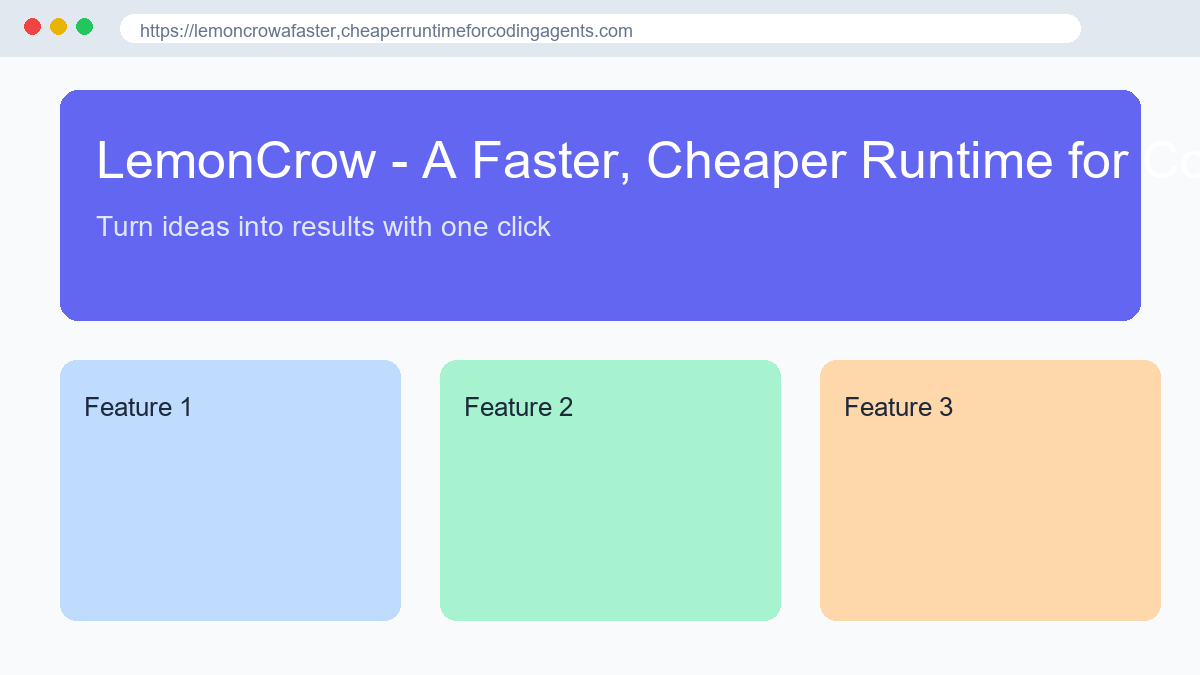
LemonCrow is a runtime that makes coding agents cheaper and faster by fixing how they read and reuse context, built for engineering teams running Claude Code, Codex, or OpenCode on real codebases. Instead of stuffing the whole repository into every prompt, it keeps a local code graph so the agent reads exactly what it needs, which the project says cuts cost about 30% and wall-clock time about 25% on average.
Core Features
- Local code graph with exact-range reads and bounded output, no embeddings or vector database required.
- Retrieval quality measured at about 1.9x the MRR of ripgrep on the project's benchmark set.
- On SWE-bench Verified it resolved 92.8% of tasks versus an 80.8% baseline while costing 29.5% less.
- Reduces output tokens by 27.9% and tool calls by 37.8% on the same pinned run.
- MIT-licensed and fully local, with no account required for the Lite path.
- Runs as a one-command local plugin with no background daemon left running.
Use Cases
- Large repositories where agents burn tokens re-reading the same files every turn.
- Cost-conscious teams running agents across many tickets or PRs.
- CI pipelines that fire coding agents on every change.
Pricing
LemonCrow is free and open-source under the MIT license. An optional Hosted or Pro plan adds shared infrastructure and advanced semantic retrieval for teams that do not want to run the index themselves.
Our Take
Best for teams whose agents drown in context cost on big codebases. The trade-off is adopting a local index and treating advanced semantic retrieval as a paid hosted tier. Compare with other AI coding tools.