Wonderful AI $5B Valuation 2026 Explained: Mega-Round Era
Category: Industry Trends
This analysis was written by the aifreetool Editorial Team — a group of full-time AI-industry researchers and writers who verify every claim against primary sources. Last updated September 8, 2026. We keep no affiliate relationship with the companies covered here.
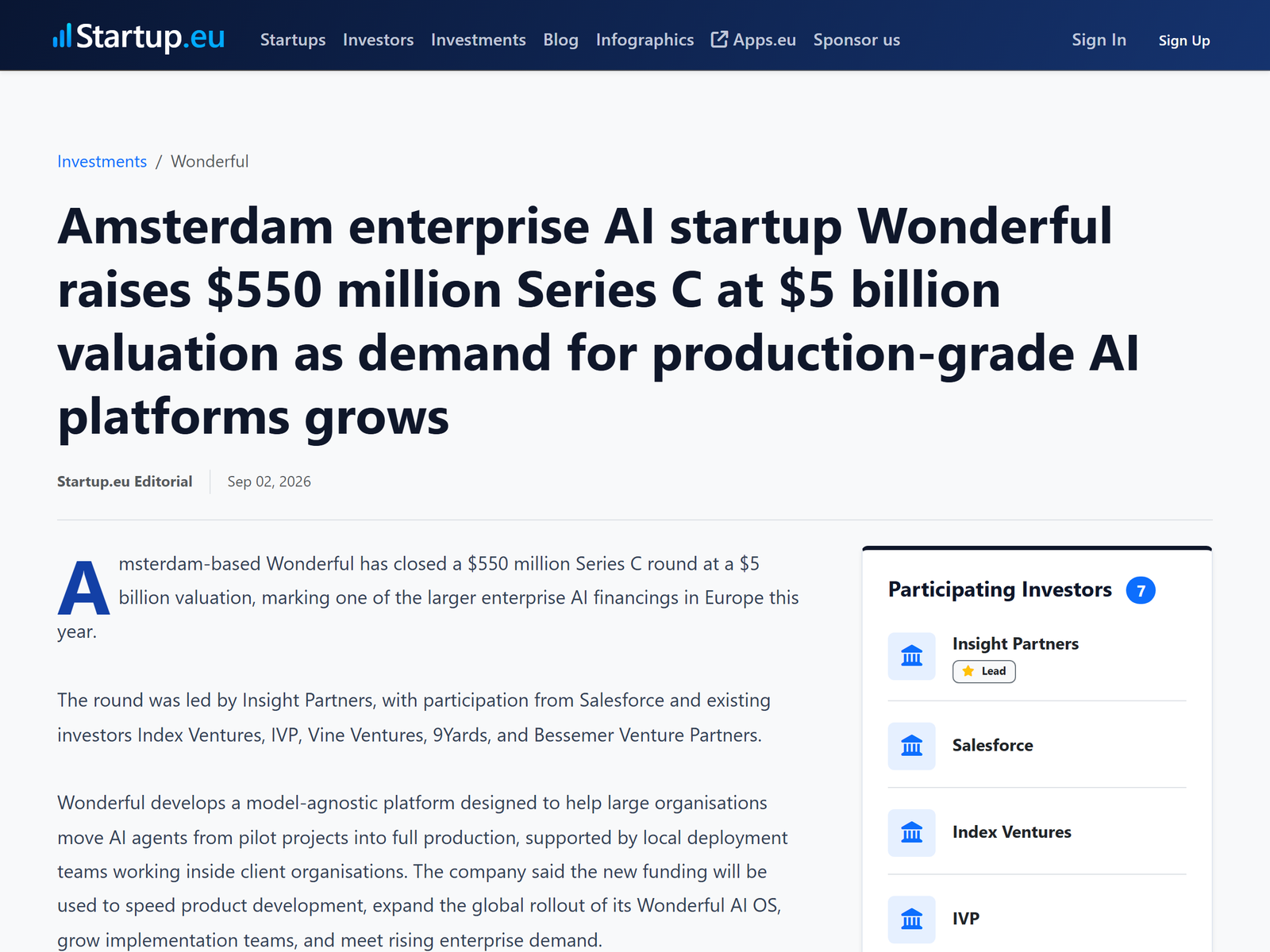
Quick answer: Wonderful, an Amsterdam-headquartered enterprise AI startup founded in early 2025, closed a $550 million Series C on September 2, 2026 at a $5 billion valuation — more than doubling the $2 billion mark it set just six months earlier. Insight Partners led the round with $150 million, while Salesforce joined as a first-time strategic backer alongside returning investors Index Ventures, IVP, Vine Ventures, 9Yards Capital, and Bessemer Venture Partners.

Wonderful’s annualized revenue is on track to clear $100 million by year-end, up from roughly $1 million a year ago. Headcount has grown from 350 to 650, the platform now operates in more than 35 markets, and total funding has crossed $836 million since the founding. The deal is the cleanest signal yet that enterprise AI has shifted from “single-function tools” to a battle for the coordination layer that sits above every model a Fortune 500 CIO is trying to deploy.
What Wonderful actually sells: not an agent, not a workflow tool — an AI operating system

Wonderful positions itself as a model-agnostic “AI OS” that bundles four products on one governed substrate: managed end-to-end workflows, productivity agents for employees, AI-native applications that replace or sit alongside legacy software, and conversational customer-facing agents. What separates the company from the dozens of point-solution vendors crowding the same RFP is the way it goes to market. Forward-deployed engineering pods embed inside the client for the first use case, get it into production, then hand the system over.
The platform can run on any cloud or on-premise, which matters for buyers with strict data residency rules. “We designed the AI OS to be modular and open because enterprises shouldn’t have to replace everything they already have to become AI-native,” CTO Roey Lalazar told reporters on the funding day call. That posture — vendor-neutral across models, deployable on existing stacks, governed centrally — is exactly what a 12-month Cloudera survey found the 95% of enterprises stuck in pilot purgatory are begging for. For a deeper look at how aifreetool.site maps the enterprise AI stack, see our AI engine and model category pillar page.
Why the valuation more than doubled in 183 days

Wonderful’s March 2026 Series B came in at $2 billion on $150 million. Six months later, $5 billion on $550 million. That is a 2.5x step-up in price and a 3.7x step-up in round size — without a single quarter of profitability disclosure. The number investors are underwriting is revenue velocity. Annualized recurring revenue is reportedly tracking to roughly $70 million today and $100 million by December 31, a 70x year-over-year jump from the ~$1 million the company generated at the time of its seed round in early 2025.
Insight Partners co-founder Jeff Horing framed the bet in a single sentence: “Wonderful is pursuing one of the largest opportunities in enterprise AI.” In enterprise software, a 70x revenue ramp inside two years is what gets the multiple from “applied AI tool” to “category-defining platform.” Investors are pricing Wonderful as if it will look like the ServiceNow or Salesforce of agentic enterprise AI — not as if it is a chatbot reseller.
The Salesforce check adds an extra signal layer. Salesforce is one of the most aggressive builders of competing agent infrastructure in the world (Agentforce, AgentExchange, Einstein Copilot), so it does not write checks into would-be competitors out of charity. The most plausible read: Salesforce wants a model-agnostic partner it can route large regulated customers to when those buyers refuse to be locked into a single vendor’s AI stack.
The mega-round era: who else raised this week, and what it signals
Wonderful is the headline, but the week around September 2 produced a cluster of enterprise-AI financings that point to the same conclusion. The table below tracks the largest rounds announced in the seven days surrounding Wonderful’s close.
| Company | Round | Amount | Lead Investor | Focus |
|---|---|---|---|---|
| Wonderful | Series C | $550M | Insight Partners | Enterprise AI OS |
| VAST | Series B/B+ | $446M | Matrix Partners China | Generative 3D |
| Félix | Series C | $200M | a16z, General Catalyst | WhatsApp remittance AI |
| Alice | Series | $140M | Undisclosed | AI trust & safety |
| Physical Superintelligence | Seed | $58M | Breakthrough Energy | AI-native physics lab |
| Deep Cogito | Series | $43M | Undisclosed | RL self-improvement |
Read together, the spread tells a clear story: capital is concentrating on a narrow band of companies that can already prove their product works in production. The deals are larger, the syndicates are tighter, and the categories are more specific. “AI” as a generic thesis is no longer fundable; “coordination layer for agent deployment in regulated industries” is.
My Take / The Bottom Line
Wonderful’s $5 billion is not a meme multiple. It is the market saying that the AI software stack will look like the cloud software stack: one or two platform companies sit beneath everything, and a long tail of point solutions gets squeezed into the substrate. Salesforce joining the cap table is the most bullish tell — a company that already owns CRM workflow has just endorsed the existence of a layer above its own Agentforce. If Wonderful can land even two of its top-five target logos in 2027, the next round will be priced on revenue, not story. If it cannot, the AI OS narrative will be remembered alongside the operating-system-on-the-desktop wars of the 1990s: one winner, two also-rans, and a graveyard of plausible alternatives that never made it past the procurement committee.
Frequently Asked Questions
What does Wonderful actually do?
It sells an enterprise “AI operating system” that runs any AI model on top of a company’s existing systems, with shared governance, workflow automation, productivity agents, and customer-facing chat agents. Forward-deployed engineers embed with the client to land the first production use case.
Who led the Series C?
Insight Partners led with $150 million. Salesforce joined as a first-time investor alongside returning backers Index Ventures, IVP, Vine Ventures, 9Yards Capital, and Bessemer Venture Partners.
Why did the valuation more than double in six months?
Annualized revenue scaled from roughly $1 million to a $70 million run rate, with $100 million projected by year-end 2026. Investors underwrote the velocity, not current profitability.
How is this different from Salesforce Agentforce or ServiceNow?
Wonderful is model-agnostic and intentionally sits above incumbent SaaS stacks instead of replacing them. Salesforce, ServiceNow, and Microsoft Copilot each lock customers into their own AI surface; Wonderful runs across all of them.
Where is Wonderful headquartered?
Amsterdam, Netherlands, founded by Israeli entrepreneurs Bar Winkler (previously built Approve.com, sold to Tipalti in 2021) and Roey Lalazar (previously founded localization platform Kaps).