Why DeepSeek Raised $15.8 Billion in 2026
Category: Industry Trends
Excerpt:
DeepSeek closed about RMB 105.5 billion, near $15.8 billion, at an $86 billion mark. Why state-linked money jumped from 2% to 27% of the round.
This analysis was written by the aifreetool Editorial Team — a group of full-time AI-industry researchers and writers who verify every claim against primary sources. Last updated October 30, 2026. We keep no affiliate relationship with the companies covered here.
TL;DR: DeepSeek closed a second round of roughly RMB 105.5 billion, about $15.8 billion, at a post-money valuation near $86 billion, according to The Information — more than double the RMB 50 billion target it began with. That prices the lab at roughly 86 times the $1 billion annualised revenue run rate founder Liang Wenfeng gave investors in September 2026. The striking detail is not the size. It is that state-linked money went from about 2% of the first round to 27% of this one.
In June 2026, DeepSeek took outside capital for the first time: more than RMB 50 billion at a valuation near $50 billion. Five months later it has raised again at close to twice the price, days after Washington ordered federal agencies to strip its software out of government systems. Both things can be true at once, and the way they fit together explains more about China's AI buildout than any benchmark does.
What DeepSeek Actually Raised
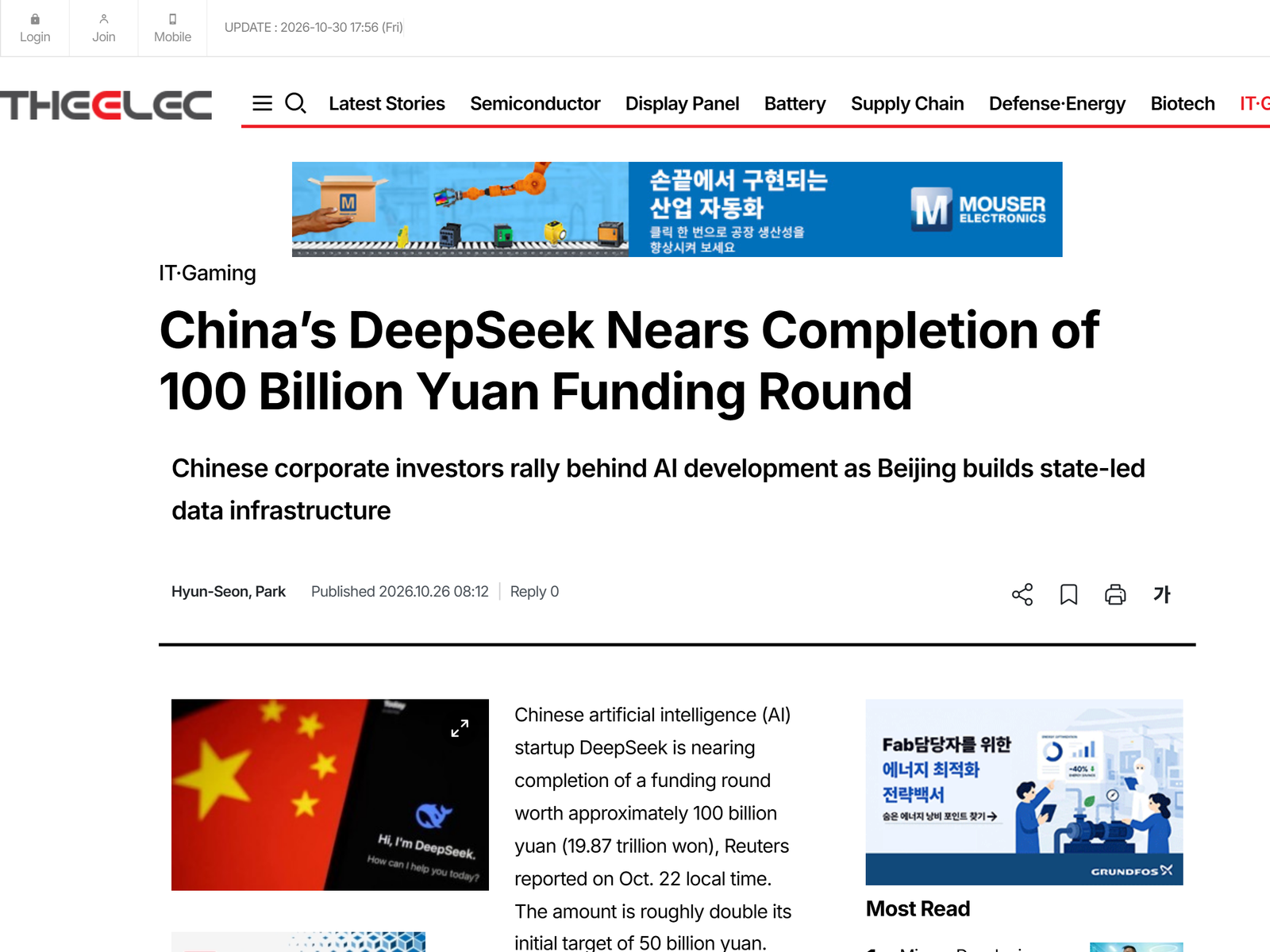
Reuters and Bloomberg both reported on October 22, 2026 that the Hangzhou lab was wrapping up a round of about RMB 100 billion, roughly $15 billion, after lifting its target twice — from RMB 50 billion to RMB 80 billion and then to the final figure. Reuters was careful with the wording: the deal was being finalised and terms "could still change."
The Information put the closing number higher on October 30: RMB 105.5 billion, about $15.8 billion, at a post-money mark of RMB 615.5 billion, or roughly $86 billion, with close to 30 investors. Reuters had the pre-money figure at RMB 500 billion, about $74 billion. DeepSeek itself has said nothing publicly about the round at any point, which is why every published version of the deal carries a caveat.
This was not a clean process. In late July, Bloomberg reported the round had been paused after a purported transcript of an investor call circulated online. It restarted, then doubled. A financing that stalls and then doubles inside a quarter is not a market clearing at a considered price. It is a queue.
Who Wrote the Cheques
Tencent put in RMB 10 billion in both rounds. CATL, the battery maker, put in RMB 5 billion in June and RMB 10 billion in October, with chairman Zeng Yuqun investing personally. Those two are the anchors.
The list beneath them is the interesting part, because it reads like an industrial supply chain rather than a cap table. New participants include Midea, Meituan, Geely, GigaDevice, vivo, Luxshare Precision, Xiaohongshu and Ctrip, with tickets between RMB 1 billion and RMB 3 billion. SMIC and ChangXin Memory Technologies sit at the same table as the model lab, bringing foundry and DRAM capacity. Per The Information, state-owned investors accounted for about 27% of the second round against roughly 2% in the first, with China Mobile, China Telecom, CICC, CITIC Securities and China Life each writing RMB 2 billion to RMB 8 billion cheques, and the National AI Industry Investment Fund matching its June commitment of RMB 1 billion.
| Round 1 (June 2026) | Round 2 (October 2026) | |
|---|---|---|
| Size | RMB 50bn+ (~$7.4bn) | RMB 105.5bn (~$15.8bn) |
| Post-money | ~$50bn | ~$86bn |
| Anchors | Tencent, CATL, Liang | Tencent, CATL, state funds |
| State-linked share | ~2% | ~27% |
| Investor count | Under 10 | Close to 30 |
Read that table as a policy document. Five months ago the money was private and commercial. Now more than a quarter of it is state-linked and the rest is dominated by companies that sell DeepSeek what a model lab consumes: wafers, DRAM, batteries for data-centre backup, handsets to run inference on.
The Multiple Is the Whole Argument
DeepSeek's annualised revenue run rate reached $1 billion by September 2026, according to Liang's remarks to investors reported by The Information and China Daily, more than double the level of a few months earlier. The revenue is real and mostly API sales to businesses and developers. Against the $86 billion post-money mark, that is roughly 86 times sales — for a lab competing with companies that have raised more than $100 billion each.
What does the money buy? Compute, and the timing explains the urgency. People familiar with the round told The Information that rising prices for Nvidia's high-end chips and fears of an AI bubble both pushed DeepSeek to take more capital than planned. The hedge against a chip price shock is to hold cash before the shock lands.
The same week, DeepSeek open-sourced DeepInfer, its internal inference framework, built to run on both Nvidia hardware and Huawei's Ascend. That is not charity. A framework that runs well on domestic silicon lowers the cost of the compute DeepSeek is about to buy, and it makes the company the reference stack for everyone else buying Ascend. Open-sourcing the tool is how you make your own supply chain cheaper.
Why the Target Doubled Twice
On October 20, 2026, the US Department of Homeland Security ordered federal civilian agencies to remove DeepSeek products, and third-party tools built on DeepSeek models, from government IT systems, under Federal Register entry 2026-21447. The round was reported two days later. No investor on the published list dropped out.
That is the part worth sitting with. The removal order closes a channel that was never a meaningful revenue line for an API business — federal civilian procurement is small, slow and heavily intermediated. What it does do is signal that integration risk now attaches to anything built on a Chinese model. DeepSeek's answer was to stop selling to the channel it lost and start financing the one it can control: domestic industry.
Liang retained an estimated 81.6% stake in the Chinese operating entity after the June round, according to WireScreen data cited by TechCrunch. Outside investors are buying economics, not control. When a founder keeps four-fifths of the equity through two megasized rounds, the money is not buying governance. It is buying allocation.
What the STAR Market Listing Changes
CITIC Securities was hired in September 2026 to prepare a Shanghai STAR Market listing, with four underwriters now attached and a debut pencilled for early 2027. No size, timetable or target valuation has been confirmed, and no prospectus has been filed.
The private mark sets the terms of that conversation. An IPO priced off an $86 billion private round needs public comparables to hold: Zhipu, listed in Hong Kong, carries a market value near $29 billion, and MiniMax near $7.2 billion. DeepSeek's pitch will be that it is the only Chinese lab with a $1 billion run rate and a genuine open-weight franchise. Its problem will be that audited accounts are less forgiving than a private round, and its revenue definition will have to survive an underwriter's diligence.
- Key Takeaways:
- DeepSeek closed roughly RMB 105.5 billion, about $15.8 billion, at a post-money mark near $86 billion, per The Information; the company has confirmed nothing.
- State-linked investors went from about 2% of the June round to about 27% of this one.
- The target was lifted twice, and the round had already stalled once in July — a queue, not a clearing price.
- At a $1 billion annualised run rate, the round prices DeepSeek at roughly 86 times sales.
- Federal removal orders landed two days before the round was reported, and no investor withdrew.
My Take / The Bottom Line
The number everyone will quote is $15.8 billion. The number that matters is 27%. When state-linked capital goes from a rounding error to more than a quarter of a round in five months, the buyer of last resort has changed, and the price stops being a return calculation and becomes a supply-security calculation. CATL is not underwriting an 86x multiple because it expects a venture outcome. It is buying a say in how the model layer of Chinese industry gets built.
Best for: procurement and strategy teams that integrate Chinese open-weight models, and anyone pricing a 2027 China AI listing. Trade-off: the same structure that makes the round possible makes the exit harder, because strategic investors who paid for supply security will not all fit inside a public float. The verdict I would defend: DeepSeek now has the capital to buy compute at scale, and has traded a slice of its independence to get it. Two rounds, two target upgrades, one stalled quarter. Watch the IPO filing — the audited revenue line will settle an argument that an $86 billion mark cannot.
Our coverage of Chinese model economics sits in the AI industry trends archive, and the product details are on the DeepSeek tool profile. For how labs gate access to their strongest models, see the Claude Mythos 5.1 listing.
FAQ
Q: How much did DeepSeek actually raise in October 2026?
Reuters and Bloomberg reported about RMB 100 billion, close to $15 billion, on October 22, 2026. The Information reported a close at RMB 105.5 billion, about $15.8 billion, at a post-money valuation near $86 billion. DeepSeek has not confirmed a figure.
Q: Why did DeepSeek raise more than planned?
People familiar with the round cited rising prices for Nvidia's high-end chips and concern about an AI bubble. Raising early locks in cash before hardware costs climb further.
Q: Is DeepSeek still a venture-capital story?
Partly. Tencent and CATL remain the two largest private backers, but state-owned investors rose to about 27% of the second round from roughly 2% in June, and the rest of the list is industrial — chips, memory, batteries, devices and platforms.
Q: When will DeepSeek list?
CITIC Securities was hired in September 2026 to prepare a STAR Market IPO, reported as early as 2027. Four underwriters are attached. No size, pricing or filing date has been confirmed.