Why Google's Gemini Work Agent Runs Claude for Enterprise AI in 2026
Category: Industry Trends
This analysis was written by the aifreetool Editorial Team — full-time AI-industry researchers who verify every claim against primary sources. Last updated October 9, 2026. We keep no affiliate relationship with the companies covered here.
TL;DR: On October 8, 2026, Google Cloud turned Gemini into a persistent enterprise work agent: one prompt box that runs knowledge work, coding and media creation across Gmail, Drive, Docs, Sheets and Calendar. The detail that matters most is buried in the spec — the agent can orchestrate Anthropic's Claude models alongside Google's own. Google is no longer selling you a model. It is selling you the layer that directs every model.
Sundar Pichai unveiled the Gemini agent at the Gemini at Work event inside NASA's Hangar One, in front of more than 700 Google Cloud customers, according to AGI Hunt's daily dispatch. Strip away the stagecraft and this is the sharpest strategic move of the young enterprise-agent market: Google just conceded that it does not need to win every model benchmark to own the workplace. It only needs to own the prompt box your company types into. For teams tracking this shift, our AI office tools and productivity categories cover the competing agent platforms in depth.
What Google Actually Shipped on October 8
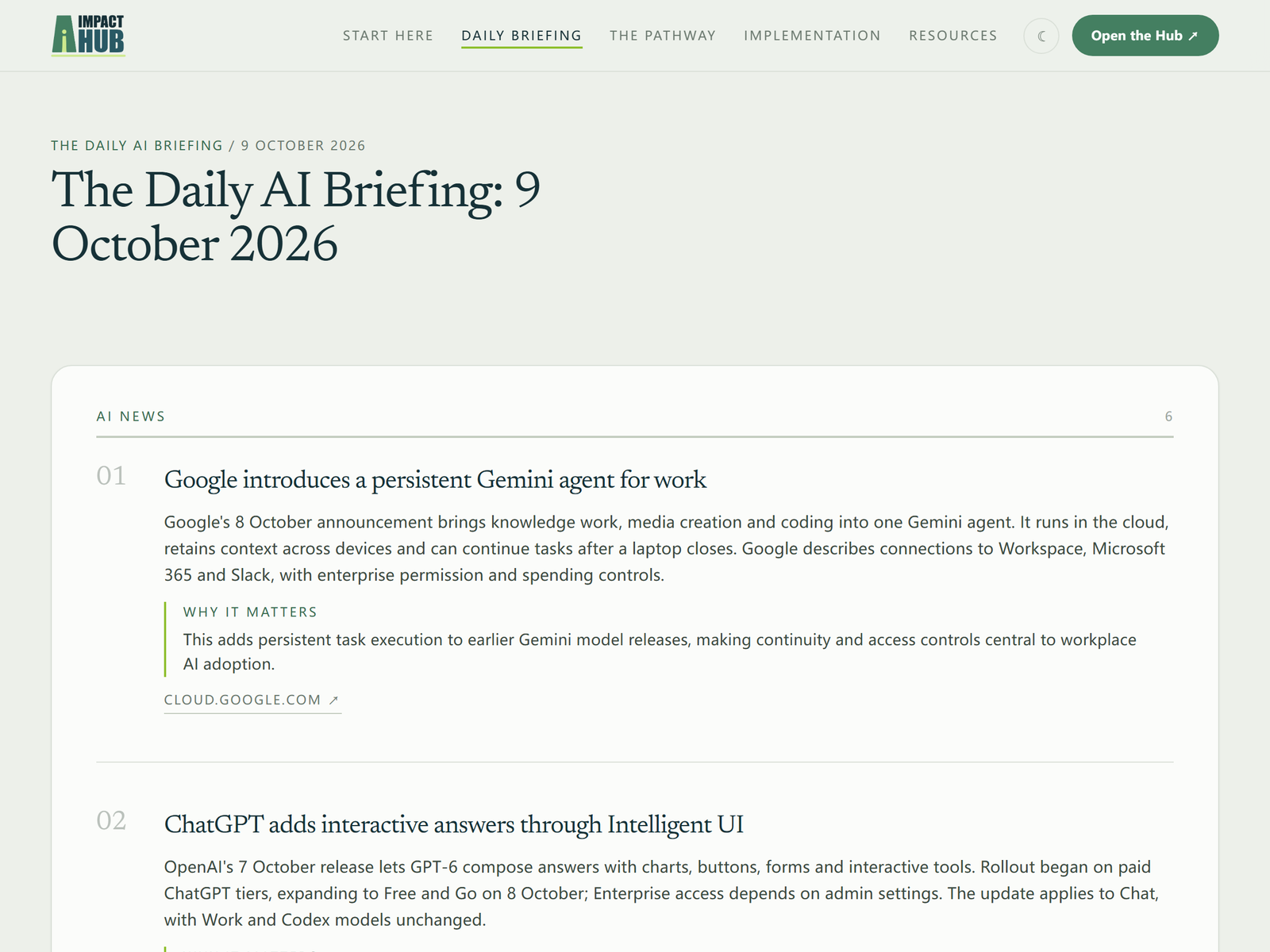
The Gemini work agent runs in the cloud, keeps persistent context across devices, and continues executing tasks after you close your laptop — the same always-on architecture Microsoft shipped for Copilot in September, but wired into Google's own productivity stack. It coordinates work across Gmail, Drive, Docs, Sheets and Calendar plus connected third-party business applications, using specialized skills and multiple underlying models to execute multi-step workflows rather than answer single questions, as AI Impact Hub's October 9 briefing summarizes. Google is also previewing finance and legal editions, a signal that the company is going after vertical workflows with compliance requirements, not just general office assistance.
The controls matter as much as the capabilities. Google ships the agent with enterprise permission scoping and spending controls, because a cloud agent that can read your email, edit your documents and schedule your meetings is a fundamentally riskier object than a chat sidebar. Anyone who has watched an over-permissioned integration leak data knows the pattern: capability arrives first, governance arrives in the incident report. Google at least put the permission model in the launch, which is more than most agent vendors managed in 2025.
The Claude Detail Is the Real Story
Here is the sentence that should worry every competitor: the agent orchestrates across Google's own models and Anthropic's Claude models. As The CODEW's enterprise agent analysis puts it, Google is positioning itself as an orchestration layer, not just a model provider. That reframes the whole market. If the durable moat is workflow integration rather than model quality, then whoever sits between the user and the models captures the customer relationship — and can route each task to whichever model is cheapest or best that week.
Read the same week together and you see four companies placing four different bets on the same question — where does durable advantage live when models commoditize? Google bet on workflow integration. OpenAI released 722 verifiable math manuscripts, betting on provable reasoning. Anthropic launched a Critical Infrastructure Defense Program, betting on safety-critical deployment. Microsoft pushed agent execution containers onto the PC itself, betting on local execution for privacy and cost. These are not four products; they are four theories of the moat.
| Company | October move | Strategic bet | Weakest flank |
|---|---|---|---|
| Gemini enterprise work agent, Claude orchestration | Workflow integration | Depends partly on a rival's model | |
| OpenAI | 722 math manuscripts, 372 finding families | Verifiable reasoning | No owned productivity suite |
| Anthropic | Critical Infrastructure Defense Program | Safety-critical deployment | Distribution rides on others' surfaces |
| Microsoft | Agent execution containers on Windows PCs | Local execution | Consumer-enterprise split after Copilot rebuild |
The Governance Clock Started Ticking This Week
On October 8, the UK's Information Commissioner's Office announced data-protection commitments from ten AI developers — including all four above — and opened a call for evidence on the risks of agentic AI. Regulators have noticed that an agent which takes actions on your behalf raises questions no existing access-control model answers: who audits a thousand autonomous sessions? What does an audit trail even look like when the agent edits documents, sends messages and spends tokens across three suites?
For buyers, the practical reading is blunt. Before you let any persistent agent touch production data, write the permission boundary and the spending cap into the pilot plan — not the retrospective. The companies that get agent deployment right in 2026 will be the ones that treated the first rollout as a security exercise with a budget ceiling, not a productivity experiment.
My Take / The Bottom Line
My verdict: the orchestration play is the strongest position on the board, and Google just took it. Owning the productivity suite is the distribution advantage Microsoft used to own by default; adding Claude orchestration means Google can serve best-of-breed quality without winning the benchmark war. The loser in this frame is Anthropic — supplying models to the platform that also owns the customer is how ingredient brands get squeezed on price. For enterprise buyers, the advice is concrete: demand model portability at the agent layer, keep your prompts and evaluation suites exportable, and cap agent spending before the first pilot. The prompt box is becoming the operating system of work. Whoever controls it controls the economics of everyone underneath — including, eventually, yours.
FAQ
What is Google's Gemini work agent?
A persistent cloud agent announced October 8, 2026 at Gemini at Work. It executes multi-step knowledge work, coding and media creation across Gmail, Drive, Docs, Sheets, Calendar and connected business apps, keeping context across devices and continuing tasks after a laptop closes.
Can the Gemini agent use Claude models?
Yes. Google says the agent orchestrates multiple models, including Anthropic's Claude alongside Google's own — making Google Cloud an orchestration layer rather than a single-model vendor.
How is it different from Microsoft Copilot's agents?
Microsoft bets on local execution — agents run on the PC inside execution containers for privacy and cost control — while Google's agent runs in the cloud with deep Workspace integration and multi-model routing.
What should enterprises check before deploying a work agent?
Permission scoping, spending caps and audit trails. Regulators including the UK ICO opened a formal review of agentic AI risks on October 8, 2026, and the ten largest developers signed data-protection commitments the same day.
When do finance and legal editions arrive?
Google is previewing finance and legal versions of the Gemini work agent now, aimed at vertical workflows with compliance requirements; general availability dates have not been announced.