Why Cognition AI's $2B Series E at $48B Valuation Makes Sense 2026
Category: Industry Trends
This analysis was written by the aifreetool Editorial Team — a group of full-time AI-industry researchers and writers who verify every claim against primary sources. Last updated September 16, 2026. We keep no affiliate relationship with the companies covered here.
TL;DR: Cognition AI closed a $2 billion Series E at a $48 billion valuation on September 8, 2026. Revenue run-rate nearly doubled from $492 million in May to almost $900 million, keeping the price-to-sales multiple around 53x. The round shows that enterprise buyers are paying for autonomous coding agents right now, but it also raises questions about customer concentration and Nvidia's dual role as investor and client.
Cognition's official Series E announcement carries the headline numbers that sound like peak AI froth: more than $2 billion in fresh capital and a $48 billion price tag. When Cognition announced its Series E, the headline numbers sounded like peak AI froth: more than $2 billion in fresh capital and a $48 billion price tag. Then the company dropped the revenue figure. Run-rate revenue went from $492 million in May to nearly $900 million in early September. That growth rate is why Andreessen Horowitz, Accel, Founders Fund, General Catalyst, Avenir, and roughly four dozen other firms piled in. It is also why the valuation, while enormous, is not obviously detached from the business.

The Numbers Behind the Round
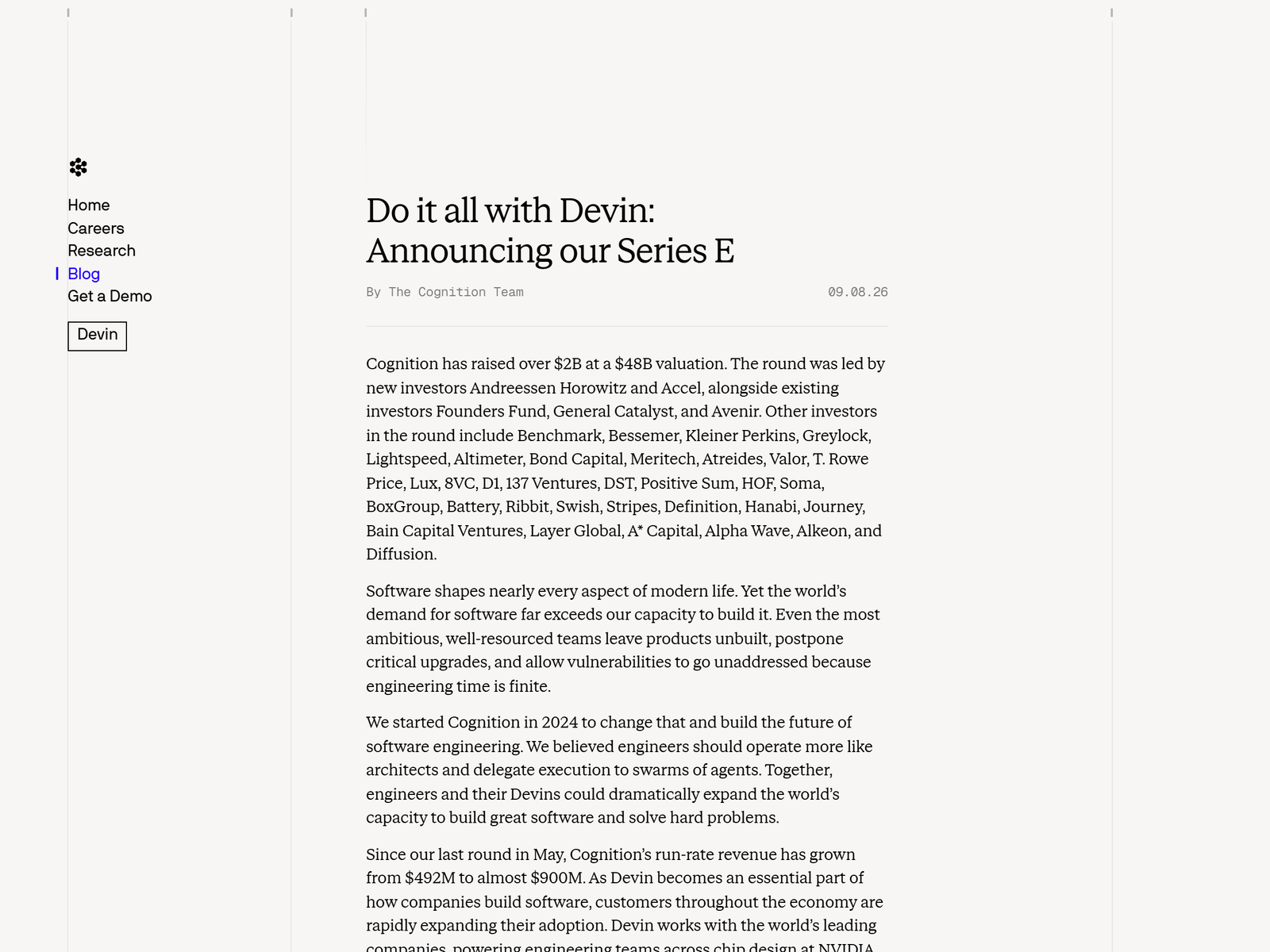
Cognition's own blog post, published September 8, 2026, says the Series E was led by Andreessen Horowitz and Accel, with returning participation from Founders Fund, General Catalyst, and Avenir. The syndicate also included Benchmark, Bessemer, Kleiner Perkins, Greylock, Lightspeed, and NVIDIA. The $48 billion valuation is roughly double the $26 billion valuation Cognition claimed in May, when it raised more than $1 billion in its Series D.
The revenue math is what makes the multiple look less absurd. At the Series D, Cognition's run-rate was $492 million. Four months later, it is almost $900 million. Dividing the old valuation by the old revenue gives roughly 53x; dividing the new valuation by the new revenue gives roughly 53x. In other words, the valuation expanded almost in lockstep with revenue. Investors did not pay a higher multiple; they paid the same multiple for a company that nearly doubled in four months.
| Metric | Series D (May 2026) | Series E (Sept 2026) |
|---|---|---|
| Valuation | $26 billion | $48 billion |
| Raised | >$1 billion | >$2 billion |
| Run-rate revenue | $492 million | ~$900 million |
| Implied revenue multiple | ~53x | ~53x |
Why Enterprise Buyers Are Signing Up

Cognition's pitch is that Devin is not a chatbot for developers; it is an autonomous software engineer that plans, writes, debugs, and deploys code. As GenAI Daily reported, the company lists NVIDIA, GE Aerospace, Citi, Mercedes-Benz, and Modal as named customers. Mercedes-Benz reportedly condensed an eight-month legacy modernization project into eight days. Itaú, the Brazilian bank, uses Devin for security operations and says 70% of its code vulnerabilities are now resolved automatically.
The product surface has also widened. Devin Auto-Triage does a first pass at incident investigation. Devin Security Swarm finds and triages vulnerabilities. Devin Automations lets teams trigger work from Slack, GitHub, Linear, and other systems without opening a chat each time. Cognition says 89% of code committed by its own engineers is now committed by Devin, a number that is either impressive or alarming depending on how much you trust the agent.
The Open Question: Customer Independence
Not every part of the story is clean. NVIDIA appears on both sides of Cognition's balance sheet: it is an investor in the Series E and a customer that uses Devin for chip-design workflows. That pattern is not unique — Nvidia has committed more than $40 billion to AI equity positions in 2026 — but it makes outside assessments of revenue quality harder. If a major customer is also a major shareholder, the line between commercial demand and strategic support gets blurry.
There is also the operational cost of running agentic workloads at scale. Autonomous coding agents burn compute. As usage grows, so does the bill for inference. Cognition's $900 million run-rate is impressive, but the gross margins on that revenue matter more than the top line. The company has not disclosed margins, and the market is essentially betting that revenue growth will outpace compute costs long enough for Cognition to become a durable platform.
What This Means for the AI Coding Race
The round lands amid a broader land grab for AI coding tools. Anysphere, the maker of Cursor, sold to SpaceX for a reported $60 billion in August. OpenAI and Anthropic are pushing their own agentic coding products. Cognition's answer is to position itself as an independent agent lab that can combine the best models for each job rather than tying customers to one provider. That independence is the theory. Whether it holds in practice will depend on whether Cognition can keep converting pilot deployments into multi-million-dollar enterprise contracts without leaning on affiliated investors.
For readers tracking the space, the key signal to watch is not the next funding round. It is whether Cognition can keep the revenue multiple stable while revenue itself keeps doubling. If the next quarter shows $1.5 billion run-rate at the same multiple, the $48 billion valuation starts to look cheap. If growth stalls, the round will look like a ceiling.
FAQ
Q: What does Cognition AI actually do?
A: It builds Devin, an autonomous AI software-engineering agent that writes, debugs, and deploys code for enterprise engineering teams.
Q: How much did Cognition raise in its Series E?
A: More than $2 billion at a $48 billion valuation, announced September 8, 2026.
Q: Who led the Series E?
A: Andreessen Horowitz and Accel led the round, with participation from Founders Fund, General Catalyst, Avenir, Benchmark, and NVIDIA, among others.
Q: Why is the valuation not obviously a bubble?
A: Run-rate revenue nearly doubled from $492 million in May to almost $900 million in September, so the price-to-sales multiple stayed roughly 53x.
Q: What is the biggest risk?
A: Customer concentration and investor-customer overlap, especially with NVIDIA, plus the high compute cost of running agentic workloads at scale.
My Take / The Bottom Line
Cognition's Series E is the strongest evidence yet that autonomous coding agents have crossed from demo to enterprise product. The revenue growth is real, the customer list is credible, and the 53x multiple is not out of line for a company doubling in four months. The question is whether that growth can continue once the easy early-adopter contracts are signed. If Devin becomes infrastructure rather than a pilot project, the $48 billion valuation will hold. If it remains a novelty for well-funded tech teams, the round will age poorly. For now, Cognition is winning the narrative — and the checkbook.
Browse more AI industry analysis in our Industry Trends section.