Why Cohere's C$7 Billion Raise Tests Sovereign AI in 2026
Category: Industry Trends
Excerpt:
Cohere's Series E targets C$7 billion at a C$35.7 billion mark, but Ottawa's staged C$1.6 billion stake is the number that decides whether sovereign AI sells.
This analysis was written by the aifreetool Editorial Team — a group of full-time AI-industry researchers and writers who verify every claim against primary sources. Last updated October 31, 2026. We keep no affiliate relationship with the companies covered here.
TL;DR: Cohere's Series E is targeting up to C$7 billion at a C$35.7 billion valuation, but the company closed only an initial tranche on October 29, 2026 and did not say how much it actually took. The sovereign AI story sits in a smaller number inside the round: a Government of Canada equity stake of up to C$1.6 billion, paid in stages, against promises of 1,000 Canadian technical jobs and C$1.7 billion of domestic compute spend by 2030.

Read the announcement closely and the headline is a ceiling, not a receipt. Cohere said it completed an initial close of a round "targeting up to" C$7 billion — about US$5 billion at the Bank of Canada rate on October 28. It did not disclose how much had been committed, when the rest would land, or what the government paid per share. Those are the three details that would let anyone outside the room price this deal.
What Cohere Announced, and What It Left Blank
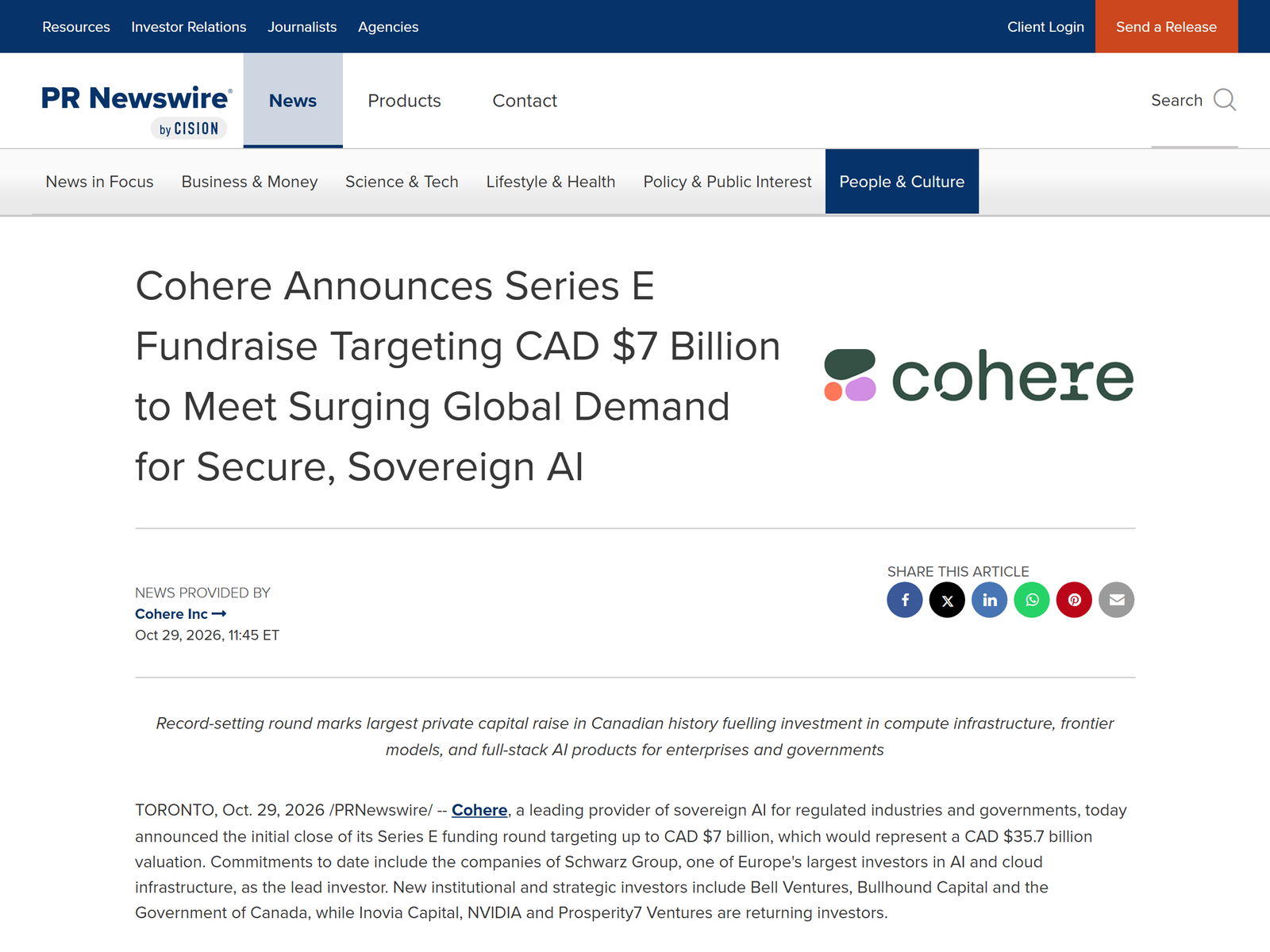
The companies of Germany's Schwarz Group lead the round, according to Cohere's October 29 release. New investors are Bell Ventures, Bullhound Capital and the Government of Canada. Inovia Capital, NVIDIA and Prosperity7 Ventures — Saudi Aramco's venture arm — are returning.
The gap matters more than usual because Cohere's numbers are not public. In September 2026, The Logic reported advanced talks to raise US$2 billion to US$3 billion at a US$20 billion valuation. Six weeks later the target is C$7 billion at C$35.7 billion. Both can be true — one described a negotiation, the other an ambition — but only one has money behind it today.
Cohere's previous round raised US$600 million across two closings in 2025 at a US$7 billion valuation, so the new target implies roughly 3.6 times that mark a year later. It would also be the largest private financing ever by a Canadian tech company, ahead of Clio's C$1.24 billion in 2024 and Waabi's US$1 billion in January 2026.
The C$1.6 Billion Is the Real Sovereign AI Story

On October 29 in Montreal, Prime Minister Mark Carney announced the stake and framed it as a response to concentration. "The most powerful AI systems are concentrated in a very small number of companies, in a very small number of countries," he said, per The Logic's reporting. "That concentration carries risks: to cost, to resilience and to sovereignty."
The conditions attached are unusually specific for a government cheque, and they are the reason this is not simply a subsidy:
| Term | Detail |
|---|---|
| Round target | Up to C$7.0bn (~US$5.0bn); initial close announced, amount undisclosed |
| Implied valuation | C$35.7bn (~US$25.4bn) if the target is reached |
| Lead investor | Companies of Schwarz Group (Germany) |
| Government equity | Up to C$1.6bn, staged, with progress reporting |
| Jobs commitment | At least 1,000 Canadian technical roles by 2030 |
| Compute commitment | At least C$1.7bn of Canadian AI infrastructure by 2030 |
| Corporate commitment | Incorporation and headquarters stay in Canada |
Ottawa had already put money to work here: up to C$240 million toward a C$725 million Cohere compute project at a CoreWeave data centre in Cambridge, Ontario — the first investment from the C$2 billion Canadian Sovereign AI Compute Strategy. Add it up and the state is not a passive index investor. It is the anchor limited partner of a company whose main customers are governments, banks and insurers — the buyers who cannot move workloads to a US hyperscaler without a procurement fight.
Why a German Retail Group Leads an AI Round

Schwarz Group owns Lidl and Kaufland and runs its technology arm as Schwarz Digits. It is not a typical lead, but the logic is straightforward: in April 2026 it committed US$600 million as part of the Cohere–Aleph Alpha combination, and its goal is to run these models on its own STACKIT cloud. "Digital sovereignty is about strategic choice, interoperability and holding the keys to our own data," Schwarz Digits chief executive Christian Müller said in the release. Germany's digital minister, Karsten Wildberger, pointed to the Sovereign Tech Alliance as a model for German-Canadian cooperation.
That is a different investment thesis from the one driving US mega-rounds. NVIDIA is in this cap table to sell silicon. Schwarz is in it to sell computing it already owns, to customers in jurisdictions uneasy about where their data sits. The lead investor is also a prospective distributor, which says more about the next two years of Cohere revenue than any benchmark does.
The 165% Growth and the 3.6x Problem
Cohere's operating numbers are the strongest part of the pitch. Annual recurring revenue grew 165% year over year in the third quarter of 2026, and the customer base expanded twentyfold in a year to 300 accounts, including RBC, TD Bank, Bell Canada, Fujitsu and PwC.
The weakness is what those numbers are measured against. Cohere has not disclosed a dollar ARR figure, so 165% growth is a percentage of an unknown base. A valuation up 3.6 times in twelve months against percentage-only disclosure asks investors to accept arithmetic they cannot check.
The peer set is context, not comfort. Mistral closed a €3 billion Series D in September 2026 above a €21 billion valuation, led by Samsung. Cohere's founders argue they need less capital because enterprise buyers often pay for their own compute — a real structural difference, and also why the company cannot buy its way to a frontier result.
Commercial proof exists but sits behind a vendor's pen. Cohere publishes Model Vault rates from US$3 an hour, or US$2,000 a month, for a dedicated instance. Its CoreWeave case study says a North support workflow reached broad production in 90 days and cut average resolution from four-to-eight days to two-to-five. Both are Cohere's own numbers, unaudited. The company says proceeds will fund two acquisitions within a year, a security product called Cohere Cyber, and a new frontier model.
- Key Takeaways:
- Cohere announced an initial close of a Series E targeting up to C$7 billion at a C$35.7 billion valuation on October 29, 2026 — with the closed amount undisclosed.
- The Government of Canada is putting up to C$1.6 billion of equity in, staged, against 1,000 jobs and C$1.7 billion of domestic compute spend by 2030.
- Schwarz Group leads, and plans to serve Cohere models from its own STACKIT cloud — investor and distributor in one.
- ARR grew 165% year over year in Q3 2026 and customers reached 300, but no dollar ARR has been published.
My Take / The Bottom Line
The number that will be quoted is C$7 billion. The number that will decide whether sovereign AI becomes a business is C$1.6 billion, and specifically its staging. A target invites a press release; a staged tranche with progress reporting invites an audit. Carney's government has bought the option to stop paying if the jobs and the compute spending do not appear, which is a better structure than the blank cheques handed to AI labs elsewhere.
Best for: regulated buyers in Canada, Germany and the wider EU who need a model vendor they can host themselves. Trade-off: a national champion carries a national discount. Cohere now has to win renewals from RBC and PwC while a minister explains the stake on television, and the first time a customer leaves for OpenAI it becomes a political story rather than a sales one. The verdict I would defend: the capital is real, the valuation is aspirational, and the test is retention — not logo count.
Our model-economics coverage sits in the AI industry trends hub and tech deep dives. For how a competing non-US lab prices its models, see the DeepSeek tool profile.
FAQ
Q: Did Cohere actually raise C$7 billion?
No. Cohere announced an initial close of a round targeting up to C$7 billion. The committed amount at that close was not disclosed, and the C$35.7 billion valuation follows from the target, not from a confirmed total.
Q: How much is the Canadian government investing in Cohere?
Up to C$1.6 billion in equity, invested in stages. The money is tied to commitments of at least 1,000 Canadian technical jobs and at least C$1.7 billion in Canadian computing infrastructure by 2030.
Q: Why is a German retailer leading an AI funding round?
Schwarz Group's technology arm, Schwarz Digits, committed US$600 million in April 2026 alongside the Cohere–Aleph Alpha combination. It wants to run Cohere models on its STACKIT cloud, so the investment doubles as a distribution agreement for European customers.
Q: Is Cohere profitable?
Cohere has not disclosed profitability. It reports 165% year-over-year ARR growth through Q3 2026 and 300 customers, both company-reported and unaudited.