Why 78% of Enterprises Still Fail to Scale AI in 2026
Category: Industry Trends
This analysis was written by the aifreetool Editorial Team — a group of full-time AI-industry researchers and writers who verify every claim against primary sources. Last updated September 4, 2026. We keep no affiliate relationship with the companies covered here.
Quick answer: Enterprises still fail to scale AI at scale: only 22% have succeeded across multiple business units, according to a September 2026 Gartner survey of 1,303 organizations. The minority that do scale share one habit: they track the ROI of every AI initiative like a portfolio and kill underperforming projects fast. Everyone else is stuck chasing productivity theater with no financial visibility.
The Scaling Gap: Gartner's 2026 Numbers
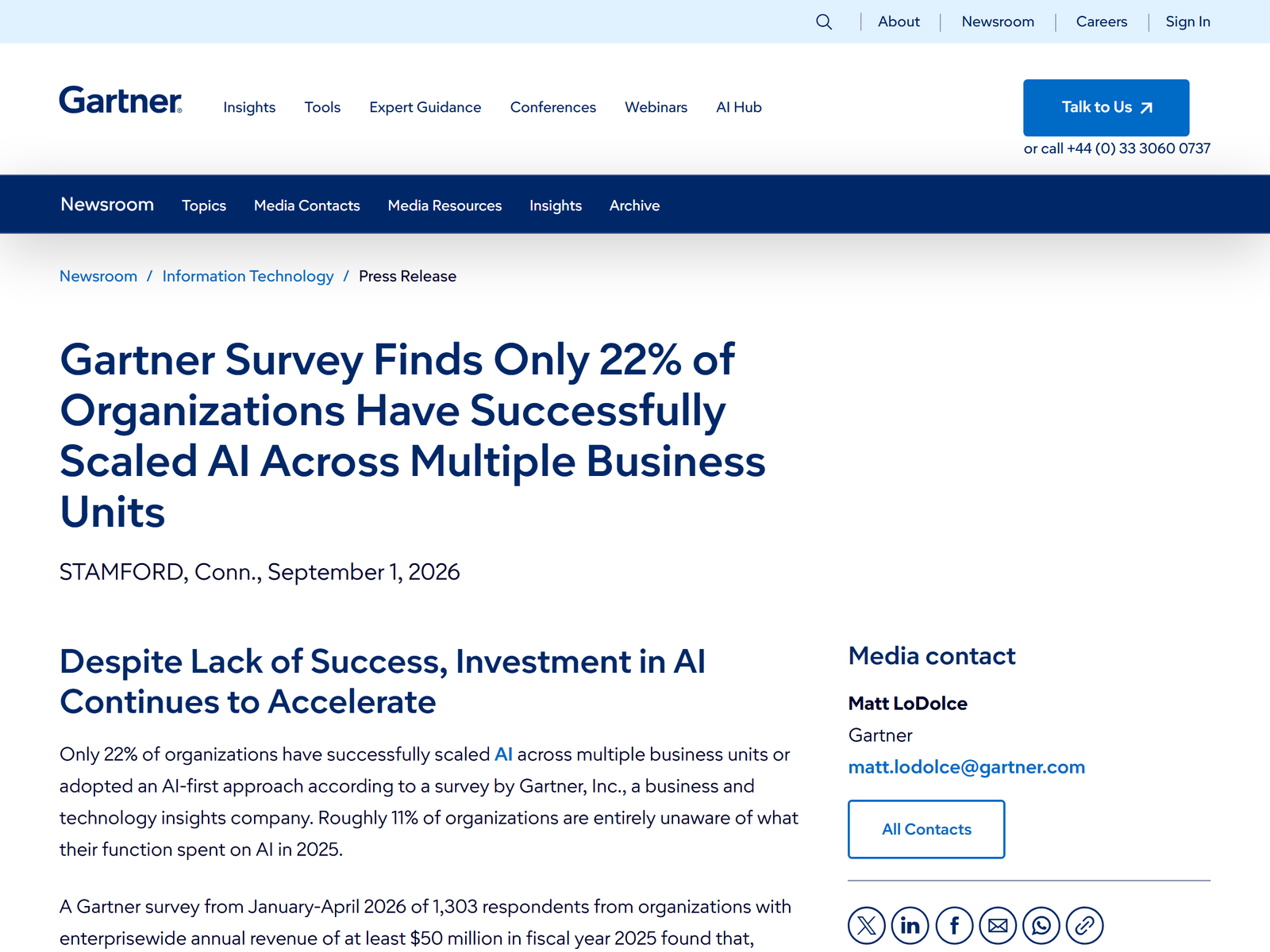
The AI industry loves to talk about adoption, but adoption is not the same as scaling. Gartner's latest C-suite survey, fielded between January and April 2026, drew responses from 1,303 functional leaders at enterprises with at least $50 million in annual revenue. The result was sobering: just 22% reported they had successfully scaled AI across multiple business units or adopted an AI-first approach. Roughly 11% did not even know what their function spent on AI in 2025.
Despite that lack of success, investment is accelerating. Eighty-five percent of functional leaders plan to increase AI spending in 2026 after dedicating an average of 12% of their functional budgets to AI in 2025. Tina Nunno, Distinguished VP at Gartner, put it bluntly: "Without disciplined measurement tied directly to business outcomes, enterprises risk wasted resources and unmet expectations."
The disconnect is not a funding problem. It is a measurement problem.
What High Performers Do Differently

Gartner split respondents into high and low performers. High performers — defined as companies that constantly track AI ROI, treat AI as a portfolio of value, and regularly reallocate or discontinue underperforming initiatives — reported positive returns on 81% of their AI projects. Low performers could not identify the rate of return for 29% of their initiatives.
The difference is operational discipline, not budget size. High performers know which use cases generate cash and which ones burn it. They do not treat AI like a corporate hobby. They treat it like a product line with P&L responsibility.
| Trait | High Performers (22%) | Low Performers (78%) |
|---|---|---|
| ROI tracking | Constant, by initiative | Missing for 29% of projects |
| Portfolio view | Reallocate or kill losers | Keep funding underperformers |
| Use-case selection | Aligned to business need | Chase popular hype |
| Positive returns | 81% of initiatives | Unknown / lower rate |
That discipline extends to use-case selection. The most popular AI projects are rarely the most profitable ones. For example, 54% of IT leaders pursued cybersecurity threat detection and IT service desk automation, yet the use cases with the highest reported positive returns were intelligent IT asset and cost optimization (40%), synthetic data generation (28%), and automated code generation (23%). Chasing hype instead of value is an expensive mistake.
The Productivity Trap
Seventy-five percent of functional leaders told Gartner that productivity is their primary target outcome for AI. On average, they direct about 30% of their functional AI spend toward productivity gains — nearly double the share aimed at the next highest objective. That sounds logical until you realize that productivity is the easiest metric to fake.
A chatbot that shaves two minutes off an email draft is a productivity win on paper. But if it does not change revenue, cost, or risk, it is not a business win. It is theater. Meanwhile, less glamorous use cases like synthetic data generation and IT cost optimization are delivering quantifiable returns because they are tightly coupled to specific financial outcomes.
The takeaway is uncomfortable: most enterprises are not failing because AI does not work. They are failing because they never defined what "work" means in dollars.
My Take / The Bottom Line
Enterprise AI is moving from the lab to the ledger, and most companies are not ready for the transition. The 22% that scale successfully are not using better models or hiring smarter engineers. They are simply running AI like a business unit with clear ROI targets, regular portfolio reviews, and the political will to cancel projects that do not pay back.
If you are a decision-maker, stop asking which model to buy and start asking which metric to move. Pick one number — cost per ticket, revenue per lead, hours per report — and tie every AI initiative to it. If you cannot draw a line from the project to the number in 90 days, kill the project. That is what the 22% do, and it is the only thing that actually separates them from everyone else.
For teams looking to apply this discipline without building infrastructure from scratch, tools like ChatGPT and other enterprise-ready assistants can accelerate pilot phases, but only if the pilot has a clear success criterion before it starts. You can also browse productivity and efficiency tools on our directory to find software that tracks output per dollar spent.
FAQ
What percentage of enterprises have successfully scaled AI?
Only 22%, according to Gartner's September 2026 survey of 1,303 organizations with $50M+ in annual revenue.
Why do most AI projects fail to scale?
Because companies lack disciplined ROI measurement. Low performers could not identify returns for 29% of their AI initiatives.
Which AI use cases deliver the highest returns?
Intelligent IT asset and cost optimization, synthetic data generation, and automated code generation report the highest proportion of positive returns.
Do high performers spend more on AI?
Not necessarily. The key difference is operational discipline and portfolio management, not budget size.
What should leaders prioritize: productivity or revenue?
Revenue or cost reduction tied to specific metrics. Productivity alone is too vague and often becomes theater.