Why Zhipu Raised $5 Billion in 2026: Self-Improving AI Bet
Category: Industry Trends
This analysis was written by the aifreetool Editorial Team — a group of full-time AI-industry researchers and writers who verify every claim against primary sources. Last updated September 14, 2026. We keep no affiliate relationship with the companies covered here.
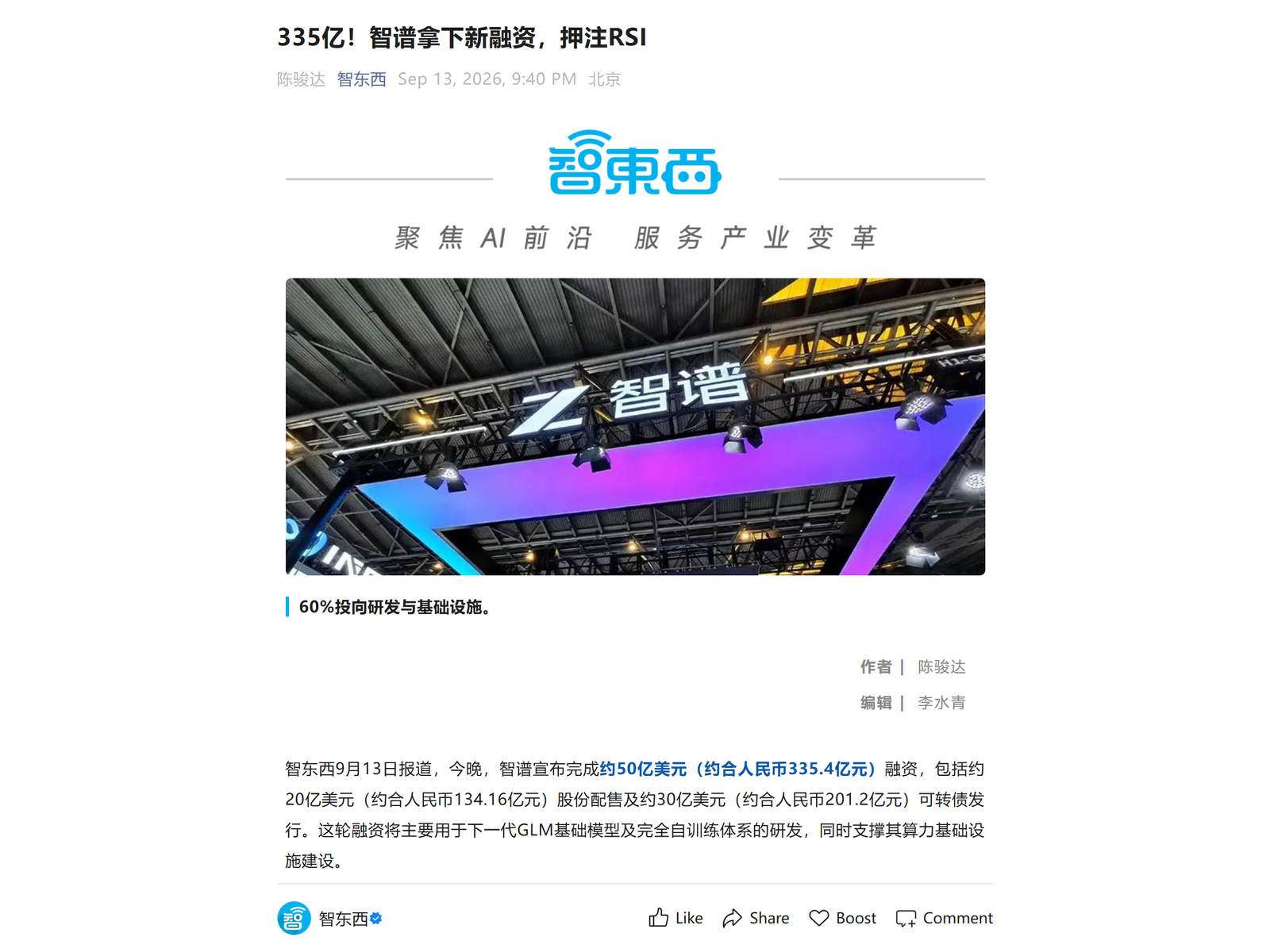
Quick answer: Zhipu, the Beijing lab behind the GLM model family, raised about $5 billion on September 13, 2026 — roughly $2 billion in new shares and $3 billion in zero-coupon convertible bonds. Around 60% of the money goes into the self-improving "fully self-training" system that underpins the next GLM-6.0, plus the data centers to run it. It is the third time the company has tapped investors in ten months, and it confirms that frontier AI is now financed like heavy industry, not software.
Zhipu's $5 billion raise, announced in a Hong Kong Stock Exchange filing on the evening of September 13, is the largest single capital raise by a Chinese AI company this year — and the market's first reaction was to sell. The stock (02513.HK) fell more than 10% at the open on September 14, with MiniMax down 6% in sympathy. Both reactions are correct: this is a serious war chest for a genuine technical bet, and it is also a reminder that the bill for staying at the frontier now arrives every eight weeks. What follows is the raise explained piece by piece — the structure, the burn rate, and the bet underneath it.
What Zhipu Actually Announced
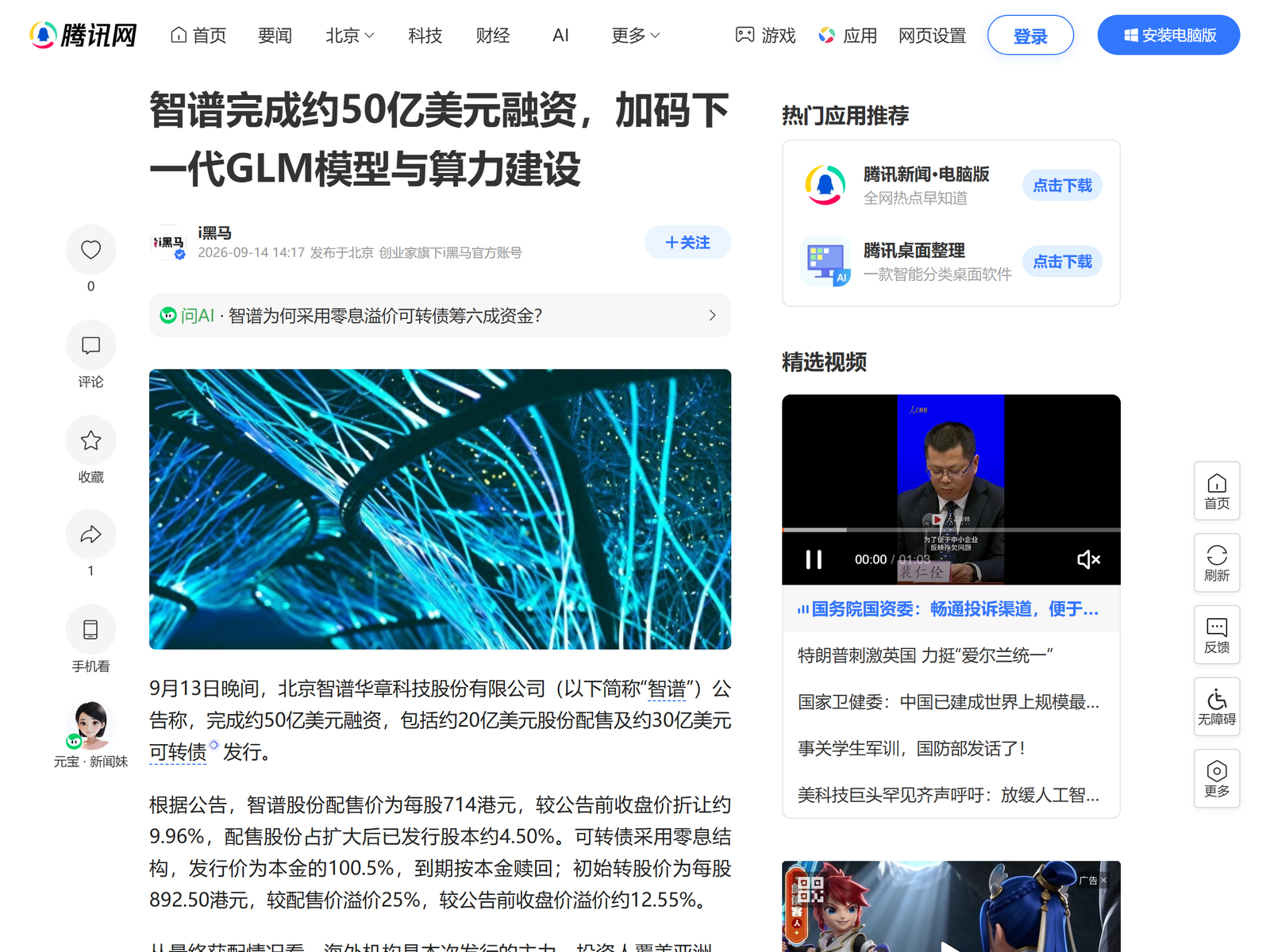
The filing breaks the round into two parts. First, a share placement of about 22 million new H shares at HK$714 each — a 9.96% discount to the pre-announcement close — raising roughly $2 billion and diluting existing holders by about 4.5%. Second, $3 billion of zero-coupon convertible bonds, issued at 100.5% of principal with an initial conversion price of HK$892.50: a 25% premium over the placement price and 12.55% above where the stock closed before the news. Bondholders get no interest; they are paying up front for the option to convert into equity later, which tells you what professional money thinks about the direction of this company.
The allocation is just as telling. Overseas institutions took the lion's share, with nearly 30 long-only funds participating. The top 20 investors absorbed more than 85% of the equity and 88% of the bonds, and several institutions each asked for more than $500 million. Management earmarked about 60% of the proceeds for the next-generation GLM model, the fully self-training program, and compute infrastructure; 15% for business expansion and possible acquisitions; and 25% for working capital. The full filing is summarized by Tencent News.
Third Raise in Ten Months — and the Money Is Already Going Out
Zhipu listed in Hong Kong on January 8, 2026, the first independent large-model company to go public anywhere. It has been back to the well twice since. Here is the timeline:
| Raise | Net proceeds | Status as of Aug 31, 2026 |
|---|---|---|
| January IPO | HK$4.90B (~$630M) | Fully spent |
| July placement (HK$1,588/share) | HK$31.38B (~$4.0B) | 34.9% spent — HK$10.96B in ~50 days |
| September raise | HK$39.27B (~$5.0B) | New |
That burn rate — roughly HK$220 million per day between late July and the end of August — is the real story. The company's own explanation is blunt: locking in ten-thousand-GPU-class clusters, high-spec networking gear, long-term capacity reservations and custom high-bandwidth memory all require large prepayments, and waiting until the coffers run dry means missing the supply-chain window. In under ten months as a listed company, Zhipu has now raised more than HK$75 billion, or about $9.6 billion, as Eastmoney calculated.
There is a business underneath, and it is growing fast. First-half 2026 revenue hit RMB 954 million, up nearly 400% year over year and already above all of 2025. The MaaS open platform and API business generated RMB 825 million of that — up 2,736% — and now contributes 86.5% of revenue. Annualized recurring revenue reached $1.6 billion by the end of August, up 60% from $1 billion in early July, API gross margin swung from -0.4% to 24.6%, and platform token volume has grown more than 40-fold since January.
The RSI Bet: Models That Build Their Own Training Grounds
The reason for the urgency sits in one phrase the filing uses repeatedly: "fully self-training" — recursive self-improvement, the same RSI concept that has defined the frontier race all year. Zhipu's version is concrete: the next-generation GLM will be trained inside task environments constructed by the previous generation, forming a closed loop where the model helps generate and filter its own training data, builds executable and verifiable environments, and strengthens long-horizon reasoning and self-verification. Management has already framed GLM-6.0 as "self-evolving" — a model that knows when to stop and when to correct itself.
Zhipu is not alone in this direction — OpenAI demonstrated a similar loop earlier in 2026 — but it is the first company financing RSI at scale with public-market money. The infrastructure side is equally aggressive: Zhipu has reportedly built a 1GW-class data center running entirely on domestic AI chips, operates multiple clusters of 10,000-plus chips each, and closed the acquisition of Zhongke Jiahe, a heterogeneous-compute software firm, to squeeze more throughput out of that hardware. The GLM release cadence — 5, 5.1, 5.2 and 5.3 between February and August, roughly one upgrade every eight weeks — is the visible output of all that spending. For a survey of the model landscape this feeds into, see our AI models directory.
My Take / The Bottom Line
The zero-coupon convert structure is genuinely clever: it delays dilution while anchoring long-term investors at a price 25% above today's — but let's be honest about what this is. A company earning under $150 million in six months has now raised $9.6 billion in ten months to fund a bet that self-improving models justify the burn. If the loop works, Zhipu owns the cheapest path to frontier capability in the Chinese market, and the domestic-chip strategy makes it uniquely insulated from export-control shocks. If it stalls, HK$220 million a day buys a lot of idle silicon. The clear losers are mid-tier Chinese labs that cannot raise at this cadence — the rumored ~$2.5 billion for StepFun now looks like the entry fee, not the ceiling. If you build on GLM APIs, the 40x token growth and improving margins are good news for pricing stability today; just assume some of that $5 billion eventually shows up in someone's infrastructure budget, because it has to come from somewhere.
Key Takeaways
- Zhipu raised ~$5 billion on September 13, 2026: ~$2B equity at HK$714/share plus ~$3B zero-coupon converts convertible at HK$892.50.
- About 60% funds the next-gen GLM model, a recursive self-improvement ("fully self-training") program, and compute infrastructure.
- Cumulative fundraising has passed HK$75 billion in under ten months as a listed company; July proceeds are being spent at ~HK$220M per day.
- The business is real but early: H1 revenue RMB 954M (+400%), ARR $1.6B in August, API gross margin 24.6%.
- The stock still fell 10% on the news — investors are financing the RSI bet, not yet rewarding it.
FAQ
How much did Zhipu raise and how is it structured?
About $5 billion (HK$39.3 billion) net: roughly $2 billion from a share placement at HK$714 per share, and about $3 billion from zero-coupon convertible bonds issued at 100.5% of principal with a HK$892.50 initial conversion price.
What is "fully self-training"?
Zhipu's term for recursive self-improvement: the next-generation GLM trains inside task environments built by the previous generation, automatically generating and filtering its own training data and strengthening long-horizon reasoning and self-verification in a closed loop.
Why raise again with HK$20 billion still unspent?
The company says large-scale compute buildouts require heavy prepayments — networking equipment, long-term capacity locks, custom HBM — and that waiting for cash to run out risks missing the supply-chain window.
How does Zhipu make money?
Predominantly through its MaaS open platform and API services: RMB 825 million in the first half of 2026, up 2,736% year over year, now 86.5% of total revenue, with ARR of $1.6 billion as of August 31.
Does this make GLM-6.0 open source?
The filing says nothing about open-sourcing GLM-6.0. The stated goals are capability (self-evolving behavior) and efficiency (domestic chip adaptation and inference optimization), not licensing changes.