Personal Agent Protocol 2026: Why AI Agents Need a Login Button
Category: Industry Trends
This analysis was written by the aifreetool Editorial Team — a group of full-time AI-industry researchers and writers who verify every claim against primary sources. Last updated October 12, 2026. We keep no affiliate relationship with the companies covered here.
TL;DR: Sierra and Meta published the Personal Agent Protocol on October 6, 2026, an open standard that lets consumer AI agents authenticate with businesses through OAuth. It gives users control over read-only or write access, lets companies decide what agents can do, and has attracted partners including Walmart, Shopify, Stripe, Genesys, Rocket, and Instinct. The v0.1 specification is expected later this month.
What the Personal Agent Protocol Actually Does
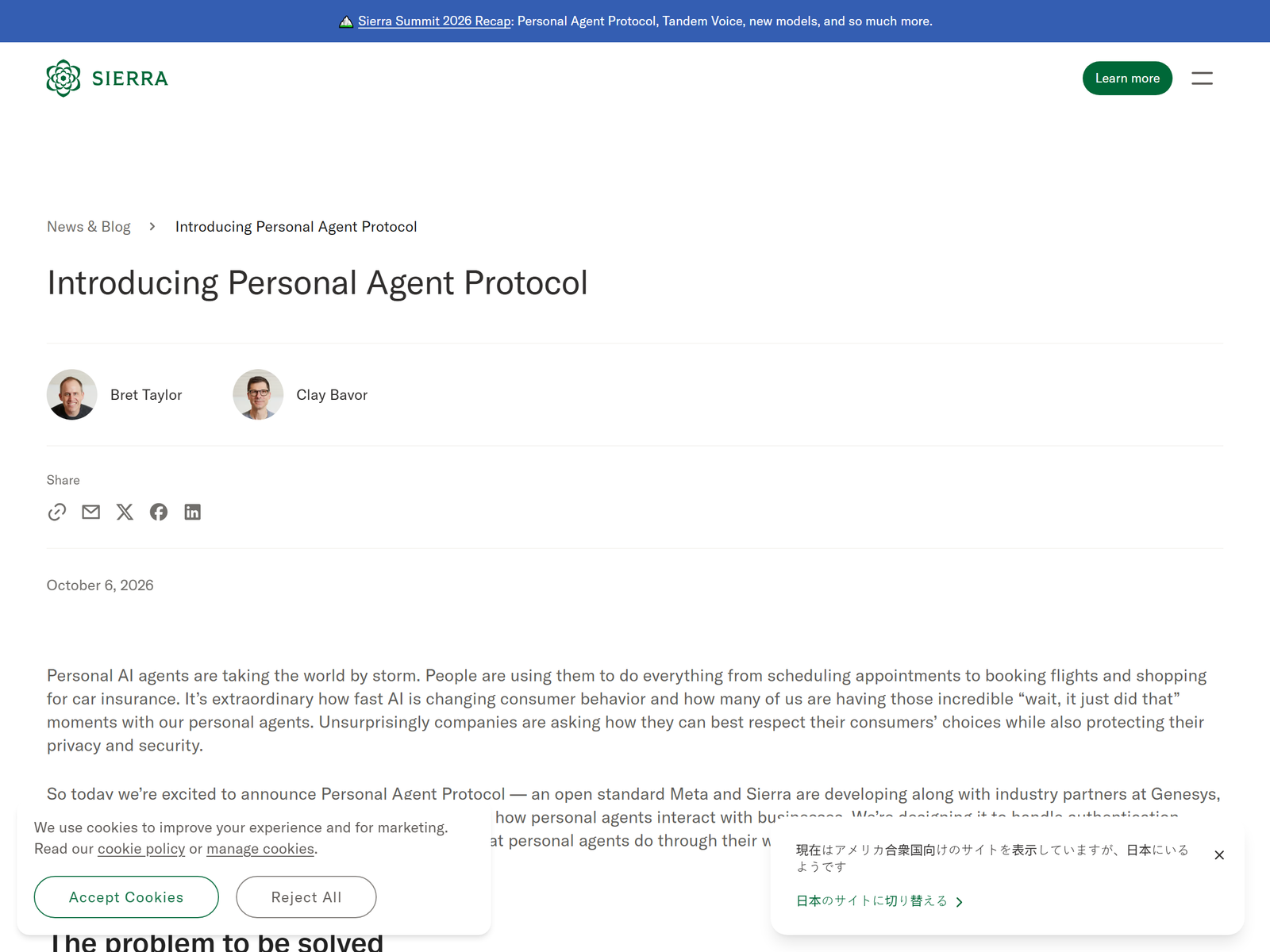
Most personal agents today operate like a human with a browser. They load pages, click forms, and call support lines when the workflow breaks. Sierra and Meta argue this is the wrong layer of abstraction. Their new Personal Agent Protocol defines how an AI agent representing a real person can connect directly to a business through websites, APIs, or the company’s own agent.
The protocol starts on the business website. The agent discovers services, begins a session as a guest, and escalates to an authenticated session when the user signs in. OAuth carries the session across channels, so a question asked before login and an order changed after login count as one continuous visit. Consumers pick read-only or write access. Businesses pick which routes the agent may use: public pages, MCP or OpenAPI APIs, or a conversational company agent for tasks like warranty claims.
Why this matters now: Meta says its Muse personal agent reached number one on the App Store in September 2026 and is already booking appointments and signing up children for classes on behalf of U.S. users. Without a shared standard, every business must reverse-engineer how to recognize and permission each agent. Bret Taylor, Sierra’s co-founder and OpenAI board chair, told CNBC that without such a standard the environment is “kind of chaos.”
The Consortium and the Missing Players
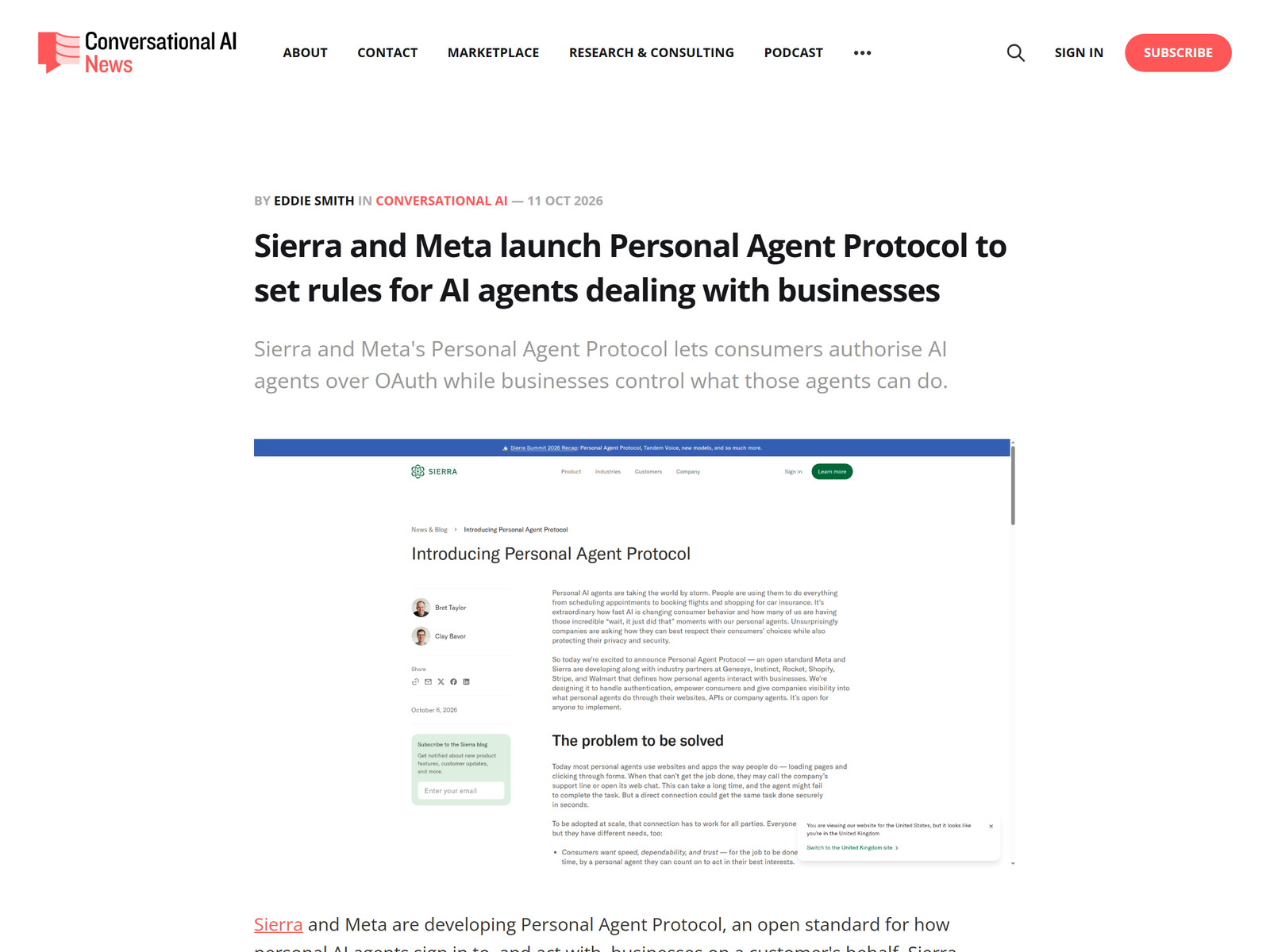
The launch partners are a cross-section of commerce, payments, and customer-service infrastructure:
- Sierra and Meta are co-developing the standard, with Sierra already running production agents for large brands.
- Walmart, Shopify, and Stripe bring retail, merchant, and payment reach.
- Genesys, Rocket, and Instinct contribute contact-center, real-estate, and agent-infrastructure expertise.
Notably absent are OpenAI and Anthropic. Taylor said he expects both to join eventually, but their absence is significant because ChatGPT, Claude, and their API platforms are the agents consumers are most likely to send. Stripe and Shopify also signed Visa’s competing Trusted Agent Protocol, which means the agent-authentication layer is becoming a contested multi-standard space.
What Is Deferred to v0.2
The founding consortium deliberately left three big features out of v0.1: payments, push notifications, and granular permissions. That sequencing mirrors how OAuth itself spread across the web in the late 2000s. Authentication came first; commerce caught up later. Payments extensions would let an agent complete a purchase without exposing card details. Push notifications would let a business tell an agent about a flight delay or shipped order. Granular permissions would restrict specific actions rather than blanket read/write access.
This conservative first release is pragmatic, but it also means the protocol does not yet solve the highest-stakes question: who is liable when an agent makes a purchase or changes a booking? The current answer is the user, because OAuth authorization flows require explicit consent.
Implications for Developers and Merchants
For merchants, the practical question is whether their storefront is reachable by an agent at all. The protocol is designed to be implemented by any business, but adoption will depend on whether agent builders route traffic to compliant sites. Early SEO and agent-search visibility may favor businesses that expose machine-readable service descriptions.
For developers, Sierra plans to publish the v0.1 specification later this month, host design workshops, and release a reference implementation. The protocol builds on existing standards: OAuth for identity, MCP and OpenAPI for tool interfaces, and the web for discovery. That lowers integration friction compared with a proprietary agent marketplace.
If you are building an AI agent or shopping assistant, browse our Industry Trends coverage for related infrastructure developments, or explore AI Chat tools that could become Personal Agent Protocol clients.
My Take / The Bottom Line
The Personal Agent Protocol is not a product launch. It is a bet that the consumer AI agent layer needs the equivalent of “Sign in with Google” before it can scale. The founding consortium has the right mix of agent builders, merchants, and payment rails to make the standard credible. The absence of OpenAI and Anthropic keeps it from being universal, and the deferred payments layer keeps it from being immediately monetizable.
My view: merchants should track the v0.1 spec and start testing OAuth-based agent sessions on low-risk, read-only endpoints such as inventory lookups. Agent developers should treat the protocol as one of several competing rails, not a winner-take-all standard. The real test comes when Visa’s Trusted Agent Protocol and any OpenAI/Anthropic alternative ship, because businesses will not implement three standards.
Frequently Asked Questions
Q: What is the Personal Agent Protocol?
A: It is an open standard co-developed by Sierra and Meta that defines how a consumer AI agent can authenticate with a business on the user’s behalf using OAuth, and what actions the agent is allowed to perform.
Q: When will the Personal Agent Protocol specification be released?
A: The v0.1 specification is scheduled for release later in October 2026, along with design workshops and a reference implementation.
Q: Which companies are part of the Personal Agent Protocol launch?
A: Founding partners include Meta, Sierra, Walmart, Shopify, Stripe, Genesys, Rocket, and Instinct. OpenAI and Anthropic have not joined yet.
Q: Does the Personal Agent Protocol handle payments?
A: Not in v0.1. Payments, push notifications, and granular action permissions are planned for future versions.
Q: Why does this protocol matter for small businesses?
A: It gives merchants a standardized way to serve customers who use AI agents, rather than forcing agents to scrape websites or call support lines.