Google AI Mode Travel 2026 Explained: 93% Clickless Reality
Category: Industry Trends
This analysis was written by the aifreetool Editorial Team — a group of full-time AI-industry researchers and writers who verify every claim against primary sources. Last updated August 28, 2026. We keep no affiliate relationship with the companies covered here.
Quick answer: On August 27, 2026, Google added three travel features to AI Mode in Search — in-chat hotel booking via Google Pay, flight price tracking in 180+ countries and loyalty points/miles display. The rollout comes as AI Mode pushes clickless google searches to roughly 93% of all sessions and turns Booking, Expedia and Marriott into a B2B arms race to stay inside Google's new travel storefront.
Google spent two decades being the world's most profitable middleman. It matched travelers with hotels and airlines, sent them off to Booking.com or Expedia to book, and took a referral cut. On August 27, that contract quietly changed. With three new travel features inside AI Mode, Google is no longer pointing users at travel sites. It is becoming the site.
What Google just shipped
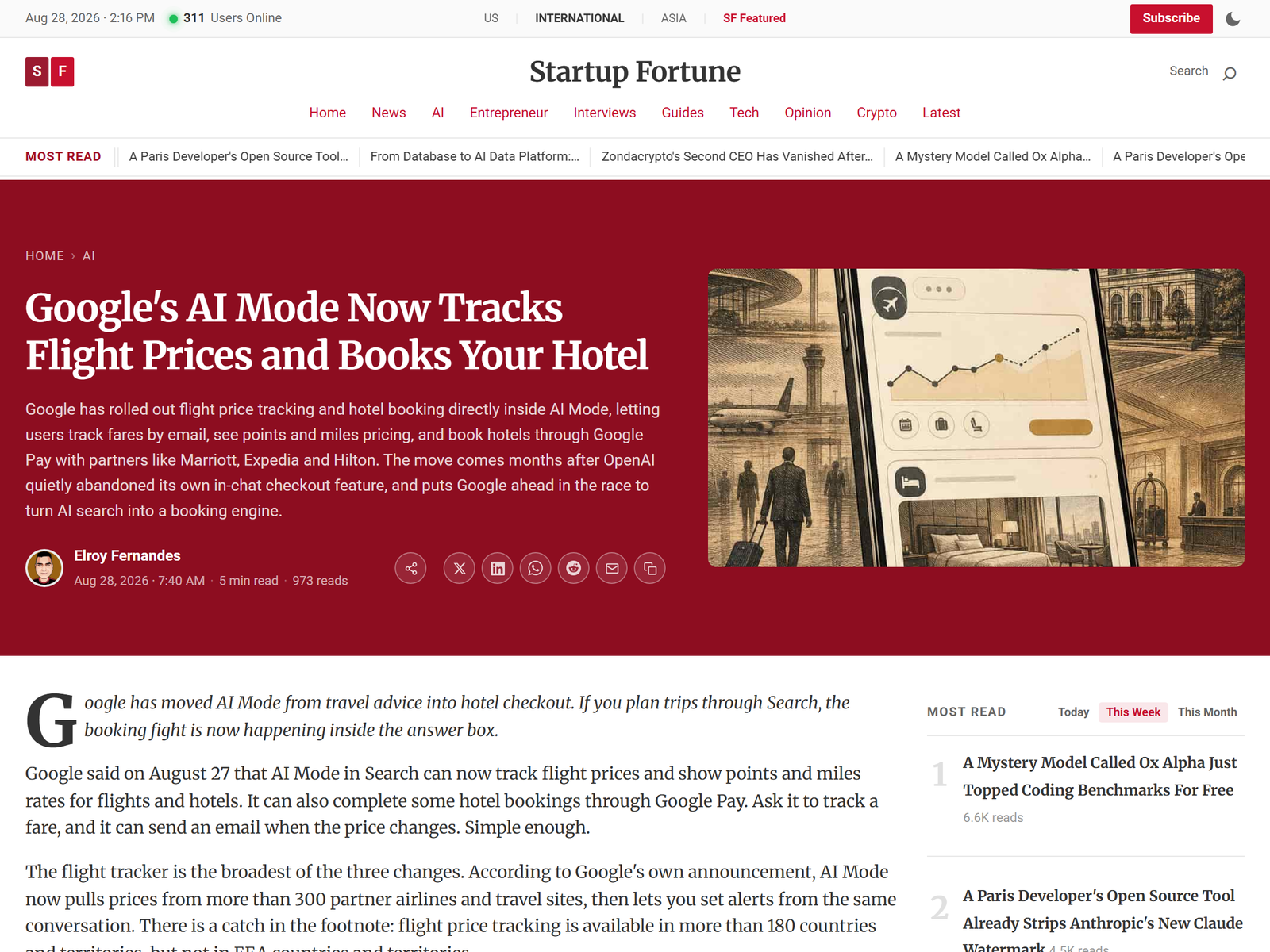
The new AI Mode travel stack has three parts:
- Hotel booking inside the chat. U.S. English users can now describe a trip, see hotels with reviews, pick a room and check out with Google Pay without leaving AI Mode. Launch partners are Booking.com, Choice Hotels International, Expedia, Hilton, Hotels.com, IHG Hotels & Resorts, Marriott International, Priceline, Trip.com and Wyndham Hotels & Resorts.
- Flight price tracking by email. AI Mode pulls fares from more than 300 partner airlines and travel sites — the same pool that powers Google Flights — and emails users when prices move on routes and dates they specified.
- Loyalty points and miles display. Travelers can ask what a flight or hotel costs in miles. Initial launch covers Alaska Airlines, Hawaiian Airlines, American Airlines, Choice Hotels, Hilton and Wyndham. Accor, Flying Blue, Hyatt, LATAM Airlines and Lufthansa Group are scheduled to follow in the coming weeks.
Two weeks earlier, Google had already pushed restaurant reservations, event tickets and beauty appointments into AI Mode. Group Product Manager James Byers wrote in the company blog that hotels are "the first real test of whether consumers are willing to complete a paid booking inside an AI chat interface rather than a traditional website or app." Google vice president of engineering for travel and local search Julie Farago told PhocusWire the company was deliberately going slow: "We are not going to rush this out the door because we want to make sure that it is a seamless experience and that people have all the control that they need and expect."
Notably, Google is not the merchant of record. Hotels and booking platforms still process the payment and own the customer. What Google owns is the moment of choice — the comparison, the reviews, the room selection — that used to happen on the OTA's own site.
The 93% zero-click reality
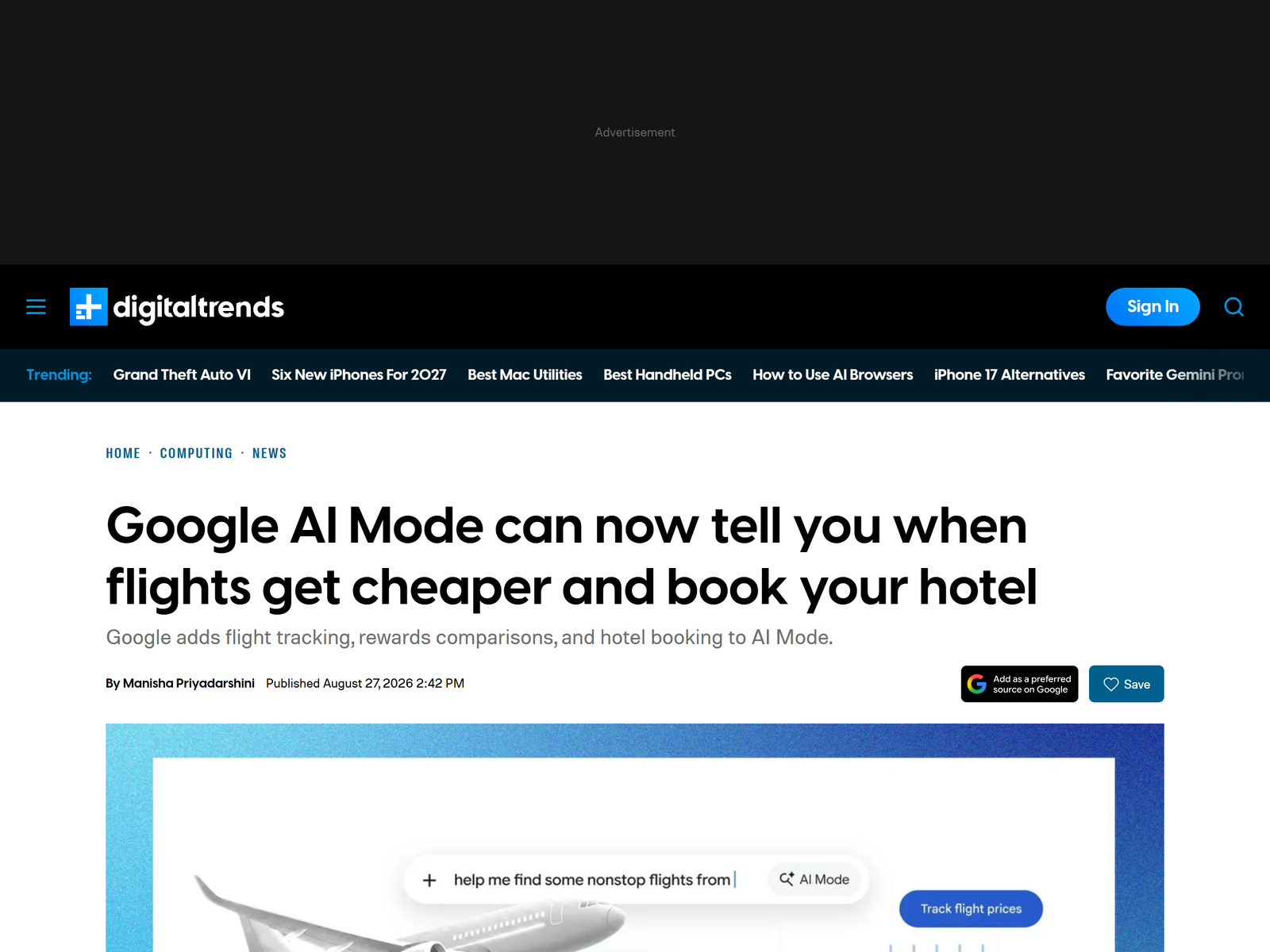
The reason this matters more than a feature update is the data behind it. Recent industry analysis has put Google's zero-click search rate — searches that never leave Google's surface — at roughly 93%. AI Mode is the engine driving that share upward, because the answers it returns include booking buttons, price alerts and reservations that complete the loop without a click through. Travelers are answering their trip-planning questions entirely inside Google's chat window, which is why 93% of search sessions end as clickless searches without ever reaching a third-party site.
That changes the business model. Google's search ads are sold per click. When the click goes away, the only way to monetize the transaction is to take a cut of the transaction itself. AI Mode's travel stack is the clearest signal yet of where that cut comes from: the same hotels and airlines that used to bid on Google Ads now become inventory inside Google's commerce layer.
This is also why the merchant-of-record arrangement matters. Google does not want to run a hotel. It wants to own the search-and-compare moment and let Booking or Marriott run the back office. That is the model that made Google Flights and Google Hotels work for a decade — it is now being applied to the booking step itself.
The OTAs' prisoner dilemma
The big online travel agencies are reacting fast, and not because they want to. Expedia's Q2 2026 results showed B2B booking volume up 21% and B2B revenue up 23% as the company leaned harder into white-label supply for AI agents and other platforms. Booking has consolidated its B2B unit under a new "Booking Partner Services" banner with the same pitch — become the inventory layer that powers other companies' AI surfaces.
That is the only rational move. If AI Mode becomes the place where travelers decide, then the value of being a brand is replaced by the value of being a wholesale supplier. Expedia and Booking can either (a) refuse to feed Google and lose the bookings, or (b) feed Google and become infrastructure. They are picking (b). Perplexity is independently chasing the same commerce layer with a free PayPal-checkout shopping agent covering more than 5,000 merchants, which puts a soft floor under Google's pricing power.
The bigger loser is the long tail of travel sites that used to live off organic Google traffic. If the comparison step happens inside AI Mode, the click-through to a Skyscanner or a Tripadvisor collapses. OpenAI tried the same in-chat commerce idea in 2025 with Instant Checkout — and shut it down by March 2026 after only about 30 merchants signed up. The lesson was that scraping the open web for product data produces unreliable answers. Google's bet is that licensed partner feeds make the same idea viable.
My Take / The Bottom Line
Google's AI Mode travel launch is the clearest case yet that the future of search is not search at all — it is commerce with a search box on top. Three things to watch in the next 90 days:
- Regulator response. U.S. and EU competition authorities have already opened cases on default placements and self-preferencing in Search. Hotel booking inside AI Mode is exactly the kind of integration that triggers a referral-fee investigation.
- Whether the data holds. Google is betting that licensed airline and hotel feeds will beat OpenAI's scrape-and-pray approach. The first quarter of conversion data will tell us whether travelers actually trust a chatbot with their credit card.
- The Perplexity variable. A free shopping agent with PayPal checkout across 5,000+ merchants is the first credible threat to Google's commerce monopoly from outside the AI labs. If Perplexity's checkout converts at even half the rate of Google Pay, the OTAs' prisoner dilemma gets worse.
The bottom line: if you run a travel site that depends on organic Google traffic for discovery, the next twelve months are an emergency. Your funnel is being absorbed into someone else's chat window, and the only sustainable counter-move is to become the inventory that AI Mode (or Perplexity, or ChatGPT, or whoever ships next) cannot book without.
FAQ
What did Google launch in AI Mode on August 27, 2026?
Hotel booking via Google Pay, flight price tracking by email, and loyalty points/miles display. Hotel booking is rolling out in the United States in English; flight tracking is live in more than 180 countries and territories.
Which hotel partners are in the initial AI Mode launch?
Booking.com, Choice Hotels International, Expedia, Hilton, Hotels.com, IHG Hotels & Resorts, Marriott International, Priceline, Trip.com and Wyndham Hotels & Resorts.
Which loyalty programs are supported?
Alaska Airlines, Hawaiian Airlines, American Airlines, Choice Hotels, Hilton and Wyndham at launch, with Accor, Flying Blue, Hyatt, LATAM Airlines and Lufthansa Group coming in the following weeks.
Is Google the merchant of record for these bookings?
No. Google handles the discovery and checkout UI but the hotel or booking platform processes the payment and owns the customer relationship.
Why does this matter for OTAs?
Industry analysis puts Google's zero-click rate at roughly 93%, which is why so many of today's search sessions end as clickless searches. When the comparison step happens inside AI Mode, the click that used to go to Booking or Expedia disappears, forcing them to compete on being the inventory layer behind Google's interface.
For more on how AI agents are reshaping everyday workflows, see our AI tools category page.