Alibaba Wanyou Wujie 2026 Review: Best Multi-Agent Workflow Platform
Category: Industry Trends
This analysis was written by the aifreetool Editorial Team — a group of full-time AI-industry researchers and writers who verify every claim against primary sources. Last updated September 3, 2026. We keep no affiliate relationship with the companies covered here.
Quick answer: On September 2, 2026, Alibaba Cloud opened public beta of Wanyou Wujie (万有无界), a multi-agent platform explained as the company's most ambitious bet on enterprise AI so far. It runs on the freshly updated Qwen3.8-Max model, lets multiple specialized AI agents cooperate inside shared "project spaces," and openly accepts agents built on Google's A2A (Agent-to-Agent) protocol. The launch also folds three earlier Qianwen agent products into a single product called Qianwen Office.
Alibaba Cloud is signaling that the next generation of enterprise software will not be a single all-knowing assistant. It will be a managed workforce of agents with job titles, KPIs, and a project manager that hands out tasks — a fully orchestrated multi-agent workflow from soup to nuts. That bet is what makes the September 2 launch worth dissecting — and what puts competitors like Microsoft Agent Mode, Salesforce Agentforce, and ServiceNow Action Fabric on a collision course with a Chinese platform that has so far stayed outside the West's enterprise stack. For background on how this space is evolving, the aifreetool industry-trends stream has been tracking the consolidation.

What Alibaba actually shipped on September 2
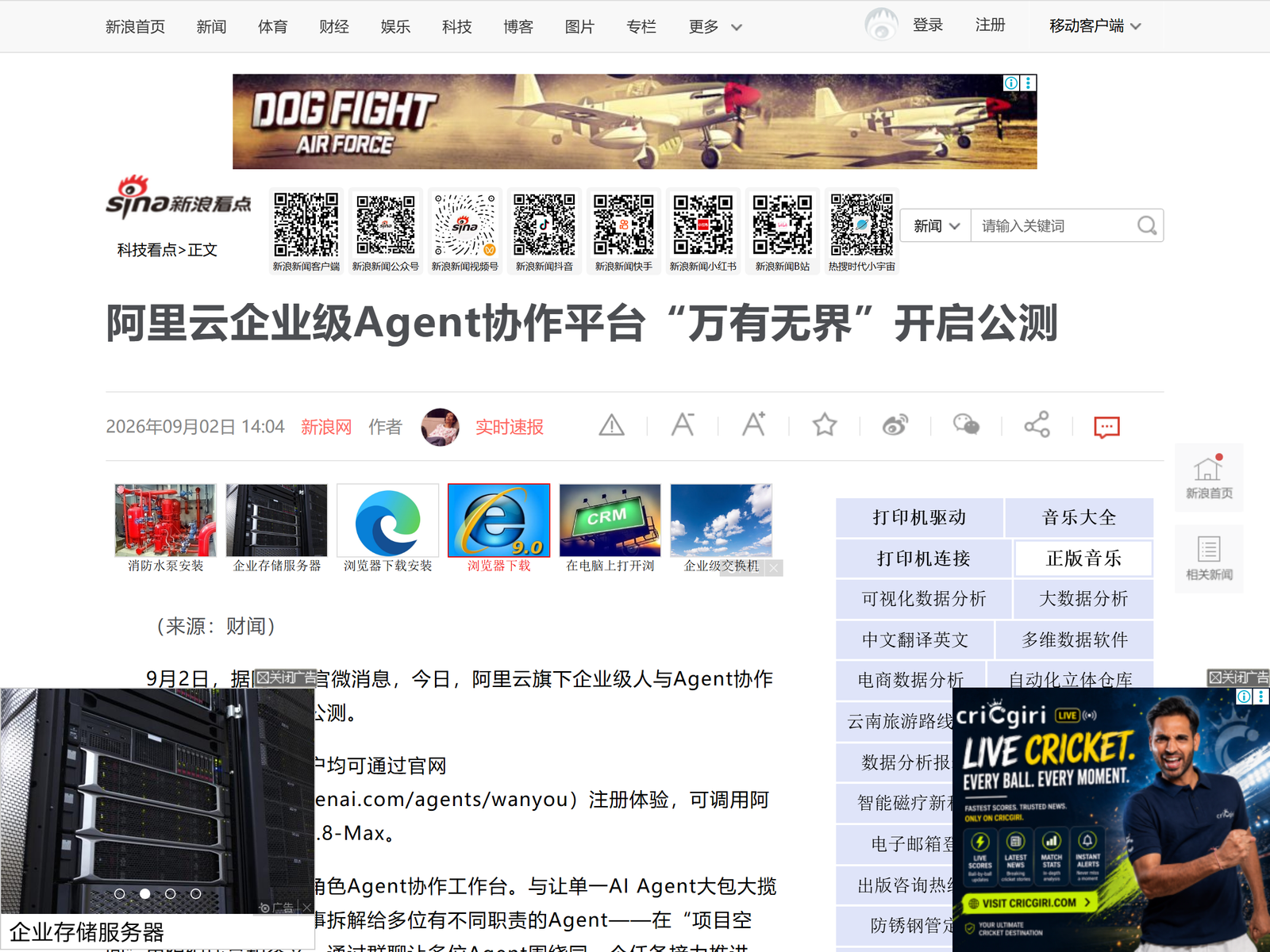
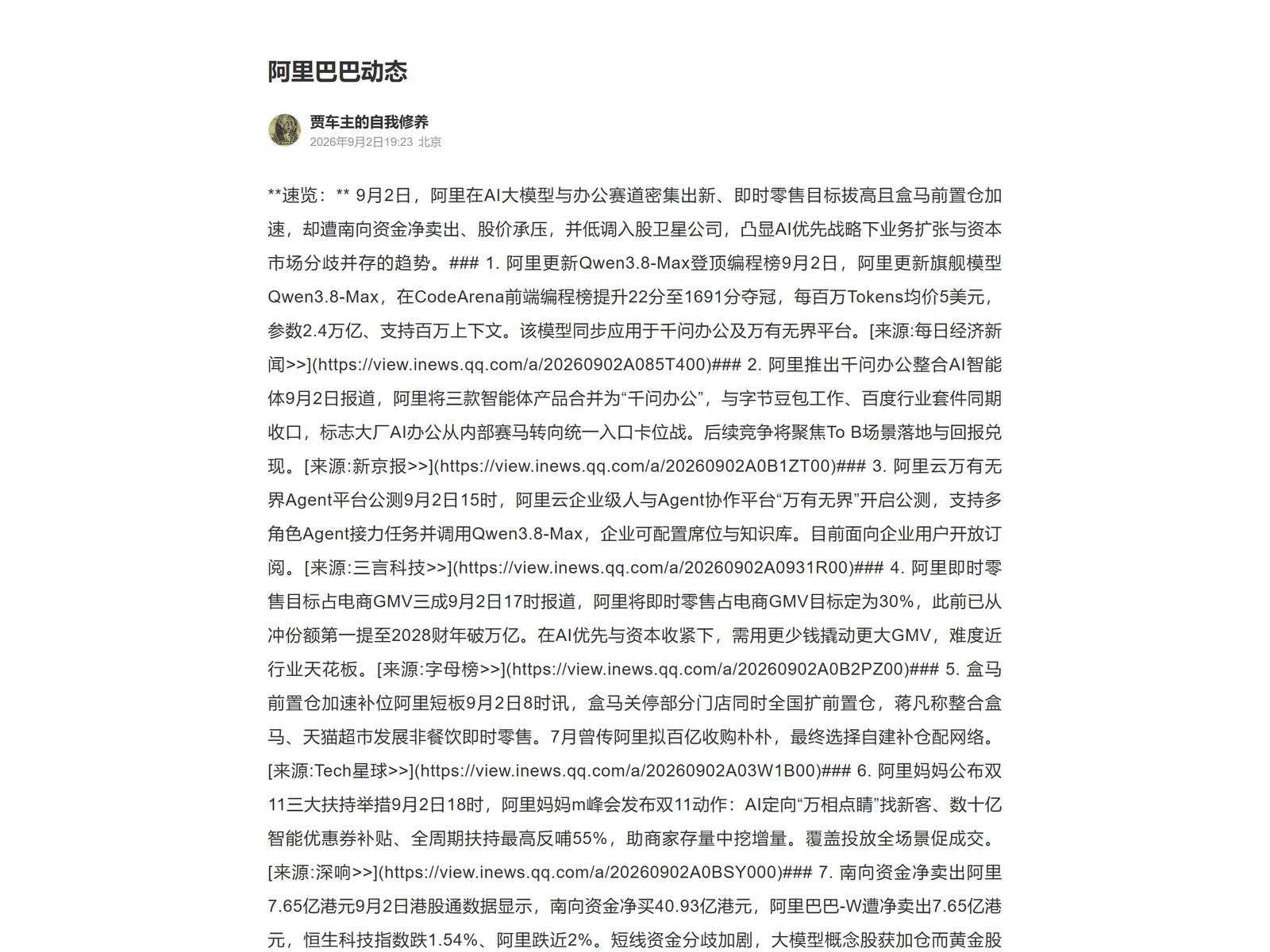
Wanyou Wujie is a workspace, not a model. Anyone can register at qianwenai.com/agents/wanyou; companies can subscribe to the enterprise tier, buy seats, attach a private knowledge base, and pick which agents get access to which data. Alibaba positions the platform as the operational backbone for the Qwen model family, with the freshly updated Qwen3.8-Max (2.4 trillion parameters, 1 million tokens of context) acting as the default brain for any task that requires frontier reasoning.
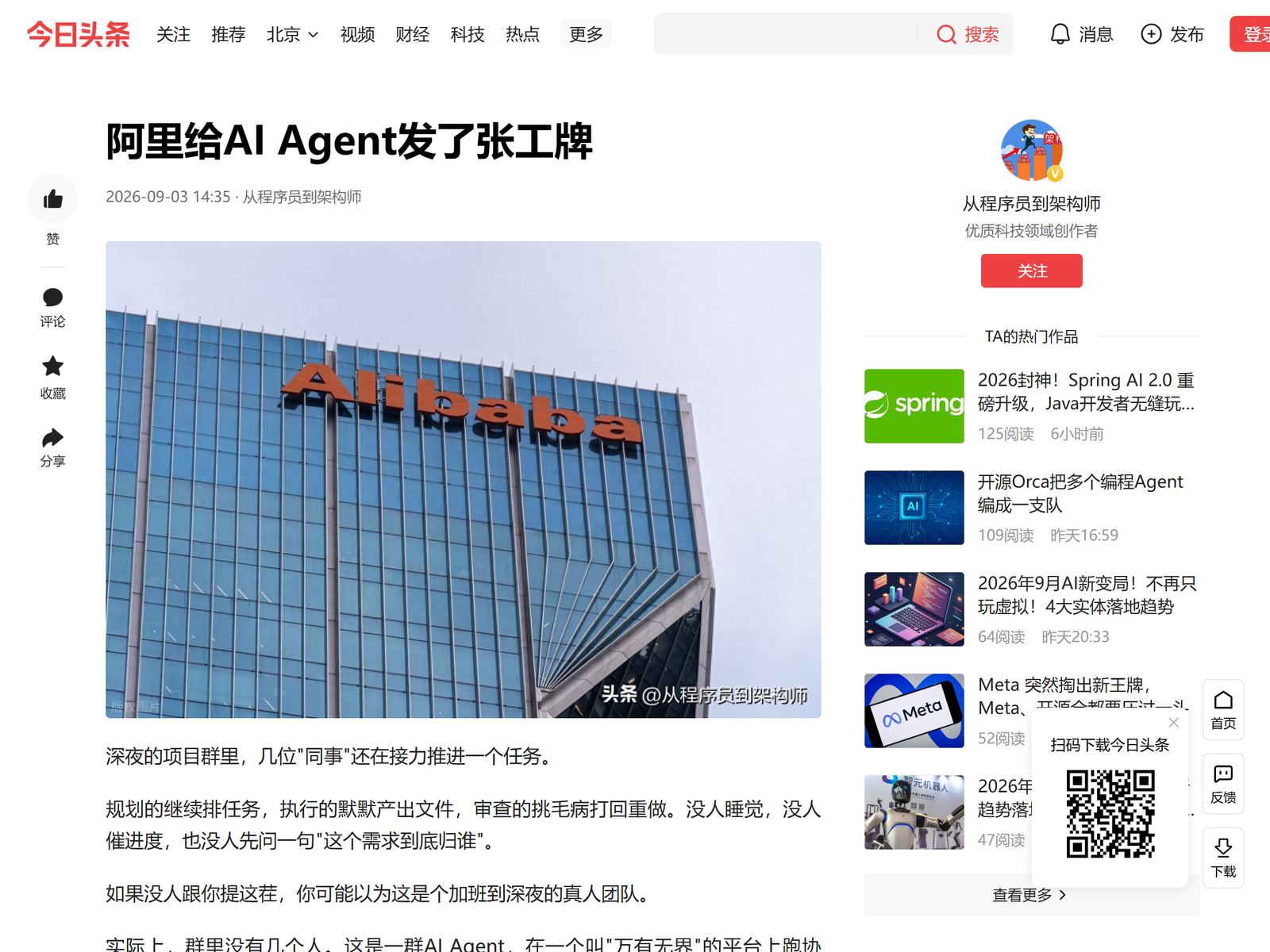
The structure is unusual. Inside a "project space," users open a group chat and invite a mix of human teammates and agents. Two default agents come baked in: Xiaowan (小万), a personal assistant owned by the user, and Xiaoyou (小有), the project manager agent that owns the workflow. Xiaoyou reads an SOP template, slices the goal into tasks, assigns them to whichever agents or humans are best qualified, tracks progress, and runs a debrief when the work is done. According to the Sina Finance launch report, this is the first Chinese platform to ship a dedicated manager-of-agents role, and it pushes Alibaba past the chat-with-one-bot pattern that has dominated Chinese LLM rollouts until now.
Underneath, the platform enforces four enterprise constraints that pure chat tools usually skip: long-lived identities per agent, durable memory scoped to the project, explicit permission boundaries for every memory and tool call, and an audit trail of who decided what. Agents can be assigned to departments, scored against KPIs, retrained on outcomes, and handed off between projects. That is what Alibaba is betting companies will pay for — not raw model intelligence, but the management layer around it.
Why open A2A support is the bigger story
The most strategic line in the launch is the one about A2A. Alibaba explicitly lets any agent that implements Google's A2A protocol be plugged into a Wanyou Wujie project, even if it was built by a third party or hosted on a customer's own servers. That decision breaks with the walled-garden playbook that has defined Chinese enterprise AI so far, where every cloud vendor tries to lock customers into its own model and agent layer.
Inside an enterprise, the trade-off is real. A multinational manufacturer might already run a maintenance agent trained on its proprietary equipment telemetry. A media company might have an editing agent tuned to its house style. Forcing those customers to migrate everything onto Qwen would be a deal-breaker. By adopting the A2A standard, Alibaba keeps the integration cheap: bring your existing agent, drop it into the project space, and let Xiaoyou schedule it alongside the Qwen agents already in the room. The same logic is what made Kubernetes beat competing container orchestrators in the 2010s, and it is the logic Wanyou Wujie is now importing into the agent era. The launch is also a quiet rebuke to Google's own A2A beta; partners listed on the A2A GitHub repo now read more like a who's-who of public clouds.
This is also why the launch does not end with a Qianwen Office integration on the consumer side. On the same day, Alibaba merged three earlier agent tools into a single product called Qianwen Office, directly competing with ByteDance's Doubao Workbench and Baidu's industry suite. Wanyou Wujie is the developer-facing platform; Qianwen Office is the consumer/business-facing entry point. The two share the Qwen model family and the A2A backbone, but they target different buying centers.
How Wanyou Wujie compares with the global multi-agent stack
The rest of the world is converging on the same architecture. SAP's Joule Work has more than 200 specialized agents and is positioned as the conversational front door to the entire S/4HANA suite. Oracle has launched 22 Fusion Agentic Applications spanning finance, HR, supply chain, and customer experience. Salesforce is shipping over 50 out-of-the-box agents inside Slack and its IT Service Desk, and ServiceNow has opened its entire platform to external agents through a framework it calls Action Fabric. Microsoft has made Agent Mode the default experience across Word, Excel, and PowerPoint. None of those vendors lets external A2A agents in as openly as Alibaba, and none of them puts a project manager agent in charge of the workflow.
| Platform | Vendor | Agent orchestration | External-agent support | Manager-of-agents role |
|---|---|---|---|---|
| Wanyou Wujie | Alibaba Cloud | Group chat + project space | A2A protocol, open | Xiaoyou (PM agent) |
| Joule Work | SAP | Goal-driven workflow composer | Limited | No |
| Agentforce | Salesforce | Multi-Agent Orchestration | Slack + IT Service Desk only | No |
| Action Fabric | ServiceNow | Open platform | Yes (limited) | No |
| Agent Mode | Microsoft 365 | Per-app, expanding | Copilot connectors | No |
The economic case is also colliding with the per-seat SaaS model that has been standard for twenty years. Salesforce now charges $0.50 per resolved conversation, Salesforce Agentforce Flex Credits bill $0.10 per standard action and $0.15 per voice action, and ServiceNow bills per AI skill execution. Wanyou Wujie uses a similar hybrid (seat license plus value-added module plus token top-up), but the price points are not yet public. As the enterprise software industry watch noted this week, every enterprise SaaS vendor is going to have to redesign its billing page before the end of 2026.
What could go wrong
Three real risks sit underneath the launch. First, cost: spinning up ten agents to handle one task multiplies the per-job token bill compared with a single chat. Alibaba has not disclosed unit economics, and projects that look great in demo videos can lose money in production. Second, reliability: every agent in a chain is a chance for a hallucination to propagate. Group-chat-style coordination is still an immature coordination pattern, and "hallucination contagion" — one agent's confident wrong answer infecting the rest — does not yet have a clean workaround. Third, the SOP problem: Xiaoyou can only plan tasks that fit a pre-built template. The cross-department, judgment-heavy work that defines most real enterprises does not have a clean SOP yet, which puts the burden back on humans at exactly the moments AI is supposed to remove them.
My Take / The Bottom Line
Alibaba Cloud has set a high bar: a Chinese platform that ships a manager-of-agents role and openly accepts A2A-compatible agents from any vendor, on a 2.4-trillion-parameter model, on day one. The bet is that the next enterprise software contract will be sold to whoever owns the coordination layer, not the model. That bet has a real chance of paying off if Alibaba can show clean unit economics and a credible governance story for cross-team agents. For the rest of the industry, the message is sharper than the marketing: as Google's Gemini Enterprise Agent Platform and Manus have shown, the agent is no longer the product. The product is the team.
FAQ
What is Alibaba Cloud Wanyou Wujie? A multi-agent collaboration platform launched into public beta on September 2, 2026. It groups AI agents and human teammates inside project spaces, runs them on Alibaba's Qwen3.8-Max model, and accepts agents that implement Google's A2A protocol.
How is it different from Qianwen Office? Qianwen Office is the consumer-facing AI-office product folded together from three earlier Qianwen agent products on the same day. Wanyou Wujie is the developer/enterprise-facing collaboration platform that powers the underlying agent fleet.
Does Wanyou Wujie support non-Alibaba models? Yes. Any agent built with the A2A protocol can join a Wanyou project, including agents hosted on customer infrastructure.
Who can sign up today? Enterprise buyers purchase the seat subscription package and provision members, knowledge bases, and knowledge resources from the admin console. Individual users can also register at qianwenai.com/agents/wanyou.
How does it compare with Salesforce Agentforce? Both coordinate multiple agents; Wanyou Wujie is open to external A2A-compatible agents and embeds a dedicated project manager agent. Salesforce Agentforce is closer to a vendor-curated multi-agent suite inside Slack and IT Service Desk.