How to Make Money Writing Ad Copy With Anyword in 2026
Category: Monetization Guide
Reviewed by the aifreetool.site editorial team. This is an independent guide; we earn no commission and have no affiliate relationship with Anyword.
You can make money writing high-converting ad copy in 2026 by using Anyword to produce scored, on-brand marketing copy for small businesses, agencies, and solo founders who run paid ads but waste budget on weak headlines. Anyword's predictive performance score rates each variation before you publish, so a freelancer can hand a client ten headline options ranked by predicted click-through rather than a guess. Charge $200 to $1,200 per client per month or $25 to $150 per asset, while your software runs $49 to $99 a month.
Quick answer: In 2026, the practical way to earn with Anyword is to sell data-backed ad copy and email variants to performance marketers who want copy pre-tested by predicted performance before they spend on ads. The Data-Driven plan at $99 a month adds predictive scoring and real-time predictions across channels, leaving you a margin above 90 percent on a $300 to $2,000 monthly side income.
What Anyword does and the plan you'd use
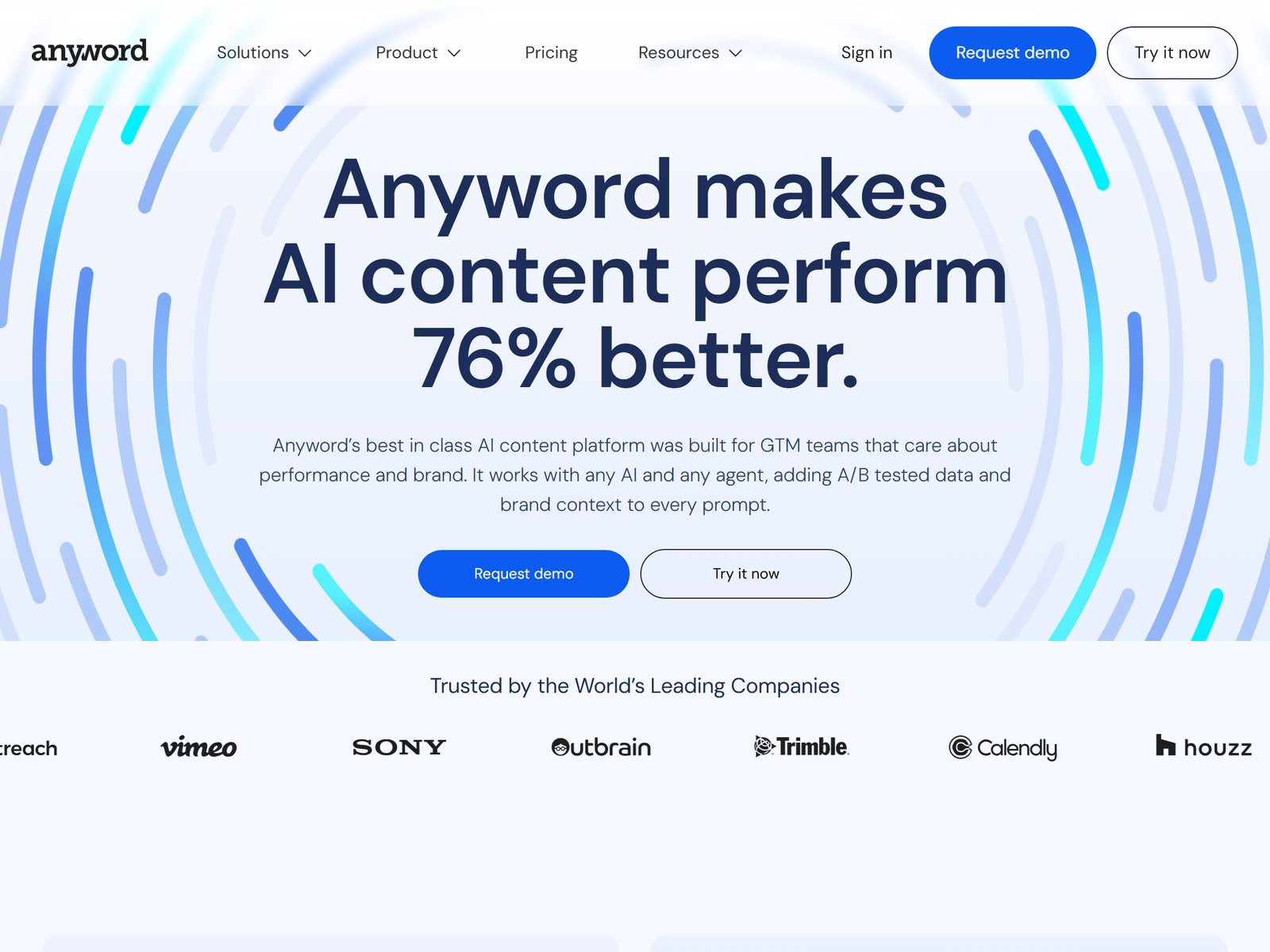
Anyword is a copywriting platform built around predicted performance. You brief it on a product, a brand voice, and a target audience, and it generates ad headlines, social posts, email subject lines, landing-page copy, and blog drafts, each tagged with a performance score from 0 to 100. The score is trained on billions of ad impressions, so it points at the variants most likely to convert, and the Data-Driven tier learns from a client's own ad account to sharpen the predictions. More than 100 marketing templates and a Blog Wizard with a plagiarism checker round out the workspace.
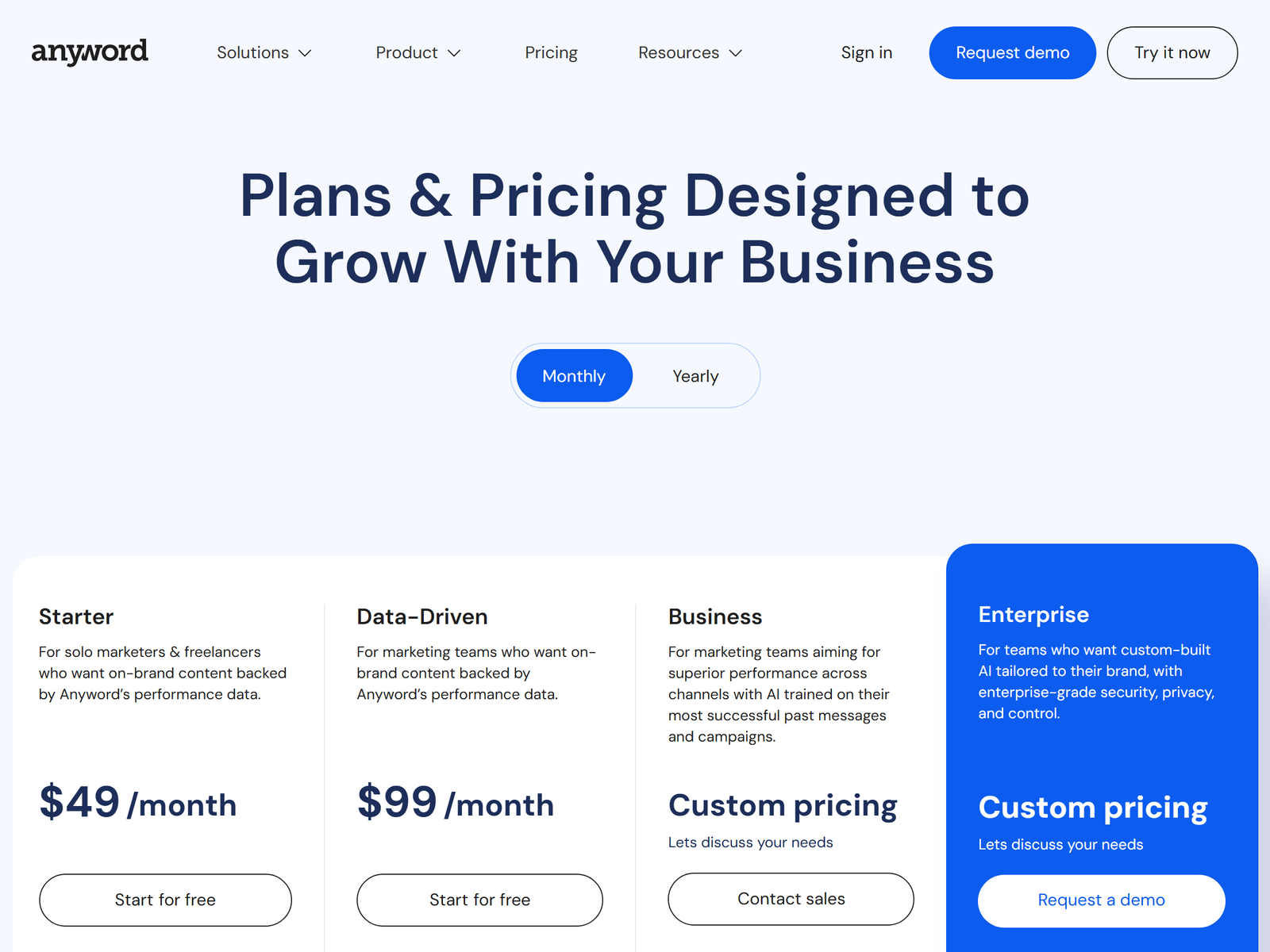
The 7-day free trial covers the core generation. The Starter plan at $49 a month, about $39 billed annually, gives unlimited copy generation, one brand voice, and 100-plus templates, but gates predictive scoring behind higher tiers. The Data-Driven plan at $99 a month, about $79 annually, adds the predictive scores, real-time predictions on manual edits, three seats, and ad-account integration, which is the tier a copy service actually sells on. The Business plan at $499 a month adds custom-trained models and an API. See the Anyword site and the pricing page for current figures.
The service to sell: scored ad copy and email variants
The cleanest offer is a paid-ad copy pack for a small brand running Google or Meta ads: you return ten to twenty headlines and primary-text variants scored and ranked, plus a recommended set, at $200 to $600 per campaign. A founder burning ad budget on one guessed headline will pay because the score removes the guesswork. A second offer is an email and subject-line sprint: you produce thirty subject lines with scores for a launch, at $150 to $400.
A third angle is a monthly copy retainer for an agency or a founder: you keep their ad and email libraries fresh and scored as they test, at $300 to $1,200 a month. Coaches, app developers, and e-commerce stores are an easy niche because each runs continuous paid acquisition.
Step-by-step: from sign-up to first paid client
Start the trial and generate a scored ad pack for a fictional brand, then screenshot the ranked variants as your portfolio. Anyword's score is the selling point, so show a before-and-after where the top-scored line beats a flat one.
Find five small brands or agencies whose ads read like filler, or whose landing pages have a weak hero; a scroll through the Facebook Ad Library and competitor sites shows who is guessing. Message them with the sample: your offer is strong, but your headline is leaving clicks on the table, and here are ten scored options. Founders hate wasted ad spend, so a fast, data-backed fix lands well.
Close a pilot at $200 to $300 for one campaign pack. Deliver the scored sheet plus a recommended set, show the predicted lift, then offer the monthly retainer once they trust the numbers. Keep batches within the plan's word and prediction limits, or bill Data-Driven into any high-volume client.
Pricing and margins
| Offer | Software cost | You charge | Gross margin |
|---|---|---|---|
| Single campaign copy pack | $49/mo Starter | $200 to $600 | about 90 percent |
| Email subject-line sprint | $49/mo Starter | $150 to $400 | about 90 percent |
| Monthly copy retainer | $99/mo Data-Driven | $300 to $1,200 | about 95 percent |
Deliver four campaign packs a month at $350 each and you earn $1,400 against $49 in software. Add a couple of retainers and $300 to $2,000 a month part-time is realistic.
Client management and quality control
Set the expectation that Anyword predicts performance, it does not guarantee it, so for regulated or medical claims you keep the copy conservative and let the client's legal review it. Always present the score as a ranking signal, not a promise, because real results also depend on targeting and the landing page. Use the Data-Driven tier's ad-account integration as a renewal engine: your copy lifted their score this month is a reason to keep paying. For copywriting tools in general, our Monetization Guides compare options, and a rival like Copy.ai covers broader GTM workflows if a client wants full funnel automation.
Pro tips and pitfalls
Reuse a brief template per client so the AI gets a clear product, audience, and brand voice; Anyword then scores the output consistently. Lean on the Blog Wizard for long-form assets so one client brief yields ads, emails, and a post. Keep each free-tier prediction under the monthly cap, and bill Data-Driven into any client whose wins depend on the predictive score.
The pitfall is handing over raw generated copy without the score, and the catch is that the score is the whole value, so always deliver ranked variants. The risk is scope creep on just one more line, so price by asset or by month. Do not promise a specific ROAS, because the score is directional, not a contract, and do not sell Starter-tier work as predictive, since scoring lives on Data-Driven and above.
Who this is and isn't for
This suits people who enjoy marketing and can read a performance score without fearing it. It fits freelancers, virtual assistants, and agency owners serving performance marketers. It is not ideal if you dislike numbers or cannot explain why one line outscores another, because clients will ask. To try it, open the Anyword page on aifreetool.site, and browse the full directory at aifreetool.site.
My Take: The Bottom Line
Best for: freelancers who want a service with hard proof built in, where the performance score is the pitch and the renewal hook. The trade-off is that Anyword is a copy scorer, not a strategist; you must bring the client's offer and the media budget, or the score has nothing to rank. I think the campaign-pack plus retainer combo is the smartest play because it pays now and gives you a metric to defend the relationship. Skip it if you cannot explain a score to a skeptical founder, or if your clients have no paid budget to optimize.
Frequently Asked Questions
How much does Anyword cost to start? There is a 7-day free trial for the core generation. The Starter plan at $49 a month, or $39 billed annually, covers unlimited generation; the Data-Driven plan at $99 a month, or $79 annually, adds the predictive scoring that a copy service sells on.
Do I need to be a copywriter? A basic grasp of marketing helps, but Anyword generates and scores the lines; you curate and explain the top picks, which is a learnable skill.
What should I charge a first client? Pilot at $200 to $300 for one scored campaign pack, then offer $150 to $400 email sprints or $300 to $1,200 monthly retainers. Price by asset and consistency, not by the hour.
Can clients use the copy commercially? Yes. Paid plans include full commercial rights to generated copy. The trial is for evaluation only, so bill a paid plan into any client work.
Will the predictive score really help? It is directionally accurate and improves when linked to a client's own ad data; treat it as a ranking signal, not a guarantee, and pair it with solid targeting and a strong landing page.