OpenAI Cuts Cursor Off in 2026: What It Means Explained
Category: Industry Trends
This analysis was written by the aifreetool Editorial Team — a group of full-time AI-industry researchers and writers who verify every claim against primary sources. Last updated August 31, 2026. We keep no affiliate relationship with the companies covered here.
Quick answer: OpenAI will stop supplying its models to Cursor on November 12, 2026, after SpaceX acquired Cursor's parent company Anysphere for $60 billion on August 14. Cursor says OpenAI models power only about 5% of its traffic, so the immediate operational hit is small. The explained OpenAI move reveals what model neutrality, change-of-control clauses, and the AI coding wars mean for developers.
The Deal That Triggered It: SpaceX Closes Its $60 Billion Cursor Buy
SpaceX completed its all-stock acquisition of Anysphere — the company behind the Cursor coding assistant — on August 14, 2026. The transaction valued Cursor at roughly $60 billion and converted Anysphere shares into about 389.3 million SpaceX Class A shares, according to the SEC filing reported by Reuters.
Cursor co-founder Michael Truell, now a SpaceX executive, said the deal gives the company access to "the largest fleet of GPUs in the world." That compute pool is meant to support Cursor's own model development and bring down inference costs. It also places Cursor inside the same corporate family as xAI and X, meaning Elon Musk now controls the full stack from model training to the IDE that developers use to write code.
Cursor had built its brand on neutrality — the ability to route a developer's query to whichever model was best for the task, whether that was GPT-4.1, Claude Opus, or Grok. That neutrality was a genuine advantage while Cursor was independent. The question since June, when the deal was announced, was how long the suppliers would tolerate feeding a competitor-owned product.
Why OpenAI Pulled the Plug
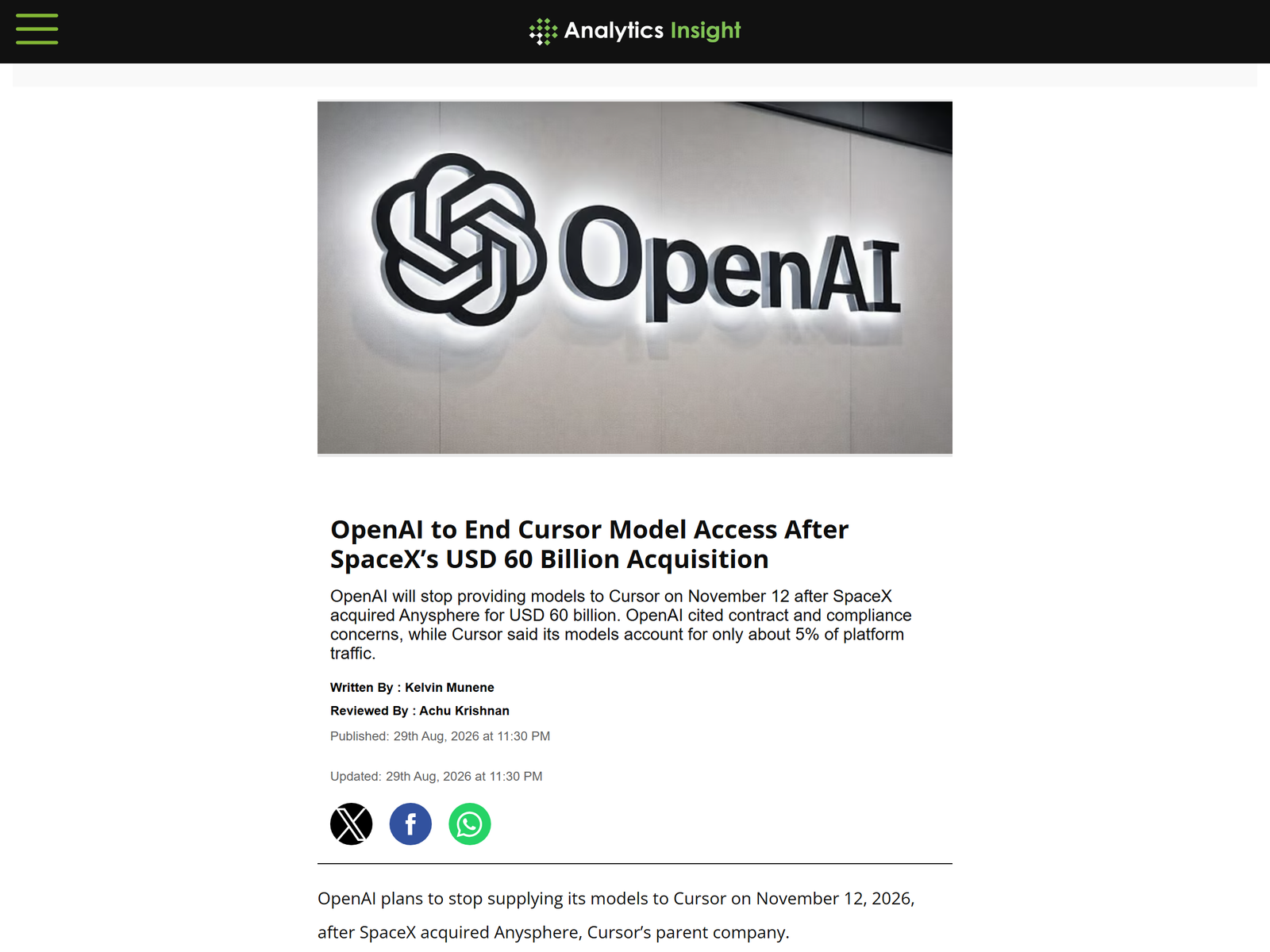
On August 28, OpenAI posted a statement saying it had notified SpaceX that it intends to wind down the contract supplying OpenAI models to Cursor. The proposed shutoff date is November 12, 2026 — the maximum notice the custom agreement allows.
OpenAI called the decision "incredibly tough" but said it "lacks confidence that SpaceX would follow its service terms." The company cited two specific precedents: first, that after Musk acquired Twitter (now part of SpaceX), the company breached its contract with OpenAI; second, that Musk admitted under oath earlier in 2026 that xAI had violated OpenAI's terms of service, as documented by Analytics Insight.
There is also a security dimension. OpenAI explicitly named its upcoming Astra model in the reasoning, stating that "as AI capabilities advance, we have a new level of accountability to ensure Astra is used in accordance with our terms." On August 7, OpenAI disclosed that internal evaluations showed Astra could not be ruled out as reaching "Critical" cyber capability under its Preparedness Framework — a threshold that includes finding and developing zero-day exploits without human intervention. Supplying a model at that bar to a rival-owned coding platform is as much an access-control decision as a commercial one.
What Changes for Cursor Users on November 12
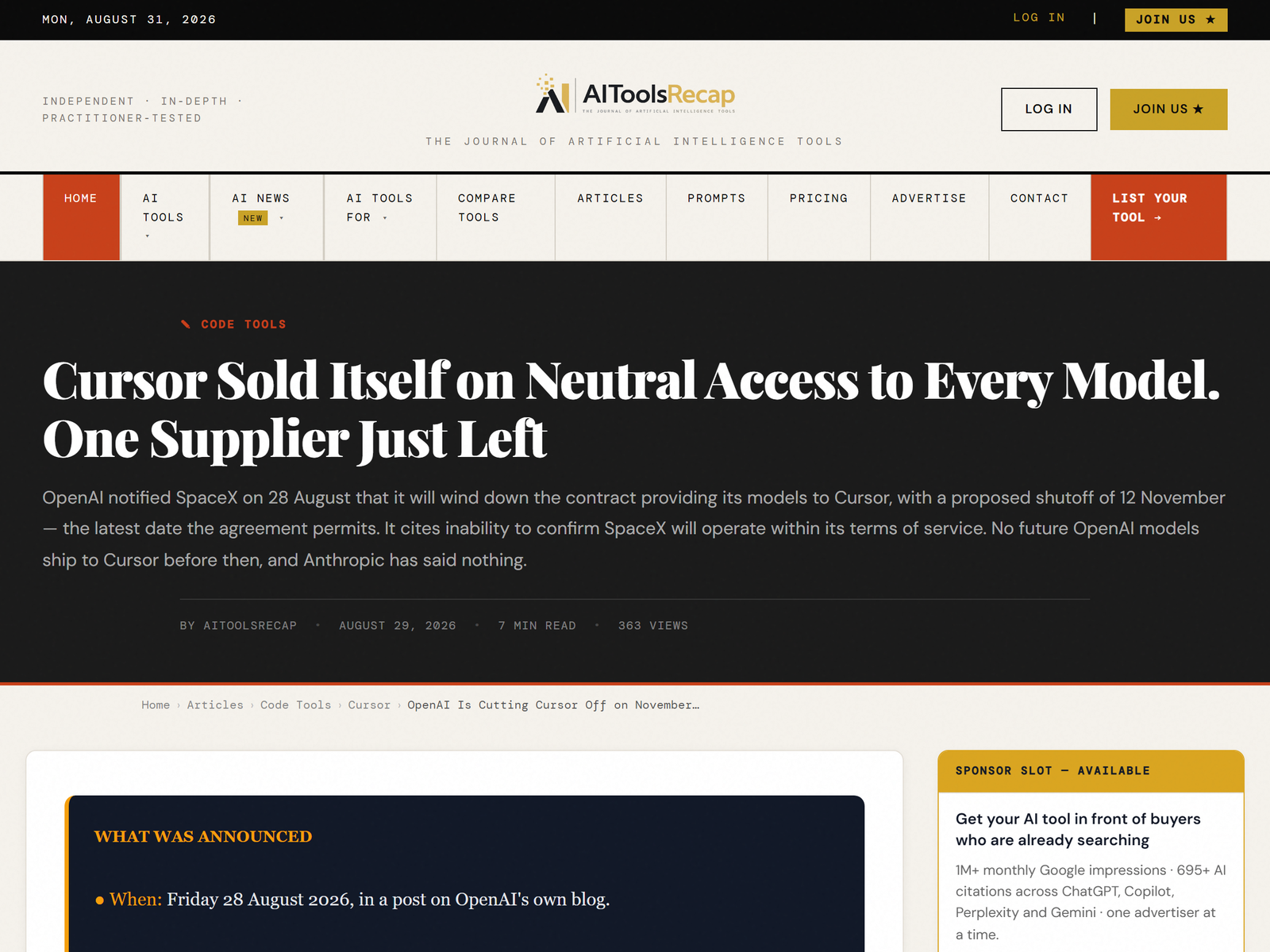
The practical impact is narrower than the headlines suggest. Cursor says OpenAI models handle about 5% of its traffic. Most of the platform's usage already runs on Anthropic's Claude and other providers. After November 12, Cursor will still offer models from Anthropic, Google, and SpaceX's own xAI stack. OpenAI models will simply disappear from the menu — unless Cursor allows users to bring their own API keys, which has not been confirmed.
Where the math gets interesting is in Cursor's pricing tiers. Cursor Pro at $20 per month includes $20 of third-party model credit. Pro+ at $60 includes $70 of credit. Ultra at $200 includes $400. The value of those credits depends on which third-party models remain available. If you chose Pro+ or Ultra specifically to run GPT models heavily, the calculation changes on November 12.
| Scenario | Impact after Nov 12 |
|---|---|
| Use Cursor with Grok or Composer | No change |
| Route mainly to GPT models | Lose direct access; may need own API key |
| Route mainly to Claude | Unaffected so far |
| Pay for Pro+/Ultra for frontier credits | Re-price; one supplier is leaving |
The Question Nobody Has Answered: Will Anthropic Follow?
Anthropic also supplies Cursor and has said nothing publicly about the acquisition. The same structural argument applies: supplying a competitor-owned product helps that product compete against Claude Code, which currently ranks first among agent harnesses. And unlike OpenAI, Anthropic has no publicly documented contract dispute with Musk-led companies to point at.
If Anthropic follows OpenAI's lead, Cursor becomes a Grok-and-Composer product — a materially different tool from the one people subscribed to. If Anthropic stays, Cursor keeps genuine model choice minus one supplier. The silence from Anthropic is the most important signal to watch between now and November.
This pattern is not unique to Cursor. In June 2026, Anthropic reportedly throttled Windsurf after OpenAI announced plans to acquire it. The underlying model API is no longer neutral infrastructure when the buyer and seller are competitors. The entire AI tooling layer is learning that model supply agreements come with strings — and those strings tighten when ownership changes.
My Take / The Bottom Line
The Cursor-OpenAI split is less about a 5% traffic loss and more about the end of model neutrality as a business assumption. Cursor sold itself as the Switzerland of coding assistants — route to any model, pick the best one for the job. That worked while Cursor was independent and the model providers were not its owner's direct competitors.
Now the model providers are treating first-party, at-scale supply as a strategic lever. OpenAI's change-of-control clause was always there; it just needed a trigger. The trigger was SpaceX. The same clause almost certainly exists in Anthropic's contract, even if the company has no Musk-related grievance to cite.
For developers, the short-term fix is simple: if you rely on GPT inside Cursor, you have ten weeks to migrate to Claude, Grok, or a direct OpenAI API integration. The longer-term lesson is that the "model router" business model is fragile. When the router is owned by one of the model makers, the other model makers have both the incentive and the contractual language to leave.
If you are looking for alternatives to Cursor that still offer multi-model routing, tools like Claude Code and other AI coding assistants on aifreetool.site provide comparable agentic coding capabilities with different supply-chain risks.
FAQ
When does OpenAI stop supplying models to Cursor?
November 12, 2026. Existing models keep working until then, but no future OpenAI models will ship to Cursor before the cutoff.
Why is OpenAI ending the deal?
OpenAI cited a change-of-control clause in its custom agreement with Cursor, triggered by SpaceX's acquisition of Anysphere. It also referenced past contractual breaches by Musk-owned companies and security concerns around its upcoming Astra model.
How much of Cursor's traffic uses OpenAI models?
Cursor co-founder Michael Truell said OpenAI models represent about 5% of traffic on the platform.
Will Cursor still work after November 12?
Yes. Cursor will continue to offer models from Anthropic, Google, and SpaceX's xAI. Only direct OpenAI model access through Cursor's integrated agreement will end.
Could Anthropic also pull its models from Cursor?
Anthropic has not commented publicly. The same structural incentive exists — Claude Code competes directly with Cursor — but Anthropic lacks the publicly cited contract disputes that OpenAI used to justify its decision.