Anthropic Fable 5.1 2026 Explained: 75% Cache Cut, Agents 25% Off
Category: Industry Trends
This analysis was written by the aifreetool Editorial Team — a group of full-time AI-industry researchers and writers who verify every claim against primary sources. Last updated September 02, 2026. We keep no affiliate relationship with the companies covered here.
Quick answer: Anthropic Fable 5.1, explained simply, is a Sept 1 2026 release that quietly rewrote Claude pricing. Anthropic shipped Claude Fable 5.1 and Claude Mythos 5.1 on the same day — the same model behind two safety policies. The Fable 5.1 launch cut cache-read pricing by 75% (from $1.00 to $0.25 per million tokens) and pushed Terminal-Bench-Science 0.1 to 52.6%, more than double Fable 5. Typical agent workloads now run ~25% cheaper; highly agentic ones run up to ~45% cheaper. That is the anthropic explained story for September 2026.
Anthropic is no longer competing only on benchmark numbers. With Fable 5.1, it is competing on the bill a real coding agent runs up at the end of the month. The September 1 release paired the highest Terminal-Bench-Science score Anthropic has ever shipped with the biggest cache-price cut the Claude API has ever seen. Both moves matter, and they land in the same week as a series of competing September releases that have made the frontier-model race feel less like a leaderboard and more like a unit-economics fight.
What Anthropic actually shipped on September 1
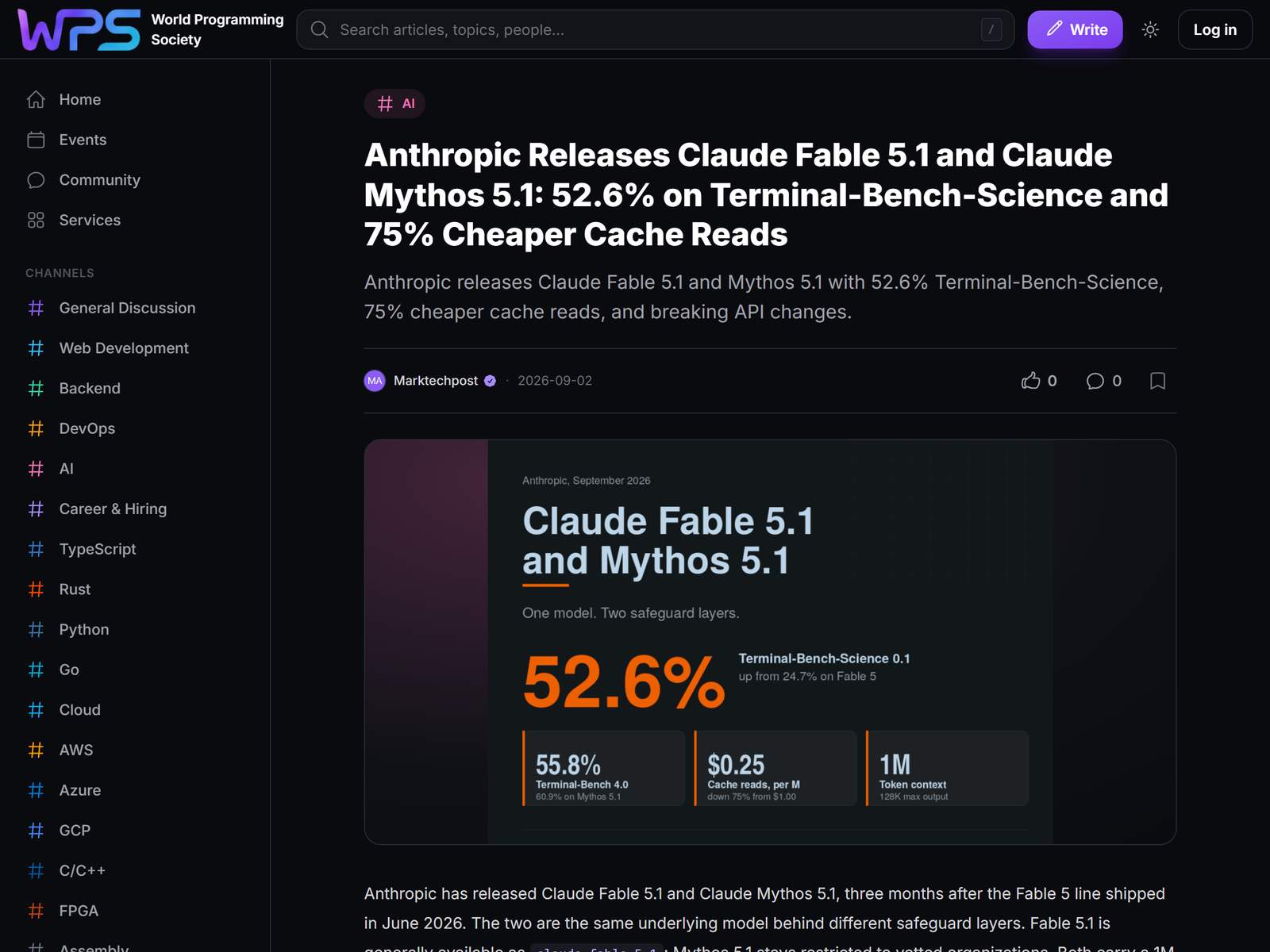
Claude Fable 5.1 is generally available as claude-fable-5-1 across the Claude API, Amazon Bedrock, Google Cloud Vertex AI, and Microsoft Foundry. Claude Mythos 5.1 is the same model with a different safety policy and stays restricted to vetted U.S. organizations inside Project Glasswing. Both carry a 1M-token context window, a 128K-token max output, and adaptive thinking always on.
The headline number sits on Terminal-Bench-Science 0.1, the agentic scientific-research benchmark Anthropic considers its north star: Fable 5.1 lands at 52.6%. The previous Fable 5 scored 24.7%. Opus 5 scored 29.0%. GPT-5.6 Sol scored 22.4%. Fable 5.1 did not just nudge past those scores — it more than doubled the previous family result.
On Terminal-Bench 4.0, Fable 5.1 reaches 55.8% and Mythos 5.1 reaches 60.9%. The 5.1-point gap between the two reveals how much capability the safety policy costs — an unusually honest disclosure. Elsewhere: CursorBench 3.2.0 at 73.4%, Humanity's Last Exam at 60.9% without tools and 65.0% with tools, AutomationBench at 31.4% (nearly double Fable 5's 17.1%), OSWorld 2.0 at 41.7% strict, and GDPval-AA v2 at 1853, edging past Opus 5's 1824.
For an overview of how this stack fits into the broader agent-coding landscape, see our guide to the best AI coding assistants in 2026. For the vendor-side primary confirmation, see Anthropic's own technical note (referenced in the Fable 5.1 release write-up) and the Economic Times coverage.
The cache-read cut that actually moves the bill

Headline input and output prices are unchanged at $10 and $50 per million tokens. The change is on cache reads, where 25 cents per million tokens replaces the old $1.00. Cache reads sit at 0.025× of base input — versus 0.1× on every other Claude model. For a long-running agent that re-reads the same code repository, conversation history, or tool results hundreds of times per session, that ratio is the difference between an experimental budget line and a production budget line.
Anthropic's own measurement against August 2026 workloads: typical workloads run about 25% cheaper on Fable 5.1 than Fable 5. Highly agentic workloads — long context, frequent tool calls, prompt-cache-dominant loops — drop up to 45%. Batch pricing stays at $5 and $25 per million tokens.
What Fable 5.1 actually does in the wild
Anthropic shared four case studies that go beyond benchmark charts. On protein design, Mythos 5.1 called open-source folding tools to design binders, and external labs verified them: affinity hit 10× the Adaptyv Bio competition best on three targets, with a ~50% effective-binder hit rate across 12 targets (industry typical is 10%–15%).
On planetary science, Fable 5.1 was trained on NASA Magellan radar data from more than 30 years ago and rebuilt high-resolution elevation maps for roughly a third of Venus's surface. Resolution moved from 10–20 km down to 2–3 km. Elevation precision improved by up to 25%. The maps are published under a Creative Commons license.
On GPU kernel optimization, Mythos 5.1 wrote custom kernels for seven open-source deep-learning models, with inference speedups between 1.4× and 2.5×. Anthropic estimates whole-genome analysis GPU cost will fall 30%–60%. And in a private test, hedge fund Millennium reports that Fable 5.1 surfaced the root cause of an intermittent internal crash that human engineers and earlier models had not been able to resolve for several years (see Digital Trends for independent confirmation).
Breaking API changes teams will hit immediately
Three shipped changes will break code the day a developer upgrades. Forced tool use is gone: tool_choice set to any now returns a 400; teams must move to auto with strict tool use or structured outputs. Thinking blocks are model-bound, which means router and fallback setups lose reasoning when they switch down. And editing earlier turns — injecting or deleting per-turn reminders, rebuilding the system or tools array mid-conversation — now errors on accounts created on or after August 31, 2026. Content provenance is also no longer optional: every Fable 5.1 output carries a statistical text watermark, and files include C2PA credentials.
Key Takeaways
- Fable 5.1 doubled Terminal-Bench-Science 0.1 in one release: 24.7% → 52.6%, ahead of Opus 5 (29.0%) and GPT-5.6 Sol (22.4%).
- Cache reads dropped 75% to $0.25 per million tokens, the largest single-line price cut Anthropic has ever shipped.
- Real workloads, not synthetic prompts, run 25% cheaper on average and up to 45% cheaper for context-heavy agentic jobs.
- The model is already available on Claude API, AWS Bedrock, Google Cloud Vertex AI, and Microsoft Foundry.
- Three breaking API changes landed: forced tool use removed, thinking blocks model-bound, mid-conversation edits now error.
- Content provenance is mandatory: a statistical watermark on text, C2PA credentials on files.
My Take / The Bottom Line
Anthropic quietly turned Fable 5.1 into a unit-economics story as much as a benchmark story. The cache-read ratio — 0.025× versus 0.1× on every other Claude model — is the part that hurts Anthropic's competitors the most. OpenAI and Google still charge the old 10% cache ratio on their respective APIs. If you are running an agent that touches the same repository all day, Claude is now structurally cheaper per useful action, not just a touch cheaper per token.
The benchmark wins remain real but are not the prize. The prize is that an investor at Millennium asked Claude to find a bug human engineers had given up on, and Claude found it. Anthropic is selling real economic outcomes now. That is a different sales pitch than the one OpenAI took to its customer base a year ago, and it is the one enterprise buyers have been quietly waiting to hear.
FAQ
Q: Is Claude Fable 5.1 better than GPT-5.6 Sol for coding?
A: On the benchmarks Anthropic published, yes. Fable 5.1 hit 55.8% on Terminal-Bench 4.0 and 73.4% on CursorBench 3.2.0; Anthropic does not publish an apples-to-apples GPT-5.6 Sol number for those tests, and the standard error on Terminal-Bench-Science is 3.5–4.5 points, so treat the ranking as more reliable than the exact margin.
Q: How much will my Claude bill actually drop?
A: Anthropic's own measurement against August 2026 workloads is roughly 25% on typical workloads and up to 45% on highly agentic ones. The biggest savings land on workloads where cache reads dominate (long-context agent loops, repeated code-base reads, retrieved document reuse).
Q: What is the difference between Fable 5.1 and Mythos 5.1?
A: Same underlying model. Fable 5.1 is the publicly available Claude API model with stricter safeguards; Mythos 5.1 has more relaxed safeguards and is restricted to vetted U.S. cybersecurity and life-science organizations inside Project Glasswing.
Q: Do I need to rewrite my integration to upgrade?
A: Possibly. Forced tool use (tool_choice: any) now returns a 400; mid-conversation system or tools edits error on accounts created on or after August 31, 2026; and thinking blocks are model-bound, so any router or fallback setup that swaps models loses reasoning trace continuity.
Q: Can Mythos 5.1 be used for offensive security?
A: No. Mythos 5.1 helps vetted researchers discover software vulnerabilities but cannot develop exploits; cybersecurity safeguards block exploit-development paths and reduced false interventions on Claude Code sessions by ~60%.