DeepSeek API Price Hike 2026: What the 1,100% Rise Means
Category: Industry Trends
This analysis was written by the aifreetool Editorial Team — a group of full-time AI-industry researchers and writers who verify every claim against primary sources. Last updated August 26, 2026. We keep no affiliate relationship with the companies covered here.
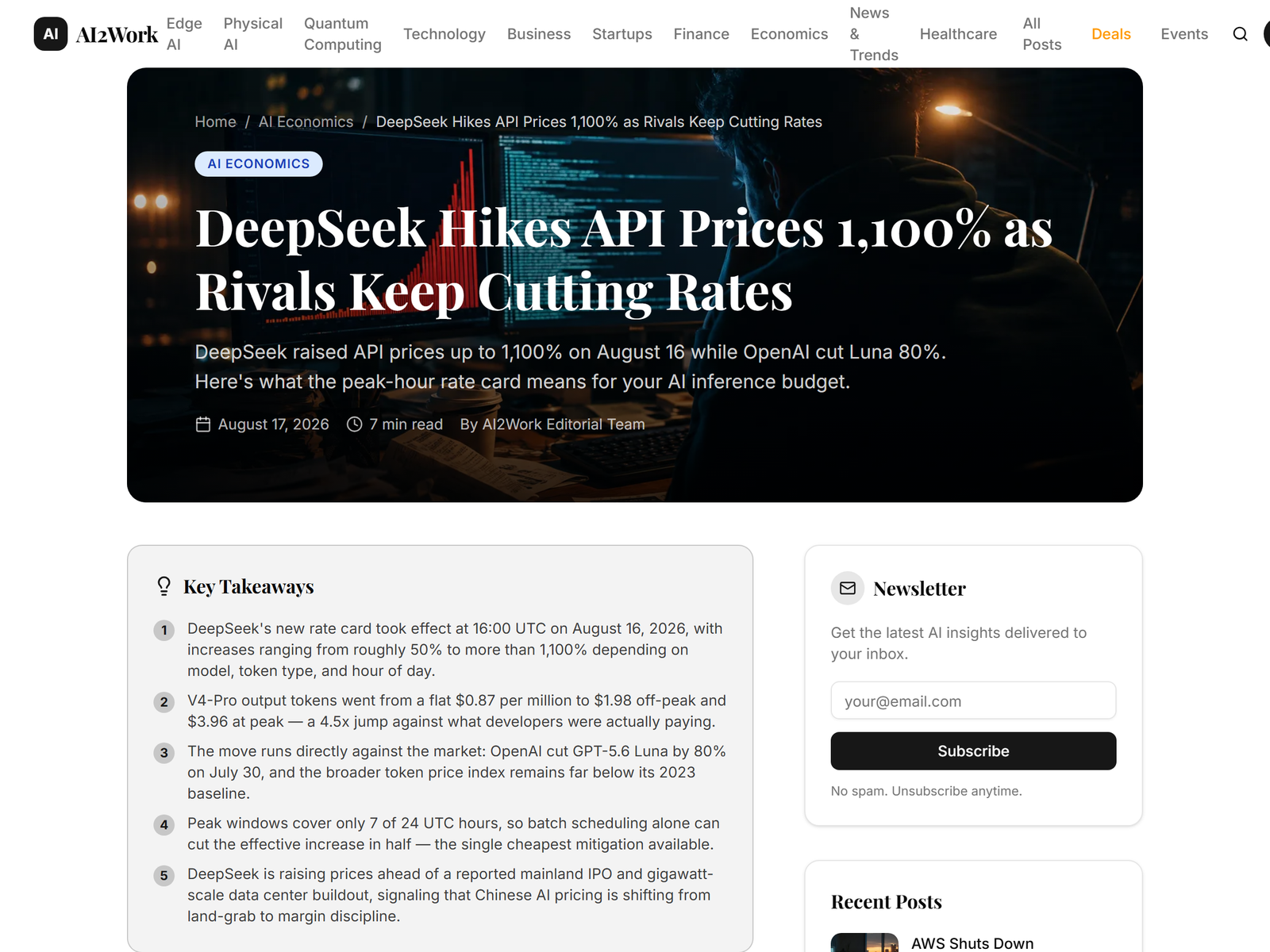
Quick answer: On August 16, 2026, DeepSeek replaced its flat API rates with peak and off-peak pricing, raising some V4-Pro and V4-Flash token categories by up to 1,100%. The move ends the era of permanently undercutting Western labs and signals that Chinese AI providers are now optimizing for margin and capacity discipline, not just market share.
For more than a year, DeepSeek was the wrecking ball of AI inference pricing. The Hangzhou lab priced frontier-adjacent models so cheaply that "we will just run it on DeepSeek" became a standard architecture shortcut. That advantage was never guaranteed to last, and on August 13 the company confirmed it would not. DeepSeek announced a new rate card effective 16:00 UTC on August 16 that introduces peak and off-peak billing for the first time and pushes some prices up by more than tenfold.
What Changed in DeepSeek's New Rate Card
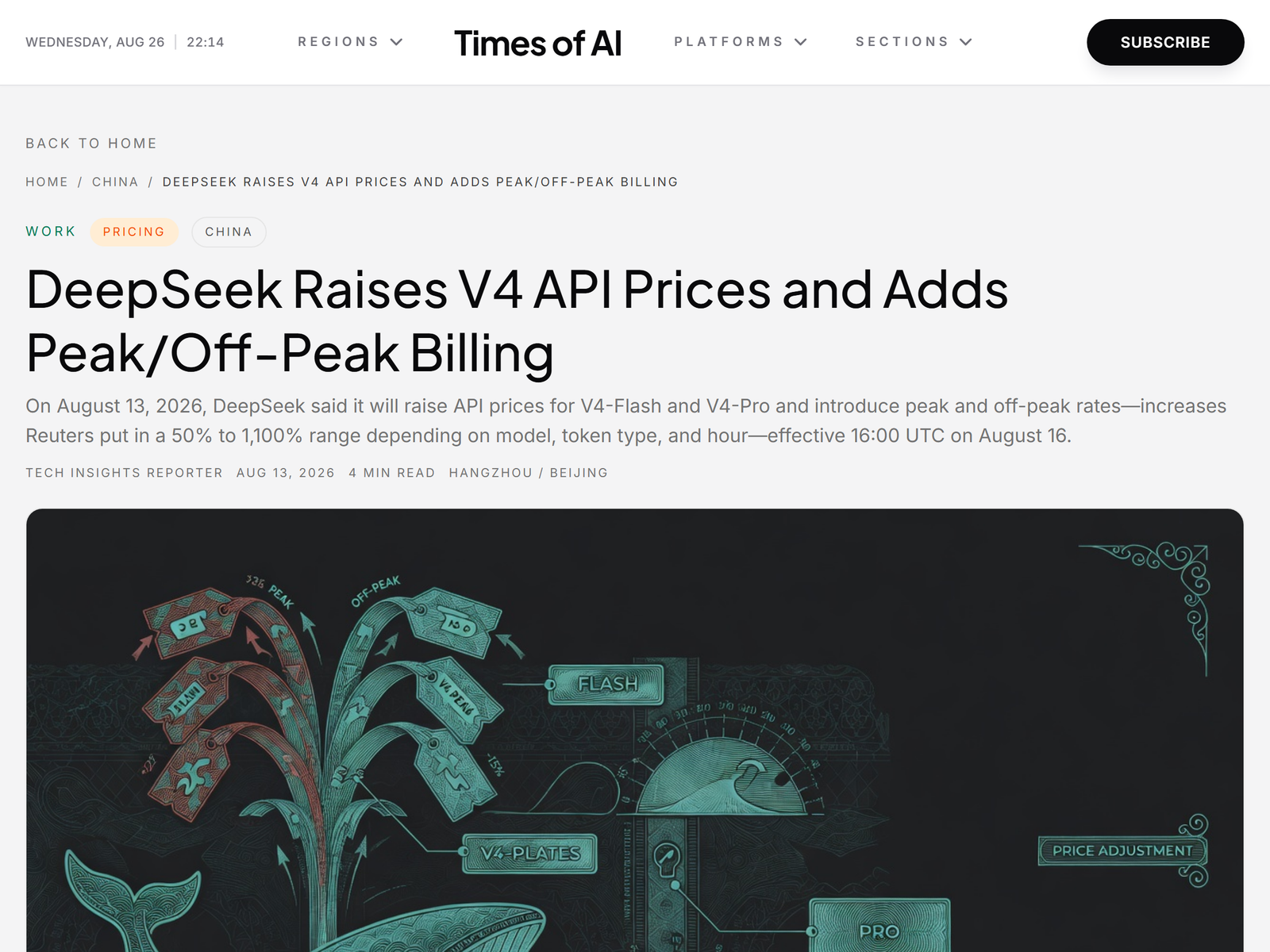
The new structure splits each day into seven peak hours — 01:00–04:00 UTC and 06:00–10:00 UTC — with off-peak rates set at exactly half the peak price. Every line item now costs more than the old flat rate, even during off-peak windows.
DeepSeek-V4-Pro output tokens, previously a flat $0.87 per million, now cost $1.98 off-peak and $3.96 at peak, a roughly 4.5x increase against what developers were actually paying. V4-Flash output jumps from $0.28 to $0.66 off-peak and $1.32 at peak. The steepest single increase is V4-Pro cache-hit input tokens, which rose from roughly $0.003625 to $0.044 at peak — an increase of about 1,100%.
Concurrency limits are also tighter: V4-Flash is capped at 2,500 concurrent requests and V4-Pro at 500. Times of AI's pricing breakdown notes that the new rate card took effect at 16:00 UTC on August 16, 2026. DeepSeek said the changes are intended "to allocate resources more reasonably" and encourage developers to move non-urgent workloads to less congested windows.
DeepSeek New vs Old Pricing Comparison
| Model / Token type | Old flat rate | New off-peak | New peak | Peak increase |
|---|---|---|---|---|
| V4-Pro output | $0.87 / M | $1.98 / M | $3.96 / M | ~355% |
| V4-Flash output | $0.28 / M | $0.66 / M | $1.32 / M | ~371% |
| V4-Pro cache-hit input | ~$0.0036 / M | $0.022 / M | $0.044 / M | ~1,100% |
| V4-Pro cache-miss input | $0.435 / M | $0.66 / M | $1.32 / M | ~203% |
Why DeepSeek Is Raising Prices Now
The timing is awkward. OpenAI cut GPT-5.6 Luna prices by 80% on July 30. Google shipped Gemini 3.6 Flash with a claimed 17% output-token efficiency gain. Anthropic launched Claude Opus 5 at roughly its predecessor's price. Most of the market is still racing downward, yet the company that started the price war is stepping off the track.
The most plausible explanation is capacity physics. Independent aggregator data showed DeepSeek V4-Flash serving more than 11 trillion tokens in a single early-August week. The company has reported repeated service incidents in 2026, including outages on May 8, 21, 24, and 28, as user demand grew faster than available compute. Rather than keep absorbing peak load at promotional rates, DeepSeek is using price as a throttle. Channel Insider frames the shift as a response to data-center capacity constraints rather than a simple margin grab.
There is also a financial-story angle. Bloomberg reported that DeepSeek has kicked off IPO preparations, while The Wall Street Journal said the company is considering a Shanghai listing as early as the second quarter of 2027 after raising more than $7.4 billion. A rate card that looks like a sustainable business, rather than a land-grab subsidy, helps that narrative. AI2Work's analysis points out that DeepSeek is raising prices while rivals keep cutting, a divergence that signals a strategic pivot from market-share pricing to unit-economics discipline.
How the New Pricing Compares to Rivals
Even after the increases, DeepSeek remains cheaper than top-tier Western flagships. Anthropic's Fable 5 lists at around $50 per million output tokens, and Moonshot AI's Kimi K3 lists at roughly $15. But the gap at the entry tier has narrowed sharply. OpenAI's lightweight GPT-5.6 Luna now costs $1.20 per million output tokens, slightly undercutting DeepSeek's peak V4-Flash rate of $1.32.
For developers, the optimization playbook is now straightforward: schedule batch extraction, synthetic-data generation, and background jobs for off-peak UTC windows. Real-time consumer applications face higher baseline costs during peak European and Asian business hours. The era of "run everything on DeepSeek and forget about it" is finished.
FAQ
When did DeepSeek's new API pricing take effect?
The new rate card took effect at 16:00 UTC on August 16, 2026.
Which DeepSeek models are affected?
DeepSeek-V4-Pro and DeepSeek-V4-Flash are both affected. The company introduced peak and off-peak billing for both models.
What is the largest price increase?
V4-Pro cache-hit input tokens at peak rose by approximately 1,100%, from roughly $0.003625 to $0.044 per million tokens.
Is DeepSeek still cheaper than OpenAI and Anthropic?
Yes for flagship tiers, but the gap has narrowed significantly. At the entry level, OpenAI's GPT-5.6 Luna now undercuts DeepSeek's peak V4-Flash rate.
Why is DeepSeek doing this?
Capacity constraints and the transition from market-share pricing to margin discipline ahead of a possible public listing.
My Take / The Bottom Line
This is the moment the AI price war stopped being a race to the bottom. DeepSeek's increases are not a blip; they are an admission that selling frontier-class tokens below cost is not a business model. For buyers, the practical response is workload scheduling and vendor diversification. For the industry, the signal is clear: the next phase of competition will be fought on capability, reliability, and unit economics, not just a headline per-million-token rate.
If you are looking for cheaper alternatives, our AI search and chat tools directory tracks pricing and capabilities across the major labs, including DeepSeek and its closest competitors.