NVIDIA Hugging Face $12.93B Acquisition 2026 Review
Category: Industry Trends
This analysis was written by the aifreetool Editorial Team — a group of full-time AI-industry researchers and writers who verify every claim against primary sources. Last updated September 9, 2026. We keep no affiliate relationship with the companies covered here.
TL;DR: This review of the NVIDIA Hugging Face $12.93B acquisition covers the deal announced September 3, 2026 — $11.9 billion in cash plus up to $1 billion in equity retention for staff. NVIDIA now owns the platform hosting 3 million+ models, 500,000 datasets, 1 million applications, and 18 million developers. Jensen Huang pledged the platform stays open and NVIDIA compute will not be required. The real question is whether AMD and Intel paths stay first-class or merely permitted.
What NVIDIA Bought for $12.93 Billion
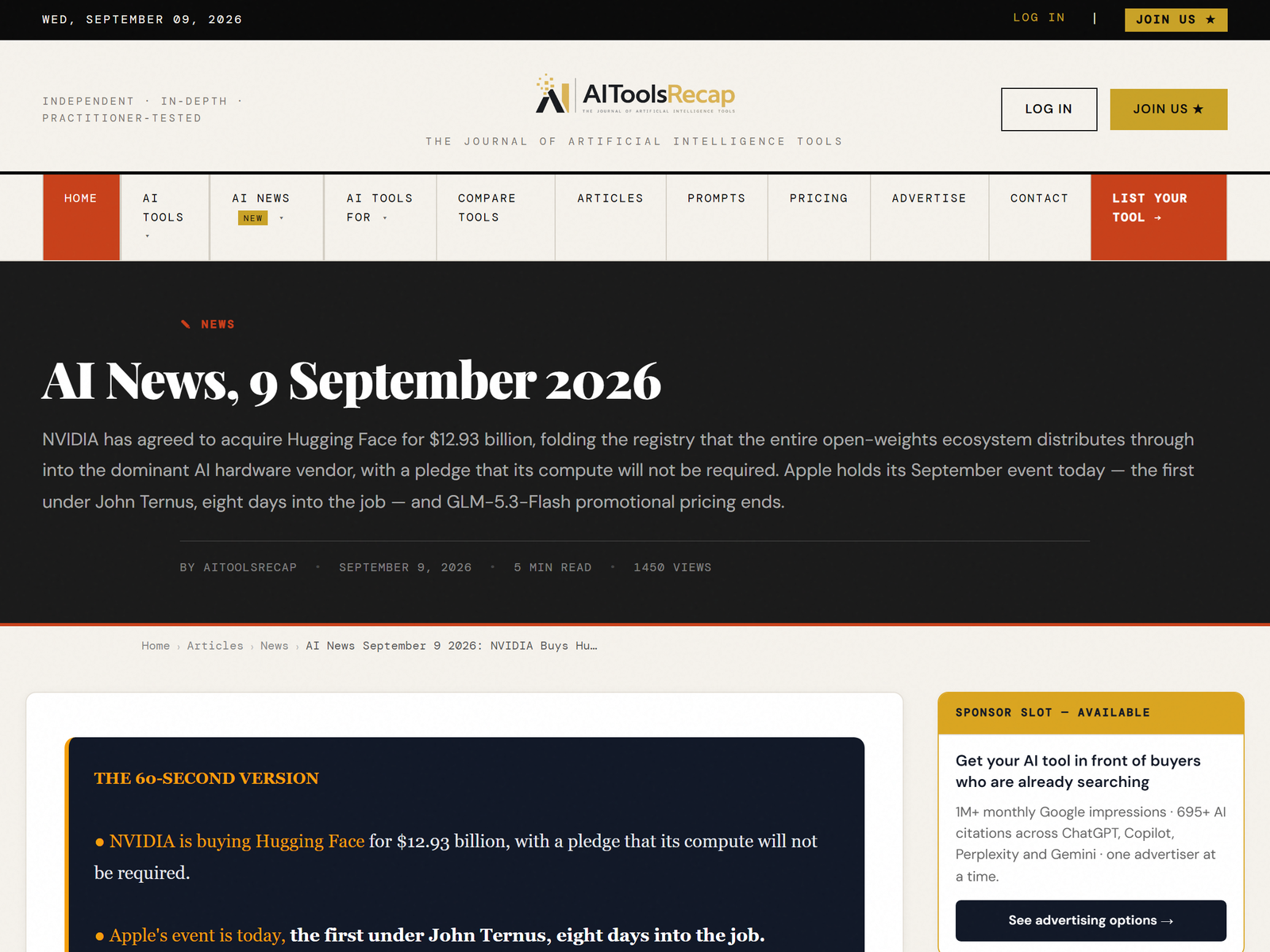
The price tag — $12,930,300,000 — is not just a number. It contains two easter eggs: 129303 as a Unicode code point maps to the Hugging Face emoji logo, and as a hex color (#129303) it produces a green close to NVIDIA's brand green. Behind that whimsy sits the most consequential AI acquisition of 2026.
Hugging Face is the distribution layer the entire open-weights ecosystem runs on. Every major open-weight release this year landed there: Moonshot's K2 Horizon with full training data, Alibaba's Qwen3.8-Flash-Next, Tencent's Apache-licensed Hy4, and Zhipu's GLM-5.3 when Z.ai finally published the weights. The platform hosts over 3 million models, 500,000 datasets, 1 million applications, and serves 18 million developers and 200,000+ companies. NVIDIA was already the largest single contributor of open models on the platform, with 500+ models and 250+ open datasets published before the acquisition.
Back in August 2023, Hugging Face's previous funding round valued the company at $4.5 billion. NVIDIA had offered a $500 million investment earlier in 2026, which Hugging Face rejected citing concerns about the influence of a single dominant investor. That concern was rendered moot by an outright acquisition at nearly triple the valuation.
Why Hugging Face Said Yes Now
Clem Delangue, Hugging Face's CEO, told CNBC he approached Jensen Huang over the summer because he realized that Hugging Face and open-source AI was at a turning point, requiring more resources, scale, and visibility. The deal closed against a backdrop of intensifying industry consolidation. On August 21, 2026, NVIDIA spent $6 billion licensing Poolside's AI model development software and hiring 109 of its employees. The Hugging Face acquisition extends that spending spree into the distribution layer.
The alignment was signaled publicly on July 24, 2026, when Huang published "Open Weights and American AI Leadership" — his first-ever X post. The open letter launched with 25 initial signatories including Hugging Face and has since grown to over 150 organizations. The document framed open-weight models as a national competitiveness issue, arguing they strengthen security, accelerate innovation, and ensure AI sovereignty. Critics noted the same document could serve as cover for consolidating distribution under a single corporate roof.
The Structural Tension Nobody Can Resolve
Jensen Huang's public commitment is unambiguous: Hugging Face will remain an open platform for the entire AI ecosystem, and NVIDIA compute will not be required to build on or deploy through it. CTO Michael Kagan reinforced this, stating the platform supports multi-cloud and multi-accelerator development, with developers free to choose models, frameworks, cloud providers, and compute platforms.
That pledge is coherent. It is also exactly what you would say either way. The tension is structural: when the entity that controls the supply of high-end compute also owns the distribution layer for open-weight models, the incentives for subtle gatekeeping become architectural. The thing to watch is whether AMD and Intel paths stay first-class rather than merely permitted — and whether any lab starts mirroring weights elsewhere.
The geopolitical dimension sharpens this tension. Chinese labs have produced the largest open models throughout 2026, with Qwen-based derivatives reaching 151,448 repositories on the Hub — 2.6 times larger than Meta's footprint. NVIDIA now sits at a critical choke point: a US corporate gatekeeper for the distribution of global open-weight models, creating new friction for international research collaboration that operates outside traditional state-sanctioned channels. If you want to explore AI model tools on aifreetool.site, you will find that many listed there also distribute through Hugging Face — making this acquisition directly relevant to the tools our readers use daily.
Five Signals to Watch
- AMD and Intel support depth: Will alternative hardware paths maintain first-class SDK integration, or degrade to technically permitted but practically painful?
- Weight mirroring: Will any major lab (Zhipu, Moonshot, Alibaba) start publishing weights to an independent secondary registry as insurance?
- NVIDIA model ranking algorithms: The Hub's trending and search ranking now sits inside NVIDIA. Watch for whether NVIDIA-published models gain ranking advantages.
- Compute bundle discounts: Will NVIDIA offer combined GPU-lease-plus-Hub-deployment pricing that makes staying within NVIDIA's stack economically rational even when alternatives are technically available?
- Antitrust scrutiny timing: Delangue argued the deal redistributes power rather than concentrating it, pointing to proprietary API dominance. Regulators may not agree — the FTC and EU competition authorities have not yet commented.
My Take / The Bottom Line
The NVIDIA Hugging Face acquisition is the moment the compute landlord thesis became structural reality. NVIDIA has completed a vertical integration spanning from silicon in the data center to the marketplace where models are discovered, shared, and deployed. The pledges are credible because Huang has been consistent on open weights. They are also insufficient because structural incentives do not require conscious gatekeeping — they create drift. The practical takeaway for developers: start building redundancy now. Mirror your models. Test deployment paths on AMD and Intel hardware. The open-weights ecosystem survived because no single entity controlled both the hardware and the distribution. That condition no longer holds. A detailed analysis of the deal is available from Yahoo Finance's coverage and the AIToolsRecap daily digest.
FAQ
How much is NVIDIA paying for Hugging Face?
$12.93 billion — approximately $11.9 billion in cash to existing shareholders and up to $1 billion in equity retention for Hugging Face employees who join NVIDIA.
Will Hugging Face stay open after the NVIDIA acquisition?
Jensen Huang publicly committed that the platform stays open and NVIDIA compute will not be required. The real test is whether AMD and Intel hardware paths remain first-class in practice over the next 12-18 months.
How many models and developers does Hugging Face host?
Over 3 million models, 500,000 datasets, 1 million applications, and 18 million developers, with 200,000+ companies building on the platform as of September 2026.
Did Hugging Face reject NVIDIA before?
Yes. Hugging Face rejected a $500 million NVIDIA investment earlier in 2026, citing concerns about the influence of a single dominant investor. The company was valued at $4.5 billion in August 2023.
What should developers do now?
Mirror your model weights to independent registries. Test deployment on non-NVIDIA hardware. Monitor whether NVIDIA-published models receive ranking advantages on the Hub. Build redundancy before you need it.