Unitree IPO 2026: Why the First Humanoid Robot Stock Surged 460%
Category: Industry Trends
This analysis was written by the aifreetool Editorial Team — a group of full-time AI-industry researchers and writers who verify every claim against primary sources. Last updated August 20, 2026. We keep no affiliate relationship with the companies covered here.
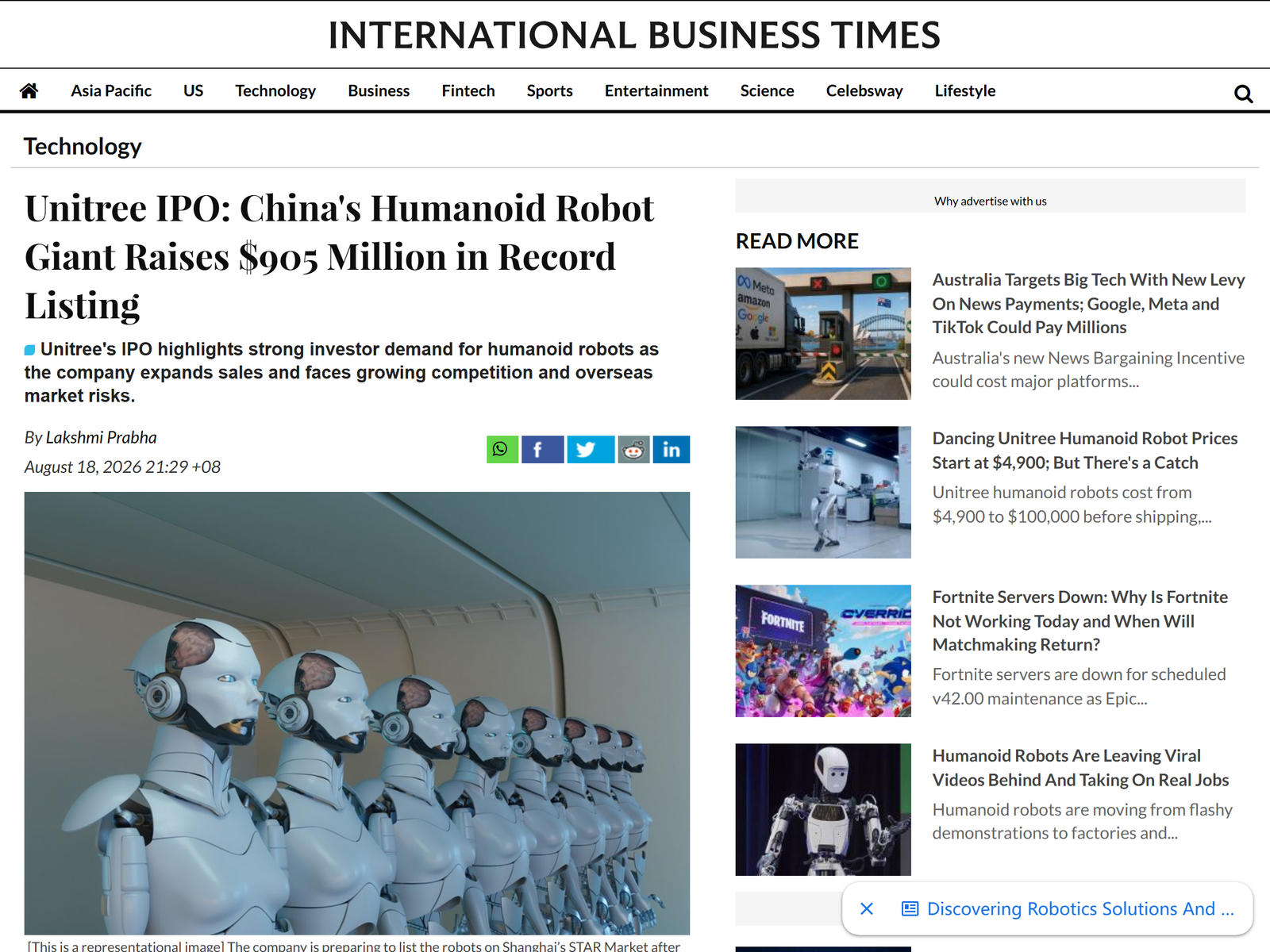
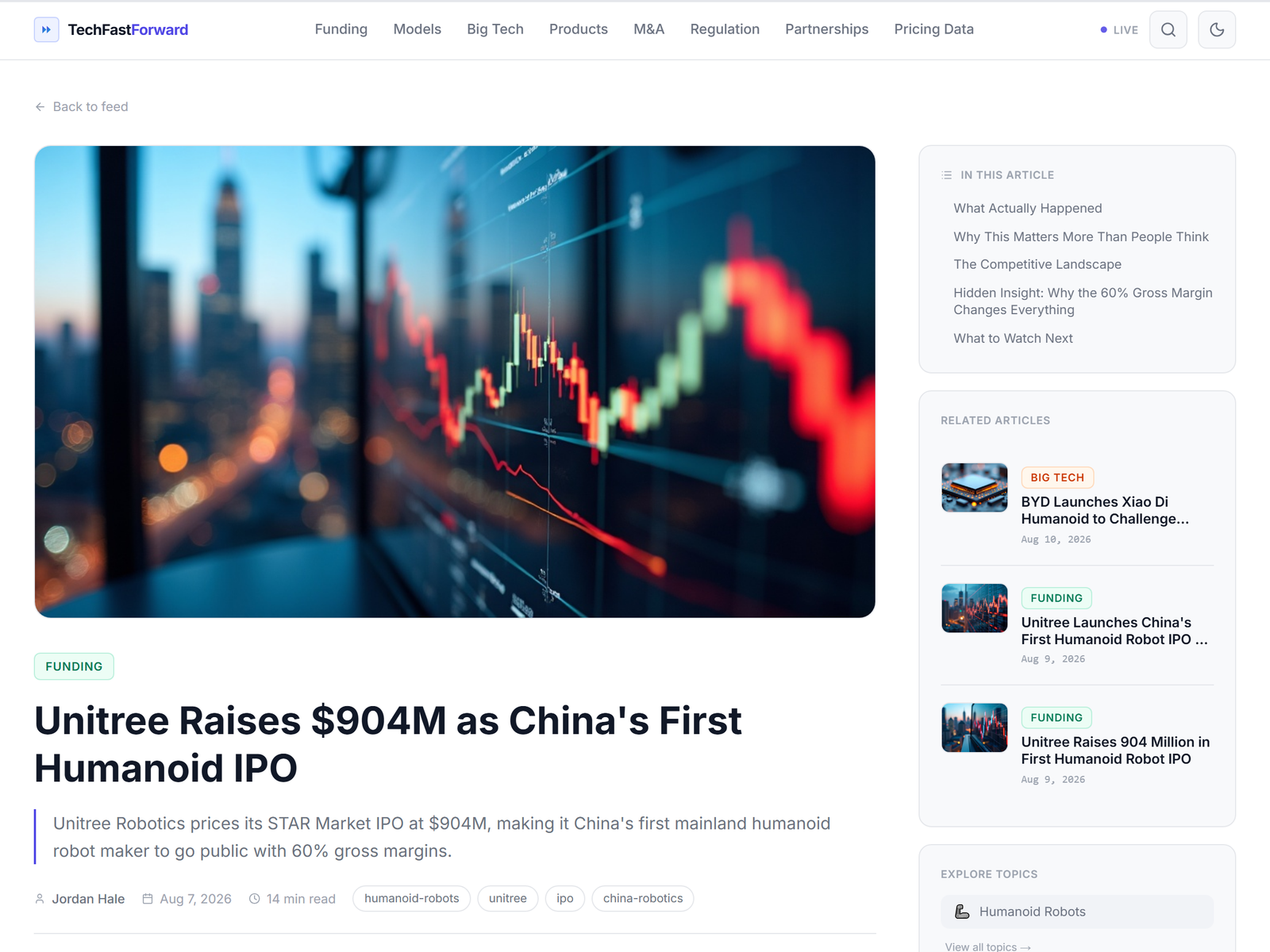
Quick answer: The Unitree IPO on Shanghai's STAR Market raised $905 million at a $9 billion base valuation, then surged 460% to close at roughly $50.7 billion on August 19, 2026. The frenzy reflects investor demand for the first publicly traded humanoid robot maker with real revenue — $235 million in 2025 at 60% gross margins — but the valuation also implies expectations the company must grow into for years.
The Unitree IPO is the most dramatic robotics debut of 2026. A Hangzhou-based company that most Western readers had never heard of until its robots danced at the 2025 Chinese New Year Gala just became the first humanoid robot manufacturer to list on mainland China's A-share market. The numbers are staggering: shares priced at RMB 150.80, opened at RMB 1,100 — a 629% jump — and closed the day at RMB 845, giving Unitree a market capitalization of approximately RMB 342 billion ($50.7 billion). That is more than five times the $9 billion valuation set at the IPO price. For context, Unitree's entire 2025 revenue was RMB 1.70 billion ($235 million). The stock now trades at roughly 200 times trailing sales.
What Unitree Actually Sells
Unitree Robotics makes two product lines: quadruped robots (robotic dogs) and humanoid robots. The quadruped business came first — the company has shipped over 33,000 units cumulatively and holds more than 60% global market share in that category. But the humanoid line is where the growth story lives. Back in 2023, Unitree shipped just 5 humanoid robots. In 2025, that number exploded to over 5,500 units, making Unitree the world's largest humanoid robot maker by volume — ahead of Tesla and Figure AI, which shipped in the hundreds. Humanoid revenue reached RMB 868 million ($120 million) in 2025, representing 51.8% of total revenue and overtaking quadrupeds as the primary business. To explore more AI-powered automation tools, visit aifreetool.site or browse AI model tools.
The company's competitive edge is cost control. Unitree's R1 humanoid starts at RMB 39,900 ($5,500), and the Air version dropped to RMB 29,900 ($4,200) — price points that would have been unthinkable two years ago. This is possible because over 90% of core components, including motors, reducers, and motion controllers, are designed and manufactured in-house. External sourcing accounts for only 14-18% of total cost.
The Financials Behind the Hype
What separates Unitree from the parade of unprofitable robotics startups is that it actually makes money. Here are the key numbers from its prospectus and STAR Market disclosures:
| Metric | 2024 | 2025 |
|---|---|---|
| Revenue | RMB 393M | RMB 1.70B (+335%) |
| Net profit | RMB 95.5M | RMB 278M |
| Adjusted profit (excl. non-recurring) | — | RMB 590M |
| Gross margin | ~44% | 60.13% |
| Humanoid shipments | ~200 | 5,500+ |
The 60% gross margin is the number that matters most. Most humanoid robot companies are burning capital on research and prototypes. Unitree is already running a profitable hardware business with margins that would make a consumer electronics company jealous. The margin expansion from 44% to 60% in two years came from a product mix shift toward higher-value humanoid systems and vertical integration of the supply chain.
Growth Is Decelerating and Washington Is Closing Doors

The IPO filing also reveals warning signs that investors should weigh against the euphoria. Q1 2026 revenue grew 68.5% year-over-year to RMB 422.8 million — a sharp deceleration from the 335% growth in 2025. Adjusted profit fell 52.6% to RMB 40.3 million as R&D and marketing spend increased. H1 2026 revenue was RMB 1.15 billion, up 48.5% — still healthy, but the growth curve is clearly flattening from its 2025 peak.
Then there is the geopolitical risk. On July 28, 2026, the US Federal Communications Commission added Unitree to its Covered List, effectively blocking new Unitree robot models from receiving FCC equipment authorization. The Pentagon separately designated Unitree a Chinese military company in June 2026. The FCC action cited a confirmed security vulnerability — CVE-2025-2894, a backdoor service called CloudSail embedded in the Unitree Go1 firmware that allowed remote access without user authorization. Unitree's US revenue share already dropped from 19.5% in 2024 to 13.3% in 2025, reflecting a deliberate pivot toward European and Southeast Asian markets.
What the Market Is Really Pricing
The 219x price-to-earnings ratio at the IPO price was already aggressive. At the closing price, the valuation implies that Unitree must sustain hypergrowth for years to justify its $50.7 billion market cap. Morgan Stanley estimates the global humanoid robot market will exceed $7.5 trillion by 2050. Industry data shows global humanoid shipments reached 19,100 units in H1 2026, up 272% year-over-year, with industrial and commercial applications now accounting for over 70% of deployments — up from 50% a year earlier.
Retail demand was extreme. The online tranche was oversubscribed over 5,500 times, with 978.46 million investors applying — a STAR Market record. The final allocation rate was 0.018%. Only 7.44% of total shares were freely tradable on day one, creating a scarcity premium that amplified the price surge. The stock opened at RMB 1,100, then fell to RMB 845 by close — a 23% drop from the open — telling you the market has no consensus on what this company is worth.
FAQ
What is the Unitree IPO valuation?
Unitree priced its IPO at RMB 150.80 per share, raising RMB 6.1 billion ($905 million) at a base valuation of approximately RMB 61 billion ($9 billion). On the first trading day (August 19, 2026), shares closed at RMB 845, giving the company a market capitalization of roughly RMB 342 billion ($50.7 billion).
Is Unitree profitable?
Yes. Unitree reported RMB 278 million in net profit for 2025, with adjusted profit excluding non-recurring items of approximately RMB 590 million. Gross margin reached 60.13%. This makes Unitree one of the few profitable humanoid robot manufacturers at scale globally.
Why did the Unitree stock surge so much on day one?
Three factors: extreme scarcity (only 7.44% of shares were freely tradable), record retail demand (5,500x oversubscription with 978 million applicants), and the novelty of being the first publicly traded pure-play humanoid robot stock on mainland Chinese exchanges. The debut also coincided with the World Robot Conference 2026 in Beijing.
Can US investors buy Unitree stock?
Unitree trades on the Shanghai STAR Market, which is accessible to domestic Chinese investors and qualified foreign institutional investors. US regulatory restrictions on Unitree products (FCC Covered List, Pentagon designation) do not directly prevent stock ownership, but they add compliance complexity for US-based investors.
My Take / The Bottom Line
Unitree is a genuinely impressive company. It ships more humanoid robots than anyone else on Earth, runs a profitable hardware business at 60% margins, and has driven prices down to levels that make real commercial deployment possible. The R1 Air at $4,200 is the first humanoid robot that a small business could plausibly justify buying for a specific repetitive task.
But $50.7 billion for a company doing $235 million in annual revenue is not a valuation — it is a bet on a market that does not exist yet at scale. Morgan Stanley's $7.5 trillion 2050 estimate assumes a world where humanoid robots are as ubiquitous as smartphones. We are not there. The growth deceleration in H1 2026 and the US market closure are real headwinds. The intraday crash from RMB 1,100 to RMB 845 — a 23% drop from the open — shows that even enthusiastic buyers have no idea what fair value is.
Best for: investors who want exposure to the humanoid robotics theme and can tolerate extreme volatility. The trade-off is that you are paying 200x sales for a company whose growth is slowing and whose largest potential market just shut the door.
If you are interested in AI tools you can actually use today rather than stocks to bet on, browse the directory at aifreetool.site.