Why Stripe Paid $75 Billion for OpenRouter in 2026
Category: Industry Trends
This analysis was written by the aifreetool Editorial Team — a group of full-time AI-industry researchers and writers who verify every claim against primary sources. Last updated August 21, 2026. We keep no affiliate relationship with the companies covered here.
Quick answer: Stripe agreed to acquire AI model gateway OpenRouter for roughly $75 billion in August 2026, a 5x jump from its $1.3 billion valuation in May 2026. The deal gives Stripe control of the largest neutral routing layer between developers and more than 400 AI models — effectively the toll booth for the next wave of AI spending.
What the OpenRouter Deal Actually Is
On August 20, 2026, Stripe confirmed it had agreed to buy OpenRouter, the San Francisco-based model marketplace and routing platform. OpenRouter's own announcement said the platform processes more than 10 trillion tokens per day across 400+ models from 80+ providers, serving over 10 million developers and companies. Stripe's official statement framed the acquisition as a way to help businesses "maximize profitability by routing their requests intelligently and spending their tokens efficiently."
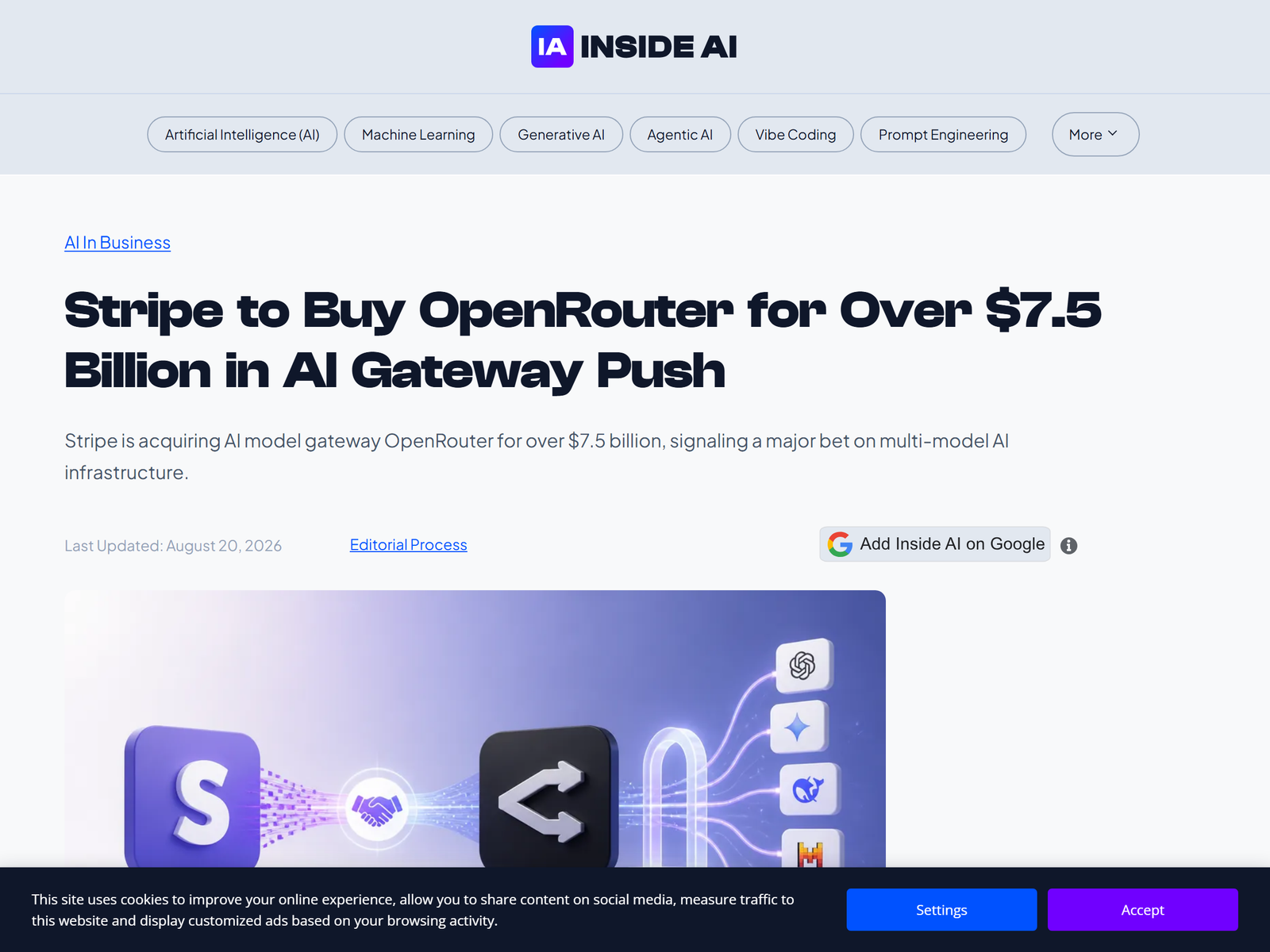
The reported price keeps climbing in subsequent reports: The New York Times cited $7.5 billion, Axios said over $8 billion, and other outlets put the figure around $70–75 billion. The lower number appears to be a reporting artifact; the consensus among The Information, Inside AI, and aggregated wire reports converges on roughly $75 billion, with $1.5 billion allocated to the two founders. Even at the conservative end, the valuation is roughly five times OpenRouter's May 2026 financing round, when it raised $164 million at about $1.3 billion from Andreessen Horowitz, Sequoia Capital, Nvidia, and Alphabet's investment arm.
Why a Payments Company Wants a Model Router
OpenRouter is often described as "the Stripe of AI models." While Stripe routes payments between buyers and sellers, OpenRouter routes inference spending between developers and model labs. That symmetry is why the deal makes strategic sense to Stripe CEO Patrick Collison, who said in Stripe's newsroom release that "tokens are the central currency for companies building with AI."
The business problem OpenRouter solves is simple but expensive. Models are released and repriced constantly. A company that defaults to GPT-5.6 Sol for every query can burn through its AI budget in weeks. OpenRouter lets the same company send simple tasks to cheaper open-weight models — many from Chinese labs like DeepSeek, Zhipu, and Moonshot — while reserving frontier models for complex work. Inside AI reported that OpenRouter's monthly revenue more than tripled to about $13 million since April 2026 as finance teams started capping internal token use.
Stripe's broader push supports the bet. The company acquired usage-based billing platform Metronome, stablecoin infrastructure firm Bridge Ventures, and crypto wallet developer Privy. Each acquisition tightens Stripe's grip on the financial plumbing behind digital economies. OpenRouter does the same for AI inference.
Who Wins and Who Loses
OpenRouter wins because it gains Stripe's balance sheet, trust infrastructure, and enterprise sales reach while keeping its brand and product roadmap intact. Stripe wins because it moves up the AI stack without picking a winning model. As OpenRouter co-founder Alex Atallah put it in the joint announcement, "intelligence will be multi-model: no single model will be optimal for every task."
The losers are harder to spot but more important. Closed model providers like OpenAI and Anthropic face a thinner moat if enterprise customers route around their APIs by default. Vercel, Switchboard, Concentrate AI, and other routing competitors now have to compete against a Stripe-backed incumbent. And any startup that thought a thin API gateway was a defensible business just watched the market leader get acquired at a price that values strategic position over near-term revenue.
Key Takeaways
- Stripe is buying OpenRouter for roughly $75 billion, a ~5x premium to its May 2026 valuation.
- OpenRouter routes more than 10 trillion tokens per day across 400+ models for 10 million+ developers.
- The deal turns Stripe into a neutral economic layer for AI spending, not just payments.
- Closed-model labs face new pressure as enterprises mix cheap open-weight models with frontier APIs.
- Competing routers and bare-bones gateways are now up against a $160 billion fintech giant.
My Take / The Bottom Line
This is not a normal acquisition. Stripe is not buying revenue; it is buying placement. OpenRouter sits between the people who build AI applications and the labs that supply the models, which means Stripe can influence where inference dollars flow without ever training a model itself.
The long-term play is clearer when you look at Stripe's recent purchases. Metronome handles usage billing. Bridge handles stablecoin payments. OpenRouter handles model selection and token routing. Put them together and Stripe is building the operating system for AI-native businesses — billing, payments, and now compute allocation, all in one stack.
For developers, the immediate impact is probably neutral or positive. OpenRouter says nothing changes for existing integrations. For AI labs, the message is sharper: distribution now matters as much as capability. If you want a piece of the enterprise inference budget, you may need to go through Stripe's toll road.
Frequently Asked Questions
What is OpenRouter?
OpenRouter is an AI model marketplace and routing gateway. Developers connect to one API and can call more than 400 models from 80+ providers, with automatic routing based on price, speed, and task complexity.
How much is Stripe paying for OpenRouter?
Reports vary between $7.5 billion and over $80 billion, but the most consistent figure from The Information and aggregated trade coverage is roughly $75 billion, up from a $1.3 billion valuation in May 2026.
Will OpenRouter remain independent?
OpenRouter says it will keep the same name, product, and roadmap. Stripe has positioned the deal as an acceleration of OpenRouter's existing mission rather than a product overhaul.
Why does Stripe care about AI model routing?
Tokens have become the core spending unit for AI applications. By controlling the routing layer, Stripe can help businesses optimize AI costs while embedding itself deeper into the AI economy.
Which AI models can I access through OpenRouter?
OpenRouter lists models from OpenAI, Anthropic, Google, Meta, DeepSeek, Zhipu, Moonshot, and many smaller providers. If you are comparing options, our AI engine and model directory covers many of the same labs.