Last Updated: December 24, 2025 | Review Stance: Independent testing, includes affiliate links
Quick Navigation
TL;DR - BIG-bench 2025 Review
BIG-bench remains the most comprehensive open-source LLM evaluation benchmark suite in late 2025, with over 200 diverse tasks probing reasoning, creativity, and robustness. Though largely superseded by BIG-bench Hard in practice, it continues to serve as a foundational resource for broad capability assessment—completely free and community-driven.
BIG-bench Review Overview and Methodology
BIG-bench (Beyond the Imitation Game benchmark) is a massive collaborative effort to evaluate language models across an unprecedented range of tasks. Launched in 2022 and still widely referenced in 2025, this review examines its current relevance, task diversity, ease of use, and comparison to newer benchmarks like BIG-bench Hard.
We tested BIG-bench by running subsets on modern open and closed models, analyzing task difficulty distribution, and reviewing community contributions up to late 2025.
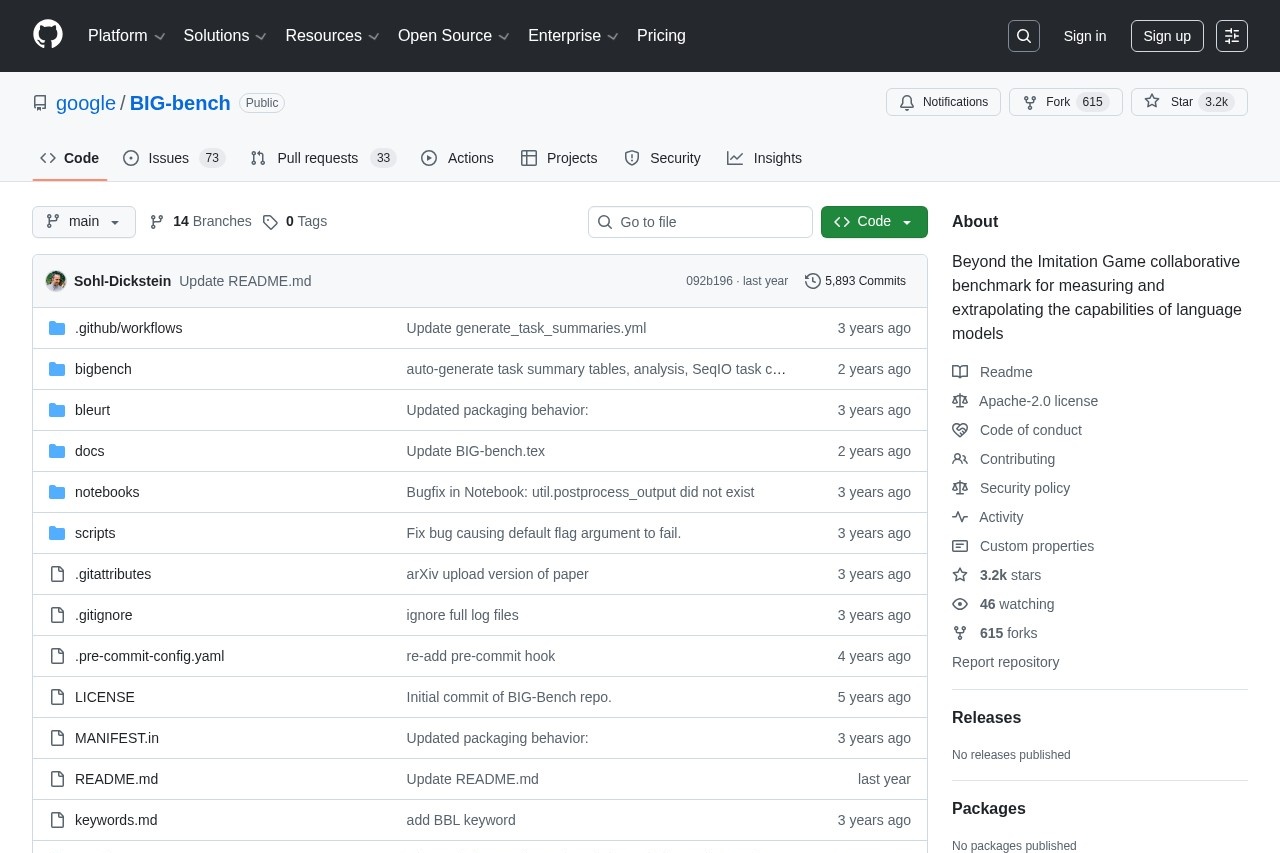
Sample tasks from BIG-bench (source: official repository)
Broad Reasoning
Logic, math, commonsense tasks.
Creativity & Language
Storytelling, humor, metaphor.
Social & Ethical
Bias, truthfulness, safety probes.
Programming
Code generation and understanding.
Core Features of BIG-bench Benchmark
Task Diversity in BIG-bench
- 204+ Tasks: Covering linguistic, logical, creative, and domain-specific challenges.
- Multiple Formats: Multiple-choice, exact match, generative scoring.
- Difficulty Scaling: From trivial to beyond-human performance.
- JSON-Based: Easy to extend and integrate.
- Community contributions from hundreds of researchers.
Running BIG-bench Evaluations
- Python library with simple CLI
- Supports any model via completion API
- Subset selection for faster testing
- Results visualization scripts included
BIG-bench Scale & Current Performance
While many frontier models now exceed human performance on most BIG-bench tasks in 2025, the benchmark remains valuable for broad capability profiling and historical comparison.
Notable Aspects of BIG-bench
Community-Driven
Historical Baseline
Easy Integration
Open Source
BIG-bench Use Cases
Best Applications
- Academic research comparing model families
- Baseline testing for new architectures
- Educational demonstrations of LLM limits
- Historical progress tracking
Integration Options
Any LLM API
Python Scripts
JSON Tasks
GitHub Repo
BIG-bench Access & Costs
Framework
Free forever
Open source
✓ No Cost
Model inference separate
Run Costs
Model-dependent API
Varies by scale
Inference Only
BIG-bench is completely free and open-source; costs arise only from model inference during evaluation as of December 2025.
Pros & Cons: Balanced Assessment
Strengths
- Unmatched task diversity (200+)
- Community-driven and transparent
- Easy to run subsets
- Historical significance
- Completely free and open
- Well-documented
Limitations
- Many tasks now too easy for frontier models
- Superseded by BIG-bench Hard for cutting-edge eval
- No active development
- Large full-run compute intensive
- Limited programmatic scoring options
Who Should Use BIG-bench?
Best For
- Academic researchers
- Historical comparisons
- Broad capability surveys
- Educational purposes
Consider Alternatives If
- You need hardest current tasks
- Evaluating frontier models
- Active maintenance required
- Minimal compute budget
Final Verdict: 8.7/10
BIG-bench remains a landmark achievement in LLM evaluation and a valuable historical benchmark in 2025. While newer subsets like BIG-bench Hard have taken the spotlight for frontier research, its breadth and accessibility continue to make it excellent for education, broad comparisons, and understanding model progress.
Accessibility: 9.2/10
Current Relevance: 7.8/10
Value: 9.0/10
Explore the Landmark LLM Benchmark
Clone the free repository and start evaluating models across hundreds of diverse tasks.
Free and open-source as of December 2025.