Unitree Robotics IPO 2026: First Humanoid Robot Stock
Category: Industry Trends
By AI Trends Desk · Last updated August 12, 2026
TL;DR: Unitree Robotics priced its Shanghai STAR Market IPO at 150.80 yuan per share on August 11, 2026, with a 0.018% online lottery rate — a record low. The $8.5 billion listing is the first pure-play humanoid robot public stock.
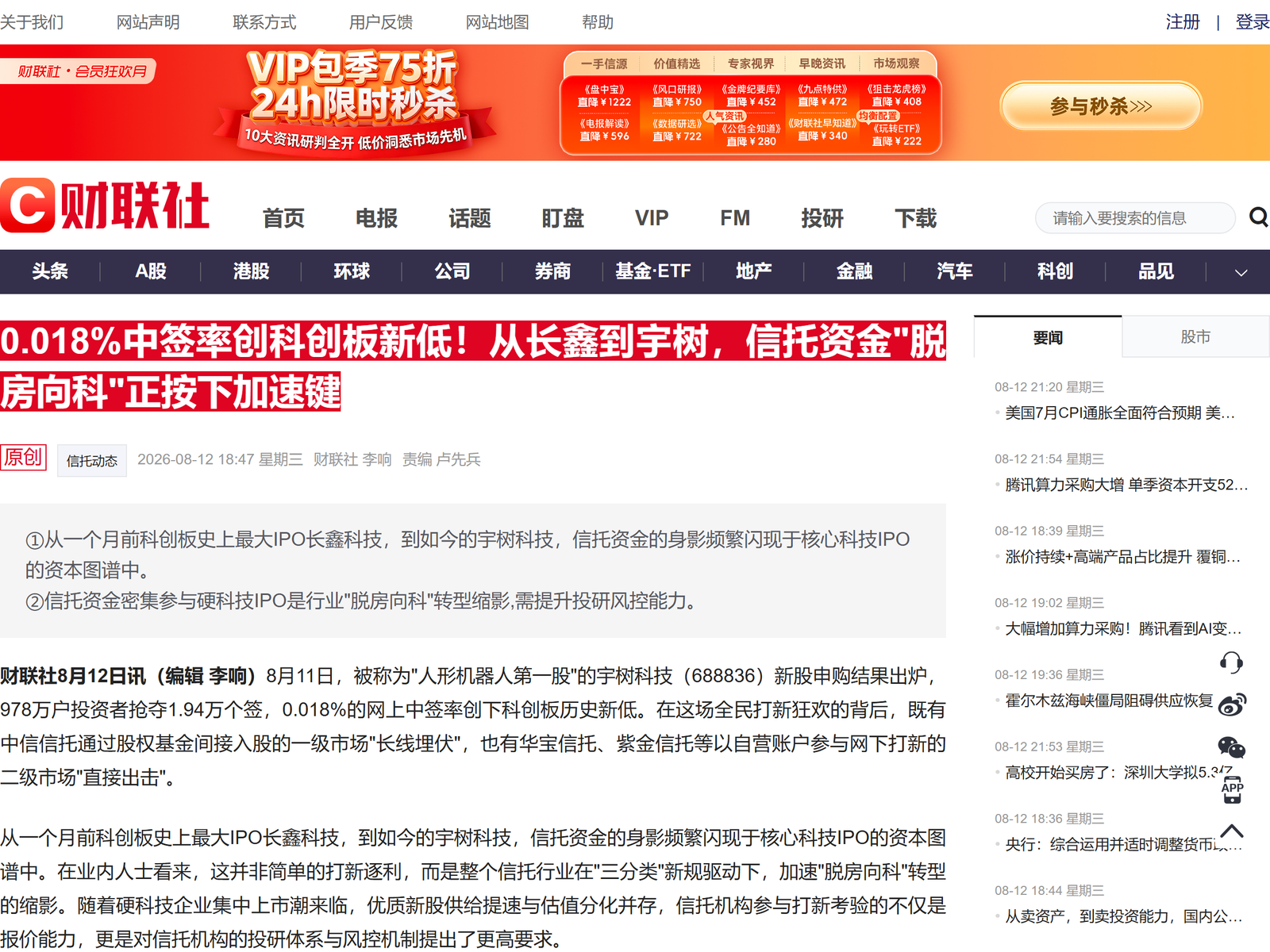
Unitree Robotics completed its initial public offering lottery on August 11, 2026, and the demand was unlike anything China's STAR Market has seen this year. The Hangzhou-based robot maker, best known for its quadruped and humanoid machines, priced its shares at 150.80 yuan each, implying a market value of roughly 61 billion yuan ($8.5 billion). Nearly 9.78 million investors applied for the IPO. Only 19,400 lots were available. The resulting online lottery rate was 0.018%, a record low for the Shanghai Stock Exchange's science and technology board, according to Cailianshe.
This is more than a hot stock. Unitree is the first publicly traded company whose core business is humanoid robots, and its debut marks the moment China's embodied-AI industry moved from venture capital portfolios into public markets.
The Offering: 73 Days From Filing to Subscription
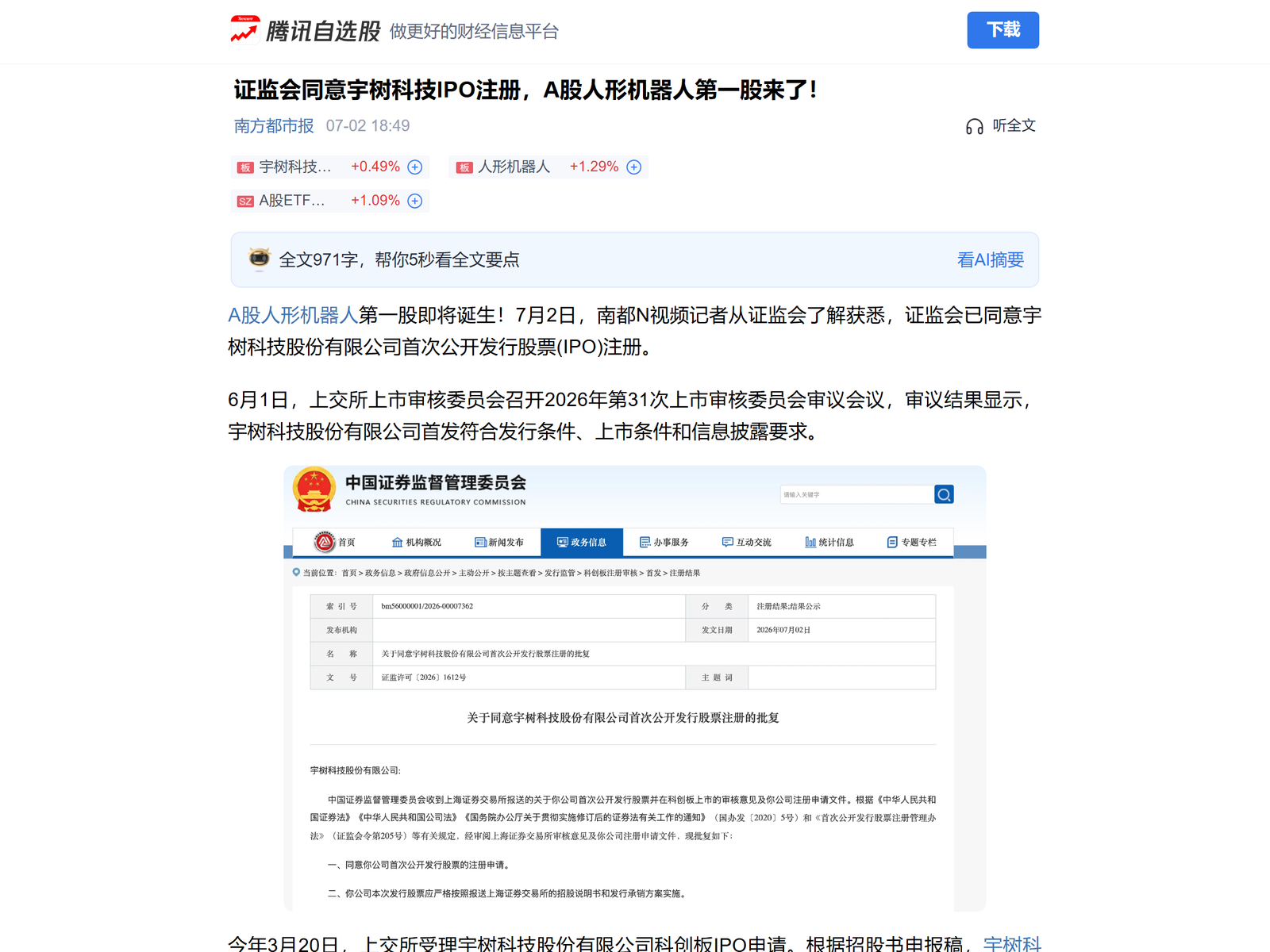
Unitree's IPO moved at startup speed. The company submitted its application on March 20, 2026, received approval from the listing committee on June 1, and won registration approval from the China Securities Regulatory Commission on July 2. From acceptance to committee approval took just 73 days, one of the fastest reviews on record for STAR Market, according to local exchange data compiled by Tencent Securities.
The company planned to raise 4.202 billion yuan for four projects: intelligent robot model R&D, robot body R&D, a smart manufacturing base, and working capital. Founder Wang Xingxing directly owns 23.82% of shares before the offering, but his voting rights sit at 63.55% thanks to a weighted-voting-rights arrangement. Including the employee shareholding platform Shanghai Yuyi, his total voting control reaches 68.78%.
The shareholder register reads like a map of Chinese tech capital. Meituan entities hold a combined 9.65% stake, making the food-delivery giant one of the largest outside investors. CITIC Securities' private equity fund holds 4.15%, and the National Council for Social Security Fund is the top strategic placement investor, according to August 12 disclosures.
Growth Is Explosive — and Already Slowing
Unitree's revenue numbers are the reason retail investors stormed the lottery. Full-year 2025 revenue was approximately 1.7 billion yuan, up more than 335% year over year. Net profit rose 191%. In the first quarter of 2026 the company generated 423 million yuan, still up 68.5% year over year, but the pace of expansion has clearly cooled from triple-digit territory.
Margins are also under pressure. First-quarter 2026 non-GAAP net profit fell 52.6% year over year to 40.25 million yuan, as research and sales expenses climbed. Unitree expects first-half 2026 revenue of 1.052 billion to 1.128 billion yuan, up 35.6% to 45.4%, with non-GAAP profit down 22% to 6.4%. The company is explicitly telling investors that it is sacrificing short-term profitability to fund R&D and scale.
What Unitree Actually Sells
Beyond the IPO numbers, Unitree has built a real hardware portfolio. Its Unitree R1 bipedal robot launched earlier this year and had its official price cut from 39,900 yuan to 29,900 yuan in June 2026 — a move that undercuts most Western humanoid prototypes by an order of magnitude. The company also sells the GD01, a $390,000 rideable mech that founder Wang Xingxing demonstrated personally. It is billed as the world's first mass-produced manned mech capable of transforming.
The low price points are possible because Unitree controls much of its supply chain and benefits from China's dense manufacturing ecosystem. That same ecosystem helped Chinese manufacturers ship more than 97% of global humanoid robot units in the first half of 2026, according to industry data cited by local media.
My Take: The IPO Is a Milestone, Not a Recommendation
The 0.018% lottery rate tells you more about scarcity and retail enthusiasm than it does about Unitree's intrinsic value. The company is genuinely important: it shipped hardware at price points competitors struggled to match and proved that humanoid robots can be manufactured at scale. But going public means it now has to report quarterly results while investing heavily in a market that is still mostly pilots and proofs of concept.
The broader signal is that embodied AI has reached the public-markets phase. Industry data cited by local media estimates China's humanoid robot market will reach $15 billion by 2030. Unitree will not be the last listing. Agility Robotics, Figure AI, and other Western peers are watching closely, because the first public comps in any new sector set the valuation language everyone else uses.
Pros and Cons of the Unitree IPO
Pros:
- First-mover public status gives Unitree a valuation benchmark and media halo in a new sector.
- Manufacturing scale and low production costs are hard for Western rivals to replicate quickly.
- Strong backing from Meituan, CITIC, and China's social security fund signals institutional confidence.
Cons:
- Profit growth is decelerating as R&D spending rises, a classic pre-IPO growth story.
- Founder-controlled voting rights limit minority shareholder influence.
- Humanoid robot demand is still unproven at consumer scale; most revenue comes from enterprise and research buyers.
Key Takeaways
- Unitree Robotics priced its STAR Market IPO at 150.80 yuan per share, valuing the company near $8.5 billion.
- The online lottery rate was 0.018%, a record low for Shanghai's STAR Market.
- 2025 revenue grew more than 335%, but 2026 growth and margins are decelerating as R&D spending rises.
- Founder Wang Xingxing controls 68.78% of voting power through a weighted-rights structure.
- The listing is the first pure-play humanoid robot public stock and sets a valuation benchmark for the global sector.
FAQ
What is Unitree Robotics?
Unitree is a Chinese robotics company based in Hangzhou known for quadruped and humanoid robots, including the Unitree R1 biped and the GD01 rideable mech.
When did Unitree go public?
The company completed its IPO subscription on August 11, 2026, and is expected to begin trading on the Shanghai STAR Market shortly after.
How much is Unitree worth?
At the IPO price of 150.80 yuan, the implied market value is roughly 61 billion yuan, or about $8.5 billion.
Who are the major shareholders?
Founder Wang Xingxing owns 23.82% of shares but controls 68.78% of voting rights. Meituan entities hold 9.65%, and the National Council for Social Security Fund is the top strategic investor.
Why does this listing matter globally?
It is the first public offering of a company whose main business is humanoid robots, giving investors, competitors, and analysts a real valuation benchmark for the embodied-AI sector.
Methodology: This analysis draws on Chinese-language exchange filings, CSRC disclosures, and local financial reporting dated July 2–August 12, 2026. Revenue and ownership figures come from Unitree's prospectus and post-subscription disclosures.
If you are building or sourcing AI-powered robotics tools, browse our AI audio and robotics tools directory for software that integrates with hardware workflows.