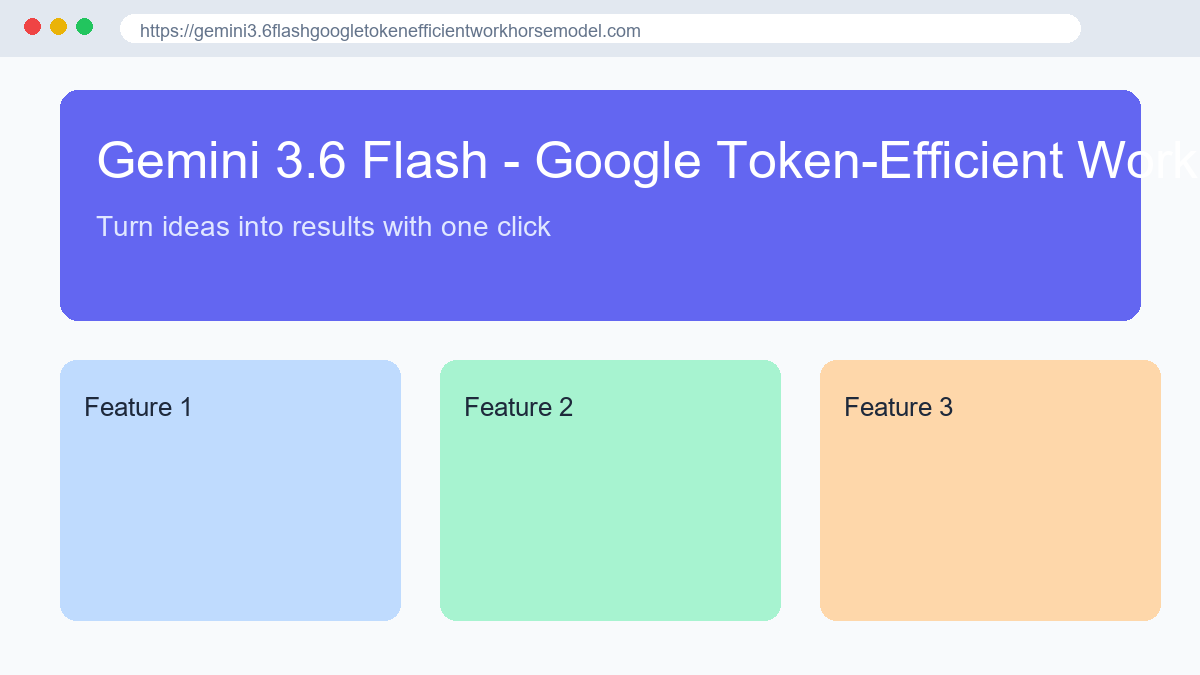
Gemini 3.6 Flash is Google's token-efficient workhorse AI model for scaled coding, knowledge work, and multimodal tasks, released on July 21, 2026. It is aimed at developers and enterprises running high-volume agentic workloads who need strong performance without premium per-token cost. The model keeps a one-million-token context window while using about 17 percent fewer output tokens than its 3.5 Flash predecessor.
Core Features
- One-million-token context with a 64K output cap and a March 2026 knowledge cutoff, accepting text, images, audio, video, and PDFs.
- Natively multimodal with built-in tool use: function calling, structured output, code execution, computer use, and search grounding.
- Roughly 65 percent fewer output tokens than 3.5 Flash on DeepSWE, with strong agentic and coding scores.
- Available through the Gemini API, Google AI Studio, Vertex AI, the Gemini app, Antigravity IDE, and GitHub Copilot.
Use Cases / Best For
- Engineering teams building agentic coding and computer-use pipelines at scale.
- Knowledge workers handling long documents and multimodal analysis.
- Cost-sensitive productions that still want frontier-class benchmark performance.
Pricing
Gemini 3.6 Flash is priced at $1.50 per million input tokens and $7.50 per million output tokens via the Gemini API, down from $9.00 output on 3.5 Flash. A cheaper sibling, Gemini 3.5 Flash-Lite, runs at $0.30 input and $2.50 output.
Pros & Cons
- Pros: best-in-class token efficiency for the Flash class at strong benchmark scores.
- Cons: the more capable Gemini 3.5 Pro is delayed, so top-end reasoning is missing.
Our Take: Best for high-volume agentic workloads where token efficiency matters more than maximum reasoning depth. The trade-off is that the flagship Gemini 3.5 Pro slipped and remains in limited testing. See how it stacks up against DeepSeek V4-Flash in our AI engine category.