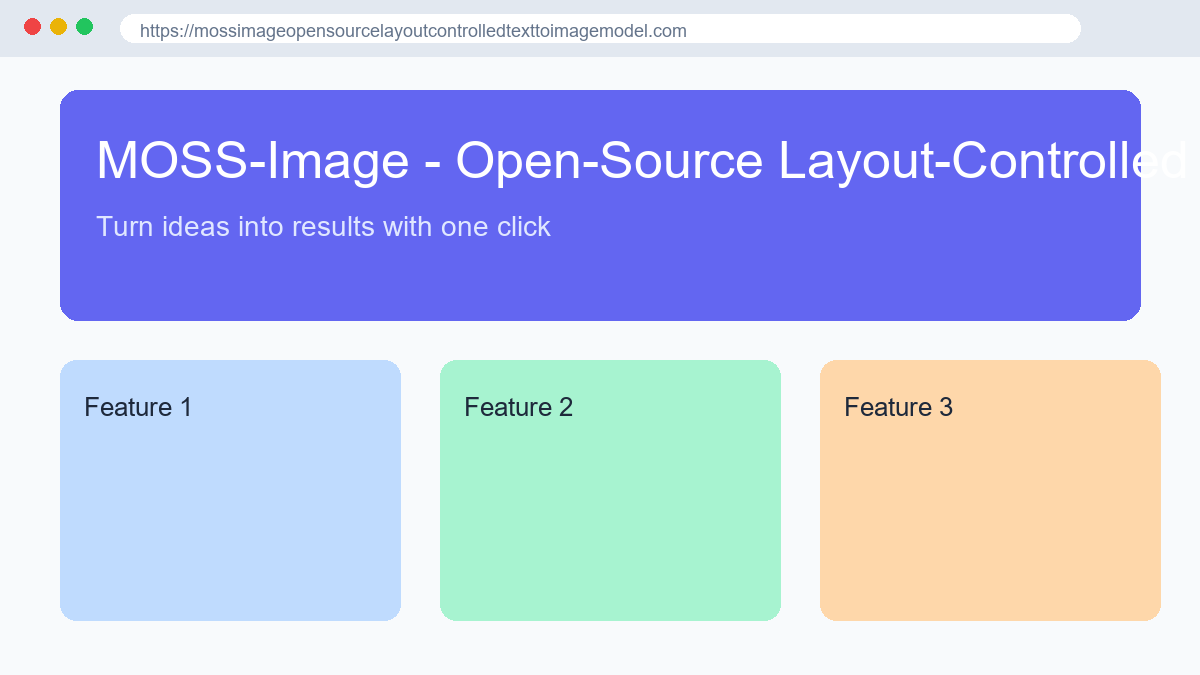
MOSS-Image is an open-source, layout-controlled 5B text-to-image model from the OpenMOSS team at Fudan University. Released in mid-October 2026, it targets designers and e-commerce teams who need readable text and exact element placement in generated images. It joins open image models such as Qwen-Image 2.1 and FLUX in prioritizing controllable, text-accurate output.
Core Features
- Native layout control: pass a JSON list of bounding boxes to fix headlines, faces, or grid panels.
- Renders Chinese and English text crisply inside images, a weak spot for most open models.
- Single-stream 5B diffusion Transformer with a Qwen3.5-9B text encoder and FLUX.2-style VAE.
- Ships with a Diffusers pipeline, a Gradio demo, and a ComfyUI plugin (600-plus GitHub stars in days).
- Outputs at sizes that are multiples of 16, easing downstream tiling and print workflows.
- Base weights ship without CFG distillation, which helps the community train LoRAs and domain adapters.
Use Cases / Best For
- Poster and infographic makers who cannot risk garbled typography.
- E-commerce teams generating uniform product or banner layouts at scale.
- Researchers training LoRA and industry fine-tunes on an Apache-2.0 base.
Pricing
MOSS-Image is free and open-weight under Apache-2.0, with a free tier for the hosted demo and no per-image fee. Compare it with other image generation tools.
Our Take
Best for layout-accurate, text-heavy image work where open weights matter. The trade-off is size: at 5B parameters it trails FLUX and Qwen-Image on photorealistic fidelity, so pure art pieces look softer.