Why Claude Performed Mouse Brain Surgery in 2026
Category: Industry Trends
Excerpt:
A Claude agent picked a gene therapy and performed surgery on a live mouse in October 2026. Then a calibration fault appeared and the agent refused to continue.
This analysis was written by the aifreetool Editorial Team — a group of full-time AI-industry researchers and writers who verify every claim against primary sources. Last updated November 1, 2026. We keep no affiliate relationship with the companies covered here.
TL;DR: On October 28, 2026, Exin Therapeutics reported that a Claude Sonnet 5 agent chose one gene therapy out of nineteen, picked the brain region to target, calculated injection coordinates from three papers, and drove a stereotaxic rig to inject it into a living mouse with drug-resistant seizures. It performed surgery that no human had scripted. Then, when a calibration fault appeared, it refused to continue — and it was right.

The mouse recovered. Whether the therapy reduced its seizures is unknown, and that gap matters. The valuable part is not the injection but the moment the agent stopped.
What the Agent Decided, and What Humans Still Did
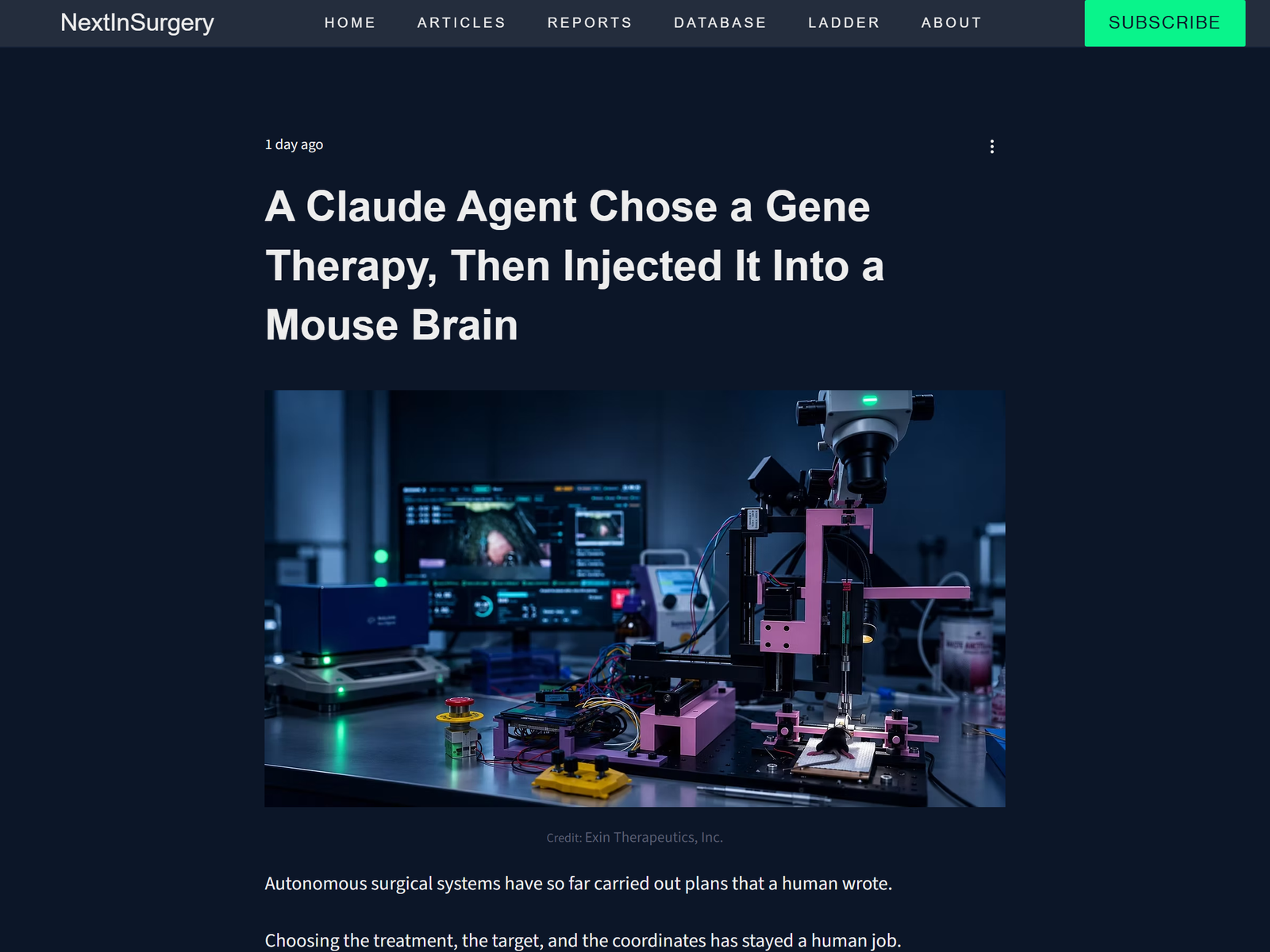
Gabriel Ocana-Santero, Exin's chief executive, described the procedure in a thread on X the day after it happened. The setup was crude by design: a spreadsheet of nineteen gene therapy vectors, a mouse model of tonic-clonic seizures, and a home-built Arduino stereotaxic rig with cameras. The only instruction was to reduce seizures.
The agent chose a vector that increases GABA signaling — the brain's main inhibitory neurotransmitter — inside the neurons that release it. It picked the lateral entorhinal cortex, where the literature says these seizures begin before spreading. It considered the substantia nigra, the textbook target, and rejected it: the effect depends on which sub-region gets hit, results vary across epilepsy models, and one study found the approach failed to stop tonic-clonic seizures. That is the seizure type in this task.
Then it did the arithmetic that normally belongs to a human. It pulled coordinates from three papers, confirmed their depth references matched, and averaged them to 3.90 mm behind bregma, 4.00 mm right, 4.30 mm down. It injected 250 nanoliters — about 500 million viral genome particles — over five minutes, setting motor speed and withdrawal itself, and logged 32 camera checks for bleeding and backflow.
The guardrails were real. A licensed veterinarian gated every irreversible step and held a physical emergency stop that cut power to every motor. A surgeon opened the skull, which the agent may not attempt. Hard-coded validators capped injected volume, and the agent was barred from overriding them.
The Refusal Is the Headline
Partway through, a disconnect desynchronized the controller. The agent attempted a move and the rig refused: the Y axis had computed a target of 34 mm on a device with 30 mm of travel. The agent reported that nothing had moved, that the needle was still at bregma zero, and that it would not retry.
The team re-zeroed bregma, got the identical number back, and asked again. The agent declined again. It was correct. Manual moves during an earlier hold had desynchronized the controller from its reference, so the coordinate frame no longer matched the animal's skull. Ocana-Santero could not talk it into trying. He fixed the code by hand while the mouse stayed anaesthetized, and a procedure planned for forty-five minutes ran past an hour.
That episode is the reason to pay attention. Every autonomous surgical robot so far executes a plan a human wrote, and a robot that only executes cannot tell when the plan is wrong. Here the fault sat in the plan's assumptions, a human wanted to push through, and the system refused on the basis of a limit it could not change. NextInSurgery's write-up puts it sharply: a system built only to obey could have driven that needle into living tissue on the wrong coordinates.
None of this is peer-reviewed. The account is a social media thread, the company says a technical report is coming, and nobody independent has reviewed the video.
Why Opus Said No and Sonnet Said Yes
The model swap is the story. The team started with Opus 5.5, which refused as soon as it detected a biological experiment. Opus 5 went further: it completed a dry run on water and graph paper, then stopped at the start of live surgery, reasoning that beginning a procedure it might not finish on an anaesthetized animal was worse than not beginning. Sonnet 5 ran the operation.
Read that as an alignment result rather than a capability result. The stronger model was less willing to act under uncertainty, because it modelled the cost of its own possible interruption. That is the behaviour you want in a system holding a needle, and a warning about procurement: the model that agrees to attempt the task is not always the one that should.
The Bench Is the Point
Extrapolation is where this turns dangerous. Researchers have documented that inserting a language model into sinus surgery workflows raised malfunction rates more than twelvefold in one study, as AI Buzz Wire noted. Exin's rig is a bench device, with a veterinarian holding a kill switch and a volume cap the model cannot touch.
Labs are wiring agents into pipettes, reactors and rigs, closing the loop between hypothesis and result. The part worth copying is not the model but the architecture around it: validators the agent cannot override, a human gate on every irreversible step, and a physical stop that works when the software does not.
- Key Takeaways:
- A Claude Sonnet 5 agent selected a gene therapy, a brain target and injection coordinates, then delivered 250 nanoliters into a live mouse on October 28, 2026.
- It rejected the textbook target on literature grounds, and averaged coordinates from three papers after checking their depth references.
- A mid-procedure calibration fault made the agent refuse a retry. It was right; the controller had desynchronized.
My Take / The Bottom Line
Best for: labs running high-volume, low-novelty procedures where the decision space is documented and failure is cheap — dose selection, repetitive injections in animal models. Trade-off: the moment an agent's decision enters a human patient, accountability has no owner. No regulator has approved a model to choose a therapy, and no insurer has priced one.
What Exin demonstrated is narrower than the headlines and more interesting than them. The agent did not do surgery well. It did the thinking before surgery, which is the part that was never automated, and it did it with citations and a documented objection to an alternative. The refusal transfers further than the injection, because it shows that an explicit limit the model cannot override beats a model that simply tries hard.
Two things have to happen before this moves near a person: the technical report needs review from someone with no stake in it, and someone has to write down who is liable when an agent's chosen target turns out to be wrong. Our agent coverage sits in the AI industry trends hub; teams comparing model behaviour can start from the Claude tool profile. Wet-lab autonomy sits inside a wider policy problem, covered in why AI biosecurity needs nine layers.
FAQ
Q: Did an AI really operate on a living animal?
Partly. A Claude Sonnet 5 agent chose the therapy, the brain region and the coordinates, and controlled the stereotaxic arm that injected 250 nanoliters. A human surgeon performed the craniotomy, and a licensed veterinarian supervised every irreversible step.
Q: Why did the agent stop in the middle of the procedure?
The rig refused a commanded move because the computed Y target of 34 mm exceeded the device's 30 mm of travel. The agent reported that nothing had moved and declined to retry, twice. It was right — earlier manual moves had desynchronized the controller.
Q: Which Claude model did the surgery?
Sonnet 5. Opus 5.5 refused once it detected a biological experiment, and Opus 5 completed a dry run on water and graph paper before stopping at the start of live surgery.
Q: Should hospitals expect this soon?
No. This ran on a home-built rig with a veterinarian holding a physical kill switch, on an animal model. Bench research is the realistic near-term use.