Why AI Capex Fears Sank the Nasdaq in 2026
Category: Industry Trends
Excerpt:
AI capex fears sank the Nasdaq in October 2026: Alphabet free cash flow hit -$9.07B, Intel fell 29%, and hyperscaler spending passed operating cash flow.
This analysis was written by the aifreetool Editorial Team, a group of full-time AI-industry researchers who check every figure against filings and wire copy. Last updated November 2, 2026. We hold no affiliate relationship with the companies covered here and no position in any stock mentioned.
TL;DR: AI capex fears turned into a real selloff on October 30, 2026. Alphabet's negative free cash flow and Intel's 29% one-day collapse convinced investors that hyperscaler spending has outrun the cash the core businesses throw off. The Nasdaq Composite fell 2.86% in a session and 5.3% in October, and Alphabet shed roughly $500 billion of market value in a day. The question is no longer whether AI demand exists. It is who pays for the build, and how fast the depreciation lands on earnings.

What happened on October 29 and 30
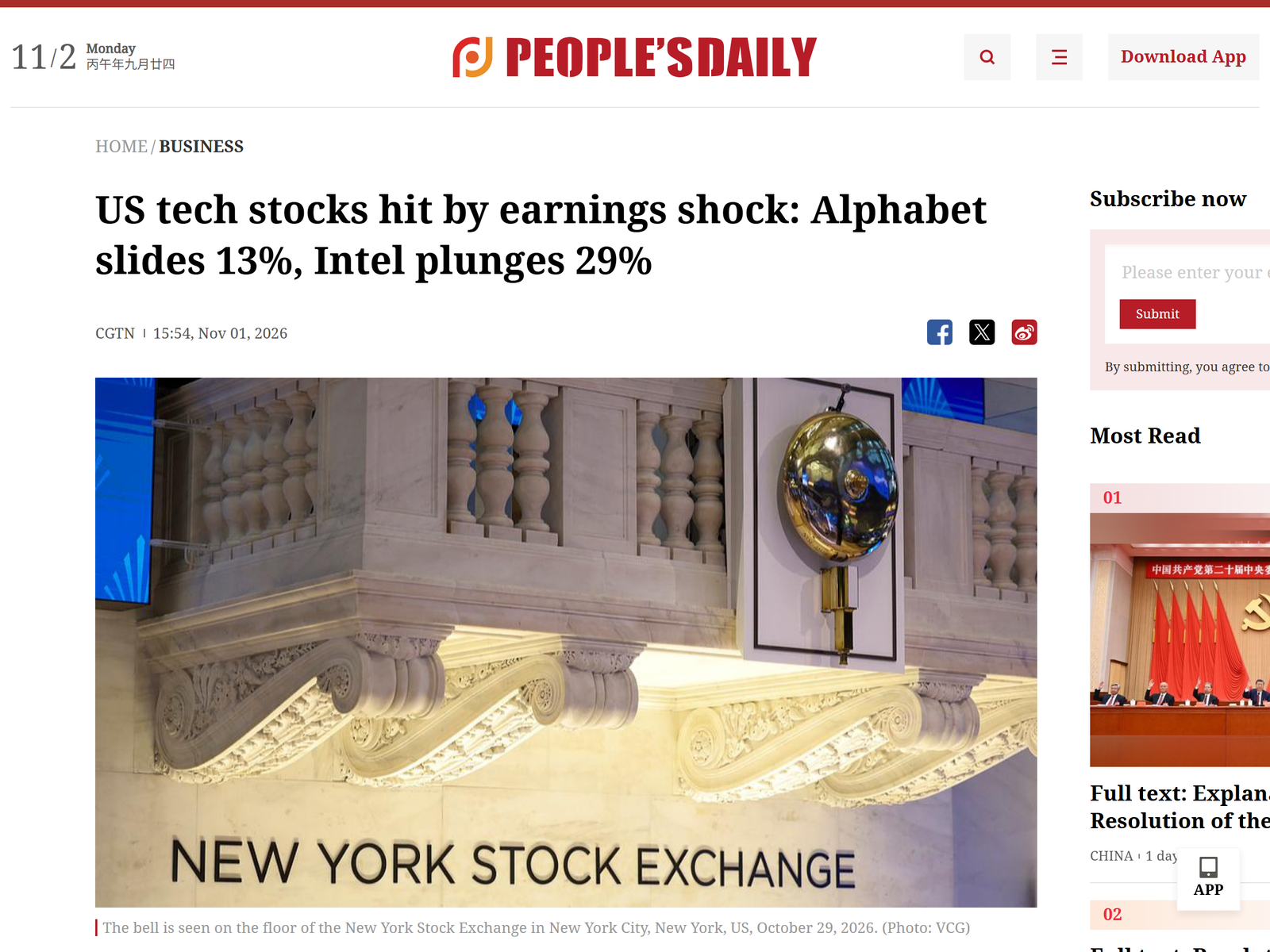
Alphabet reported third-quarter revenue of about $127.4 billion, up 24% year over year, and earnings per share of $2.12 against a $3.02 consensus. Net income fell roughly 25%. Free cash flow swung to negative $9.07 billion, where analysts had expected positive $27 billion, per the full earnings round-up.
Capital expenditure hit $51.4 billion, up 114% year over year. Management kept full-year guidance at $195 billion to $205 billion and flagged a significant increase for 2027. The stock fell 12.6% on October 29, the largest single-day decline in its history, and the 50-day moving average crossed below the 200-day.
The next day the damage spread. Intel fell 28.6%, its worst session in more than five decades. The Philadelphia Semiconductor Index dropped 7.2% with 29 of 30 components lower; AMD lost 10.9%, Arm 10%, Nvidia 4.2%. The S&P 500 gave up 1.82% and closed below its 100-day moving average as the market walked into midterm week, a session summarised in this market wrap.
The cash-flow table that broke the spell
Read the four biggest AI spenders side by side and the split is obvious: the income statement still looks healthy, the cash-flow statement does not.
| Company | Q3 capex | Free cash flow | Market reaction |
|---|---|---|---|
| Alphabet | $51.4B, up 114% | - $9.07B | -12.6%, about $500B of value gone |
| Microsoft | $45.2B | + $18.6B | Flat, then a $25B bond sale |
| Amazon | $77.3B | - $42.4B, trailing 12 months | -3% Friday after -6% after hours |
| Meta | $135B to $145B guided for the year | - $2.1B | -7% on the guidance day |
Reuters tallied the five largest spenders, adding Oracle to the list, and found operating cash flow of $542.9 billion across the first nine months of 2026, up 29%. Capital expenditure reached $556.9 billion. It is the first time in the fifteen years the series covers that capex exceeded operating cash flow for the group.
Buybacks used to hide that gap. Alphabet and Meta repurchased no shares this year, after buying back $66.5 billion combined in the first nine months of last year. ING calculates Alphabet shrank its share count 9.5% over the five years to 2025. The cushion is gone, so per-share profit now depends on real earnings, net of depreciation on servers that lose value far faster than buildings do. We flagged the first negative free-cash-flow quarter in July; the October print made it structural.
Why Intel's 29% collapse belongs in this story
On the surface Intel is a PC story, not an AI capex story. Third-quarter revenue of $16.51 billion beat estimates and data-center revenue rose 78%. Then guidance landed: $15 billion to $16 billion for the fourth quarter, against a consensus near $17 billion.
The cause is mundane and telling. AI data centers are absorbing DRAM and NAND supply, component costs climbed, and Intel expects PC shipments to fall 25% to 30% sequentially. Management guided the PC market down 12% this year and another 10% in 2027, and the CFO said the slowdown runs at least through the first half. Bank of America cut the stock from buy to neutral and took its target from $145 to $100. Intel closed October down 45%, the worst performer in the index.
That is the mechanism investors only now priced. The build is not just consuming capital. It is bidding components away from the businesses that generate the capital.
The bull case has numbers too
None of this means demand is fake. Google Cloud revenue grew 103% to $30.7 billion with operating income of $11.1 billion, and the backlog sits at $561 billion, more than half of it due within two years. AWS grew 39.3% to $46 billion with a $578 billion backlog, and Andy Jassy told analysts he sees 40%-plus growth through 2028.
Microsoft keeps the debate honest. Capex of $45.2 billion and Azure growth of 48% arrived with positive free cash flow of $18.6 billion, down 27% but roughly $10 billion above consensus. It also sold $25 billion of bonds, its first bond sale in nearly a decade. Even the strongest balance sheet is borrowing now.
Key Takeaways
- Capital spending at the five largest hyperscalers topped operating cash flow for the first time in the series: $556.9 billion against $542.9 billion.
- Alphabet's problem is revenue mix, not demand. Search ads came in at $63.35 billion versus a $64.85 billion estimate, and search growth slowed to 12% from 17% in the prior quarter.
- Memory scarcity is now a profit-and-loss item. Intel's guidance cut traces to component costs, not to weak AI orders.
- Credit is the next test. AI-linked investment-grade issuance reached $330 billion by mid-2026, about ten times the pre-boom annual rate, per the Kansas City Fed.
My Take / The Bottom Line
The index move is noise. The cash-flow crossover is the signal, and it landed in the same month Gartner published a number nobody quoted on television: AI data centers need roughly $8.5 trillion of cumulative revenue by 2030 to earn a normal return, against about $3.6 trillion of expected revenue.
What gets repriced first is the funding structure, not the technology. Once hyperscalers stop buying back stock, stop funding capex from operations and start issuing paper, the AI trade becomes a credit trade. Credit noticed before equities did: CoreWeave's unsecured spreads pushed past 1,000 basis points, and Blackstone has told investors that Anthropic's debt may not earn an investment-grade rating after its IPO. The Financial Times also reported that OpenAI trimmed its latest raise by about $10 billion, to roughly $20 billion at a $1.25 trillion valuation.
My read is two quarters where earnings quality beats model benchmarks. Companies selling metered inference with visible backlog hold up. Companies monetizing AI through advertising get asked why search grew 12%. If you buy this dip, buy the cash-flow statement, not the keynote. The deflation that makes the $8.5 trillion math survivable comes from cheaper inference, and the low-cost challenger models in our tool database are where that pressure starts. More context sits in our industry trends coverage, with the technical side in tech deep dives.
One disclosure: we are not investment advisers and none of this is a recommendation.
FAQ
Did AI stocks crash in October 2026? They corrected hard. The Nasdaq Composite lost 5.3% in October, its worst month since March 2025, and the S&P 500 slipped 0.94%. Nvidia alone shed more than $800 billion of market value from its October 6 peak of $5.77 trillion.
Why did Alphabet's free cash flow go negative? Three things stacked up: $51.4 billion of quarterly capex, a build in TPU and technical-infrastructure inventory, and a $5.2 billion European Union fine. Capex alone consumed 40% of revenue in the quarter.
Is this an AI bubble bursting? Not yet. Backlogs of $561 billion at Google Cloud and $578 billion at AWS are contracted demand, not narrative. What is deflating is the assumption that spending needs no justification.
What should I watch next? Nvidia's earnings later in November, fourth-quarter capex guides from all four hyperscalers, and credit spreads on AI-linked debt. The Federal Reserve held rates at 3.75% to 4.00% on October 29, so nothing gets cheaper while this is being financed.