Google's $17B Wyoming Data Center: Why It Bought Crusoe (2026)
Category: Industry Trends
Excerpt:
Google paid an undisclosed price for Crusoe's half-built Wyoming data center, then committed $17 billion to finish a campus planned to reach 10 GW.
This analysis was written by the aifreetool Editorial Team, which checks every claim against primary sources and company statements. Last updated November 10, 2026. We hold no affiliate relationship with any company named here.
Quick answer: Google's fix for a stalled build was to buy the site instead of renting it. On November 6, 2026, Crusoe confirmed it had sold an unfinished data center campus in southeastern Wyoming to Google, which then pledged $17 billion to finish the campus. At gigawatt scale, hyperscalers would rather own the construction schedule than depend on a developer who misses it.

- Google bought the Wyoming land and interconnection work rather than signing on as Crusoe's tenant.
- The project was announced in July 2025 with Tallgrass at 1.8 GW, designed to scale toward 10 GW.
- Google's build leans on 702 MW of Bloom Energy fuel cells contracted through American Electric Power, plus carbon capture.
- Crusoe keeps other Google work in Texas, so the relationship survived the sale.
What Google Actually Bought in Laramie County

The sequence matters. Google published its blog post about a long-term $17 billion investment in Laramie County one day before Crusoe confirmed the sale. Google listed its partners on that page: Tallgrass Energy, Black Hills Energy, American Electric Power and Related Digital. Crusoe was not among them, which told you the deal was already closed before anyone said so.
Neither company disclosed the price for the land, entitlements or utility interconnections. What Google bought was not a building but a pre-construction package: a site, a power strategy and government approvals a smaller company spent over a year assembling.
Chase Lochmiller, Crusoe's co-founder and chief executive, framed the exit as a handoff. "Crusoe's pre-construction efforts — origination, entitlement, and de-risking — have set up the Wyoming project for construction and eventual operation," he said in a statement carried by Konsulteer's write-up of the transaction. Read plainly: Crusoe did the paperwork, Google takes the construction risk.
The trigger was not a secret. Bloomberg reported in June 2026 that Crusoe had paused development after failing to land a customer, and that Google was pushing ahead with other partners. That reporting described pressure on Crusoe to hand over control after Google flagged cost and timeline concerns. Five months later the handover was official.
Why an Independent Developer Could Not Finish It

Crusoe is not a weak company. The Denver firm started in crypto mining and energy before pivoting into AI campuses, and it closed a $3.9 billion equity round in September 2026 that valued it near $30.9 billion, with Mubadala Capital joining and JB Straubel taking a board seat. Lochmiller says Crusoe has more than 6 GW contracted and over 40 GW in its pipeline, up from 4.9 GW in June.
Signing gigawatts and energizing them are different skills. A multi-gigawatt campus needs substations, long-lead transformers, gas turbines, cooling plants and a construction workforce, all sequenced so nothing idles. Each item is a schedule risk, and schedule risk compounds when the customer's product roadmap depends on the date.
That is the asymmetry the sale exposes. Crusoe could raise capital and win contracts. It could not absorb years of slippage on one site the way Google can, because a delayed campus is an accounting note to Google and an existential threat to a startup.
The Power Math: 702 MW of Fuel Cells and a CO2 Hub
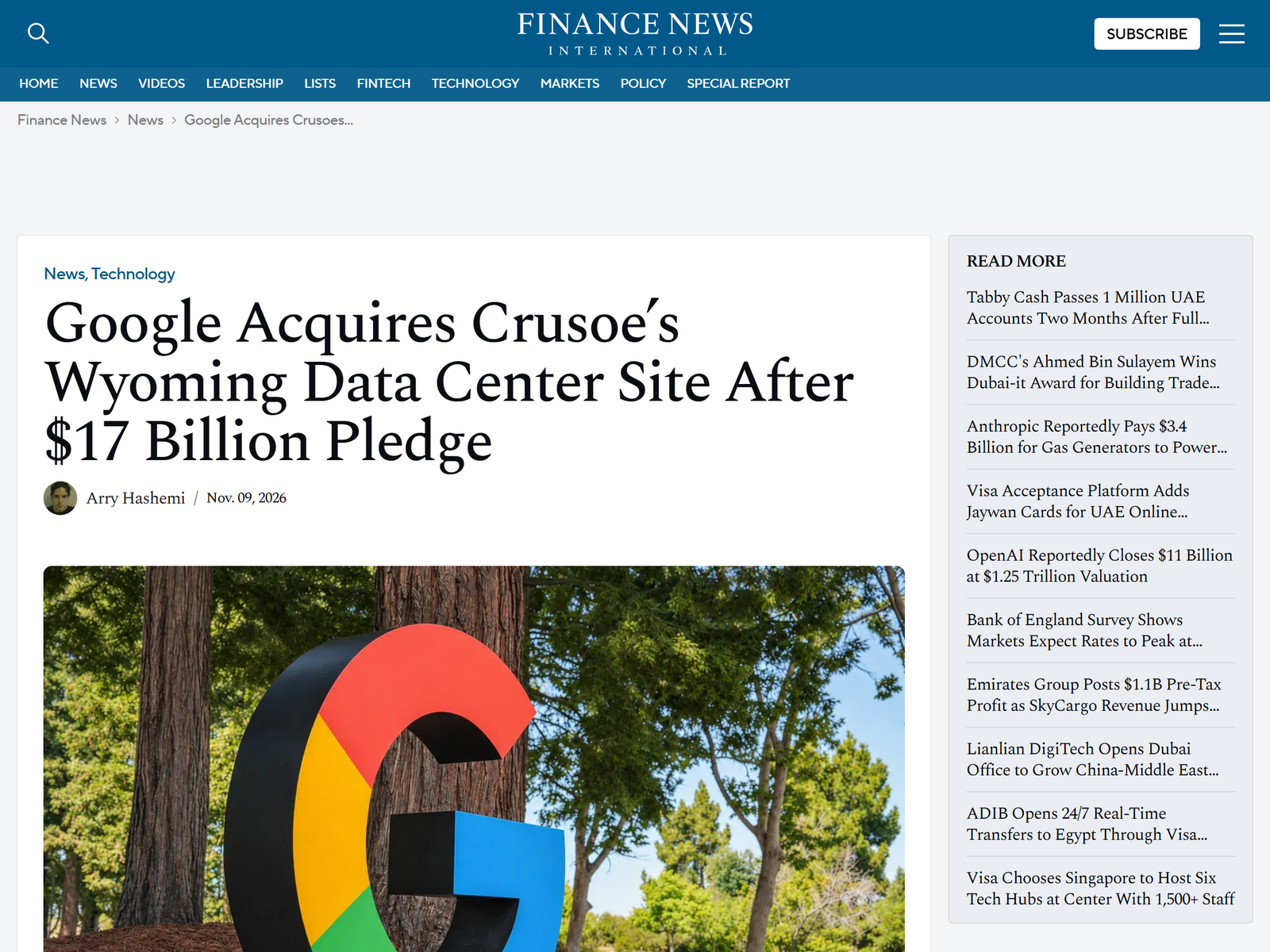
Google's plan for Wyoming is specific enough to grade. The company contracted American Electric Power for a 702 MW fuel cell development with carbon capture and storage, using Bloom Energy fuel cells. Most of the captured carbon is destined for Tallgrass's Eastern Wyoming Sequestration Hub. Google will also draw power from gas generators operated by Tallgrass Energy and Black Hills Energy, and the campus will be air-cooled to limit water use. Google says it covers 100 percent of the energy needs and infrastructure costs tied to the build-out.
The original Crusoe design used the same building blocks in a different order: fuel cells, grid power and gas turbines, with a longer route to carbon capture through Tallgrass's regional CO2 hub. The engineering did not change much when the owner did. The accountability did.
| Item | Crusoe's plan (July 2025) | Google's plan (November 2026) |
|---|---|---|
| Owner of record | Crusoe with Tallgrass | |
| Announced capacity | 1.8 GW, scaling to 10 GW | Campus investment of $17B |
| Generation mix | Fuel cells, grid, gas turbines | 702 MW fuel cells via AEP, plus gas |
| Carbon handling | Route to Tallgrass CO2 hub | Capture and storage at the same hub |
Power is the binding constraint on every frontier build, which is why Google funds stranger options too. Its Project Suncatcher test put TPUs in orbit partly to dodge grid queues, as our Suncatcher orbital data center review explains. Wyoming is the boring version of that bet: secure electrons on the ground, in a county that wants the tax base.
What This Means for Every Neocloud
Crusoe still builds for Google: its Armstrong County campus outside Amarillo, where ground broke in June 2025 and more than 5,500 tradespeople work daily, connects to the Goodnight 1 and Goodnight 2 wind farms at 265.5 MW each. Its flagship 1.2 GW Abilene site serves Oracle and OpenAI, a second 900 MW Abilene campus for Microsoft should open its first building in mid-2027, Meta is a customer, and Jane Street reportedly signed a five-year cloud agreement worth about $13 billion.
So the pattern is not "hyperscalers stop using developers." It is "hyperscalers keep the option to take the site." Any neocloud selling gigawatt capacity is now pricing in a clause it cannot see: if delivery slips, the tenant may become the owner and the developer becomes a contractor.
Local politics raise the stakes. In the November 2026 midterms, voters rejected measures that would have smoothed data center permitting and approved others that banned, paused or restricted construction. Against that backdrop, the hundreds of millions in property taxes Google expects to generate for Laramie County and School District 1 are the political argument, and owning the project means owning that argument.
October's capex repricing, covered in why AI capex fears sank the Nasdaq, punished anyone who could not show a working asset against a spending number. A $17 billion pledge on an already-entitled site is an easier story to defend than a promise.
My Take / The Bottom Line
This is not a vote of confidence in Crusoe. It is a vote of no confidence in the independent delivery model at multi-gigawatt scale, and Google paid to remove that risk rather than manage it.
The winners are unglamorous: Bloom Energy gets a 702 MW order, AEP gets a contracted load, Tallgrass gets a sequestration customer, Related Digital gets build work. Crusoe gets cash and keeps a customer, a decent outcome for a company that had stalled the site. The losers are developers who believed land plus permits equals leverage. The scarce inputs in 2026 are transformers, turbines, queue positions and skilled labor, and the party with the strongest balance sheet can wait out everyone else's schedule.
If you are buying compute, ask a blunt question before you sign: who controls the construction schedule, and what happens to my capacity if they miss? For the broader category picture, see our AI industry trends coverage.
FAQ: Google, Crusoe and the Wyoming Campus
Did Google acquire Crusoe? No. Google acquired one unfinished project in southeastern Wyoming. Crusoe remains independent and still develops campuses for Google in Texas and for Oracle, OpenAI and Microsoft.
How much did Google pay for the site? Neither company disclosed the purchase price. Google only confirmed a $17 billion investment to develop the campus.
How large will the campus be? The July 2025 announcement described 1.8 GW of initial capacity with a path to 10 GW. Google has not restated a final figure.
Is this Google's first data center in Wyoming? Yes. Google described the Laramie County campus as its first data center in the state.
Why did Crusoe sell instead of building? June reporting said Crusoe paused the site after failing to secure a customer while Google raised cost and schedule concerns.