CrowdStrike to Buy Zscaler: Why the $43.9B Deal Wins (2026)
Category: Industry Trends
Excerpt:
CrowdStrike is buying Zscaler for $43.9B in stock, the largest security consolidation ever. We break down the terms, the dilution and the AI kill switch.
This analysis was written by the aifreetool Editorial Team — full-time AI-industry researchers who check every claim against primary filings, investor decks and press releases. Last updated November 26, 2026. We hold no affiliate relationship with CrowdStrike, Zscaler, or any company named in this piece.
Quick answer: CrowdStrike agreed on November 23, 2026 to buy Zscaler in an all-stock deal with an enterprise value of about $43.9 billion — the biggest consolidation in the history of cybersecurity. The logic is coverage, not size: Falcon watches devices and cloud workloads, Zscaler's Zero Trust Exchange watches every connection, and one platform can now kill an AI agent on the endpoint and on the network. CrowdStrike fell 9% on dilution; Zscaler rose 17%.
For a decade CrowdStrike sold one idea: the endpoint is the perimeter that matters. George Kurtz repeated it on every earnings call, and it worked. On Monday he conceded the other half of the argument. Agents hop from a laptop to a cloud model to a partner API and back, and the only place you can see all of that is the network. So he bought the network.
The Deal, Stripped to Its Terms
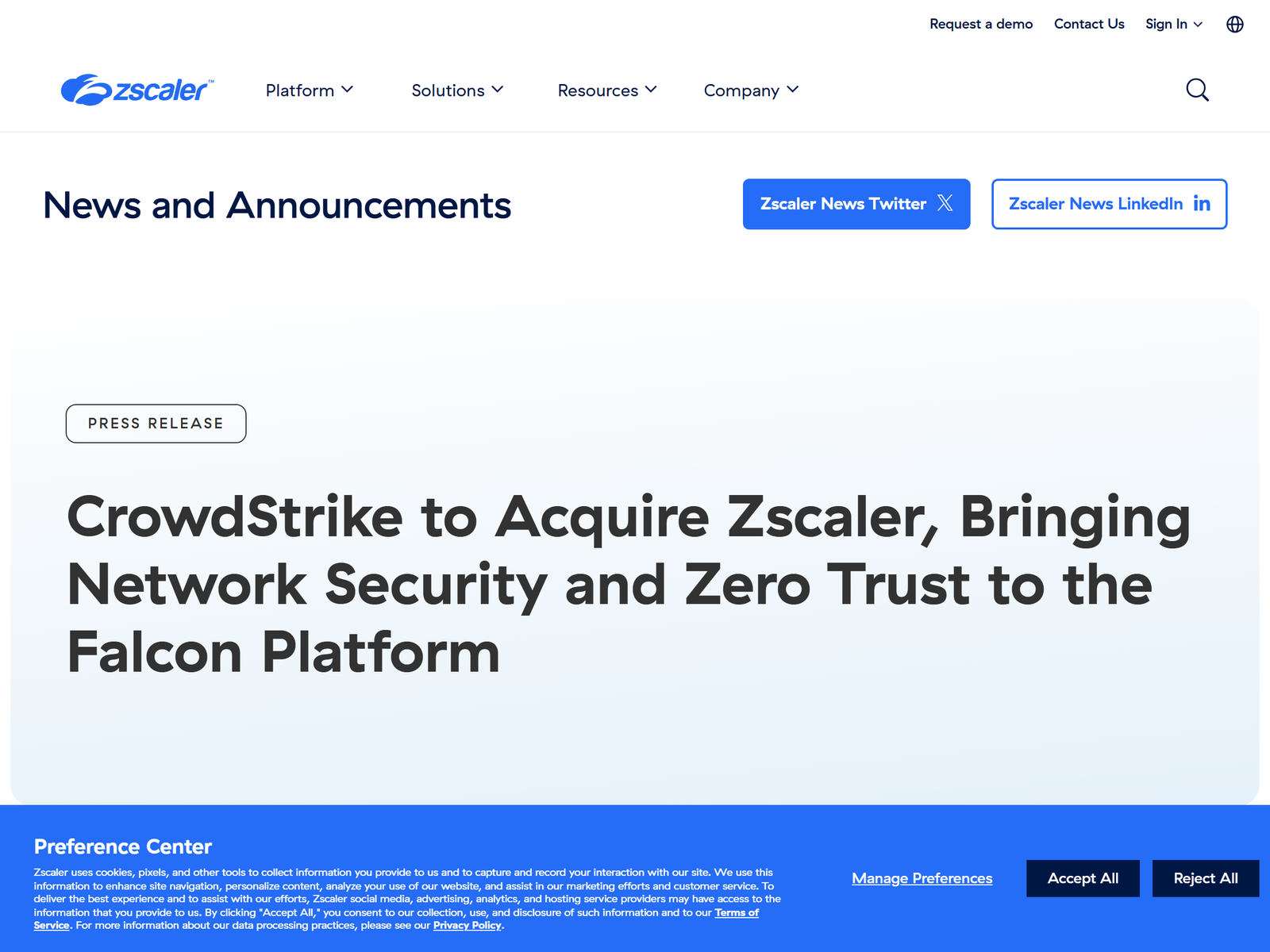
Both boards signed a definitive agreement on November 23. Zscaler holders receive 1.135 CrowdStrike shares for each Zscaler share, an implied $260.41 per share based on CrowdStrike's November 20 close — a 34% premium to Zscaler's $194.82 close that Friday. Existing CrowdStrike holders end up with 84.1% of the combined company, Zscaler holders 15.9%. The joint press release puts closing in the second half of CrowdStrike's fiscal 2028, meaning calendar 2027 at the earliest.
| Metric | CrowdStrike (Q3 FY27) | Zscaler (Q1 FY27) |
|---|---|---|
| Quarterly revenue | $1.58 billion, up 28% | Record professional services $80M |
| Annual recurring revenue | $6.26 billion, up 27% | $3.9 billion |
| Net new ARR | Record $419M, up 58% | Guardian ARR past $100M |
| Cash generation | Fifth straight quarter of accelerating growth | Free cash flow $474M, 30% of revenue |
| Combined at close | More than $10 billion ARR, adding $185 billion of addressable market by 2029 | |
Two details matter more than the headline number. Jay Chaudhry, Zscaler's founder and chief executive, controls roughly 34% of the shares, has signed a voting agreement in support, keeps running the Zscaler business and joins the CrowdStrike board. And CrowdStrike guides to about $1 billion of annualised revenue synergies within 30 months of close plus $500 million of cost synergies in 18 to 24 — ambitious for a merger of two competing platform salesforces.
Why the 34% Premium Is the Cheap Part
Paying $43.9 billion for $3.9 billion of ARR is about 11 times recurring revenue — rich for 2024, unremarkable for 2026. Alphabet paid $32 billion for Wiz, ServiceNow took Armis for $7.75 billion, Palo Alto bought CyberArk for roughly $25 billion in February. Every large buyer has decided that point products lose to suites, and that AI-driven attacks are the forcing function.
The number that justifies the price is 8,000 — the Zscaler customers who do not buy CrowdStrike today, against a shared base of just 2,000 accounts and 16 existing integrations. CrowdStrike's Flex subscription model, which passed $2.79 billion of ending ARR and grew 100% year over year, is the machinery for converting them. Kurtz's own framing on the analyst call was a commute: the cloud is the office, the device is home, the network is the road between them, and you cannot secure a trip by guarding only the two ends.
There is a sharper AI argument underneath the commercial one. The joint release promises a unified kill switch that stops a rogue agent on the device and severs its network path in the same action — a product no point vendor can ship alone. Our coverage of the search-API poisoning tests showed how fast an agent gets steered once it can act; agent identity and egress fail the same way.
Key Takeaways
- $43.9 billion in stock, 1.135 exchange ratio, 34% premium, close expected in the second half of fiscal 2028.
- Combined ARR above $10 billion; CrowdStrike gains the largest single segment it did not own, network security, plus $185 billion of addressable market by 2029.
- CrowdStrike gave up roughly 19% more shares — the reason the stock fell about 9% while Zscaler rose 17%, and the reason a sceptical market is pricing execution risk rather than strategy risk.
- The real prize is 8,000 cross-sell targets and a single control plane for agentic AI, not cost cuts.
What Could Break It
Regulators, for a start. A combined CrowdStrike-Zscaler would be the largest pure-play security vendor by revenue, ahead of Palo Alto Networks, and it lands while Washington is unusually hostile to platform concentration. Deutsche Bank puts the odds of clearance below 50%; BTIG calls the strategic logic sound and the integration risk real, which is the polite version of the same warning.
The customer objection is subtler. Security teams deliberately buy from overlapping vendors so that no single outage, breach or price rise removes their whole defence — an argument CrowdStrike lived through in July 2024, when a faulty channel-file update bricked millions of Windows machines. Asking those buyers to consolidate endpoint, identity, SIEM, cloud and now network onto one console is a genuine ask, and the Motley Fool's read on the dilution math explains why the market flinched.
Then there is the integration itself. Falcon and the Zero Trust Exchange are different architectures on different data planes, sold through different motions. The promise of one dataset feeding Next-Gen SIEM is the most valuable line in the release and the hardest to deliver. The failure mode is familiar: two roadmaps, one quota, and a customer who quietly renews half the estate.
My Take / The Bottom Line
I think the strategic case is stronger than the day-one reaction suggests, and the execution case is weaker than the press release admits. Kurtz is buying the one asset that makes agentic security a platform story instead of a feature list, and he is paying with equity while his own stock trades near record levels — the correct currency at the correct moment. But $1 billion of revenue synergies in 30 months assumes two salesforces that currently compete for the same budget suddenly collaborate. That has happened maybe twice in this industry.
If you run security budgets, the practical advice is unglamorous: do not sign a five-year consolidated contract before the close, and do not assume the unified kill switch ships on your timetable. For investors, the interesting trade is not CrowdStrike's dilution today; it is whether the combined entity is the default answer to "who secures our agents" in 2028. If it is, $43.9 billion will look like a bargain. If the integration stalls, it will look like the top of the cycle.
Frequently Asked Questions
Is the CrowdStrike-Zscaler deal cash or stock? Entirely stock. Zscaler shareholders receive 1.135 CrowdStrike shares per share held, which valued Zscaler at about $260.41 per share and an enterprise value near $43.9 billion based on the November 20, 2026 closing price. The ratio is fixed, so the dollar value moves with CrowdStrike's share price until closing.
When is the deal expected to close? CrowdStrike guides to the second half of its fiscal 2028, which maps to calendar 2027. It needs a Zscaler shareholder vote and regulatory clearance in multiple jurisdictions. Jay Chaudhry's voting agreement covering about 34% of shares makes the shareholder step largely a formality; the antitrust review is the real gate.
What happens to Zscaler's product line? Zscaler keeps operating independently until closing, then folds into the Falcon platform with Falcon Flex pricing. Its Zero Trust Exchange remains the network control point and its telemetry joins CrowdStrike's endpoint data in Next-Gen SIEM.
Why did CrowdStrike stock fall on the announcement? Dilution. CrowdStrike is issuing roughly 19% more shares, which is a real cost for holders even when the acquired revenue is high quality. The same day it reported its strongest quarter ever — $1.58 billion of revenue and record net new ARR — and the stock still dropped about 9%, which tells you how the market is weighting integration risk against strategy.
Does this affect CrowdStrike's own AI security work? Not directly. Its frontier security models and its invite-only cyber models keep their own roadmap; network telemetry gives them more to learn. More deal analysis sits in our industry trends archive.