Meta's Max Humanoid Robot Review 2026: Muse Gets a Body
Category: Industry Trends
Excerpt:
Meta and Fourier built the Max humanoid robot prototype in three months. Specs, the Muse connection, FCC import risks, and what could ship next.
This analysis was written by the aifreetool Editorial Team — a group of full-time AI-industry researchers and writers who verify every claim against primary sources. Last updated November 5, 2026. We keep no affiliate relationship with the companies covered here.
TL;DR: Meta has built "Max," a humanoid robot prototype assembled with Shanghai robot maker Fourier in roughly three months, and a second-generation Max 2 has been in development since September. The 1.5-meter, 48-kilogram machine runs on NVIDIA Jetson Thor chips and is meant to be the physical embodiment of Meta's Muse assistant — but it stays internal for now, and tightening U.S. import rules on Chinese robots may complicate any launch.

Meta's robotics ambitions have been Silicon Valley's worst-kept secret for two years; this week the company finally has something you can point at. According to a report from The Information picked up by Engadget on November 2, Meta worked with Fourier — a Shanghai robotics company founded more than a decade ago, best known for its GR-1, GR-2, and GR-3 humanoids — to build a custom household robot called Max in about three months. It is the most concrete output yet from Meta Robotics Studio, formed in early 2025, in a market where Tesla, Figure, and 1X already ship hardware — we track these launches in our AI industry trends coverage.
What Meta Actually Built (and What It Didn't)
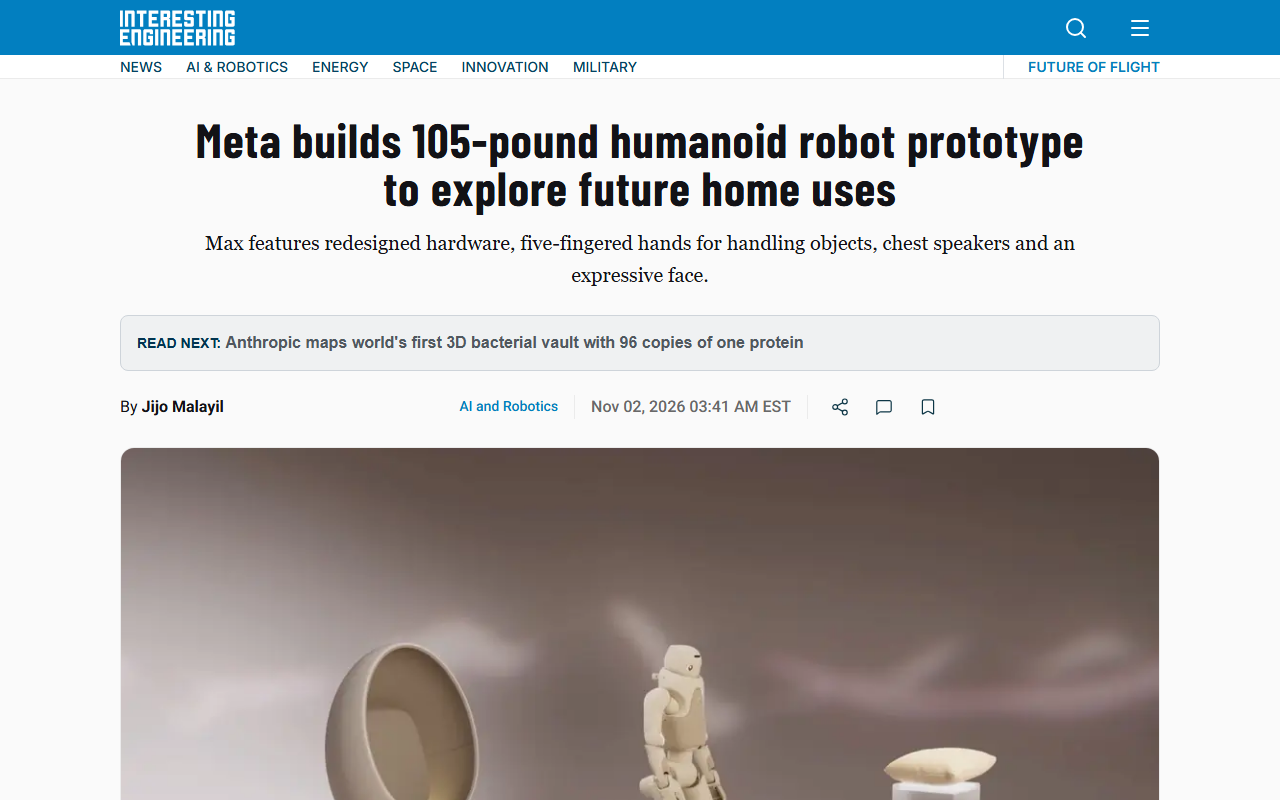
Max stands about 1.5 meters tall — roughly five feet — and weighs around 106 pounds. It has an expressive face display with animated eyes and mouth, chest speakers, and five-finger hands that pick up small objects like bottles and toys. Under the hood sits NVIDIA's Jetson Thor chip paired with a separate locomotion software stack. The design reuses hardware lessons from all three generations of Fourier's commercial robots, with Meta dictating changes to height, proportions, head shape, cameras, hands, and foot structure.
What it didn't build is a product. The prototype exists for internal experimentation only, and a Meta spokesperson was explicit: the work with Fourier is research, with no plans to sell these devices. There is no launch date for a consumer version; The Information's sources describe the goal as refining a future product. That restraint matters when 1X is already taking preorders for its NEO home robot and Figure is testing robots in real households.
How the Project Runs: Shanghai, Not Menlo Park
The organizational details in the report are as revealing as the robot itself. Two sources say Li-Chen Miller, Meta's vice president of product for robotics, spent nearly two months inside Fourier's Shanghai factory pushing the prototype along. Meta demonstrated Max to employees at an internal robotics summit at the end of August. The company has also hired supplier-development engineers in Shanghai and product-design roles in Shenzhen, with listings aimed at taking robots "from prototype to mass production."
Leadership has churned underneath all this. Marc Whitten, the former Cruise CEO who had run Meta's robotics group for about 18 months, left at the end of August. Ning Li now runs Meta Robotics Studio on an interim basis, reporting to CTO Andrew Bosworth, who took over Whitten's duties. Bosworth has reportedly described a humanoid internally as the physical embodiment of Muse — Meta's consumer AI agent — which frames the whole program as an assistant play, not a hardware play.
The Interaction Spec Tells You Who Max Is For
Max was built against a written list of household-interaction requirements that read like a consumer focus-group summary, a reminder that home robots are ultimately productivity tools: recognize a voice from five meters away, understand a gesture or wave at three meters, hold eye contact, and signal distinct states — listening, thinking, speaking, uncertain. Work on Max 2 started in September and targets the gaps between a lab demo and a useful machine: a redesigned torso, better hands, a projector module, more sensors, and improved stair handling.
Put the competitive landscape side by side and Meta's position becomes clear:
| Company | Flagship | Focus | Consumer status |
|---|---|---|---|
| Meta | Max (prototype) | Household assistant, Muse embodiment | Internal research only |
| Tesla | Optimus (third generation) | Factory first, home later | Not sold; Musk staked company's future on it |
| Figure | Figure humanoid | Home testing underway | Field trials, no retail |
| 1X | NEO | Consumer home robot | Open for preorders |
| Fourier (alone) | GR-1 / GR-2 / GR-3 | General robotics, rehab | Commercial units shipping |
Fourier's own history is instructive: its GR-1, unveiled at Shanghai's World AI Conference three years ago at 1.65 meters and 55 kg, was followed by mass production while Western consumer robots remain pre-commercial — a contrast on display when Chinese robot makers, Fourier included, drew crowds at CES 2026 (Xinhua).
The Import Problem Nobody Can Ignore
The trickiest part of the Max story is not technical. In July 2026, the U.S. Federal Communications Commission banned imports of new Chinese humanoid robots, citing supply-chain and cybersecurity concerns. Current rules still allow up to 4,000 devices for testing and development, as long as none are sold — precisely the lane Meta occupies. But an FCC draft rule proposed in August would cut that exemption to 40 units unless a company wins written approval for more. If it takes effect, batch-testing prototypes in the U.S. and sourcing components for any sellable product gets dramatically harder. Meta's spokesperson conceded the point obliquely, saying the company faces "the same realities as everyone else" in sourcing components not readily available domestically. Max is the most prominent American casualty-in-waiting in a geopolitical fight over Chinese robot supply chains.
- Key Takeaways:
- Meta built the Max humanoid prototype with Fourier in about three months; it is 1.5 m, ~48 kg, Jetson Thor-powered, and internal-only.
- Max 2 has been in development since September, adding a projector, better hands, and stair-capable sensing.
- The program is framed as giving Muse a physical body, with VP Li-Chen Miller embedded at Fourier's Shanghai factory for two months.
- FCC import restrictions on Chinese humanoids — and a draft rule shrinking the 4,000-unit test exemption to 40 — are the biggest external risk.
My Take / The Bottom Line
The signal here is that Meta thinks embodied AI is a distribution problem, not a hardware problem. Anyone can commission a 48-kilogram torso with a screen for a face — Fourier handed over a working prototype in a quarter. What Meta is buying is iteration speed at the intersection of Muse, on-device compute, and home-interaction design. My verdict: the robot is a prop; the agent is the product. The two things to watch are the FCC exemption rule, which could stall the whole program regardless of engineering progress, and whether Meta's leadership churn stabilizes — a robotics team on its third boss in two years rarely ships. Expect demos, patents, and hiring spikes through 2027, and nothing you can buy before 2028 at the earliest. If you're a developer, watch the embodied-AI toolchain space, because Meta will want an ecosystem the day Max ships.
FAQ
Q: What is Meta's Max robot?
A: Max is a humanoid robot prototype Meta built with Shanghai-based Fourier in roughly three months. It is about 1.5 meters tall, weighs around 48 kg, runs on NVIDIA Jetson Thor chips, and is designed for household interaction as a physical embodiment of Meta's Muse assistant.
Q: Can you buy Meta's Max robot?
A: No. Meta says Max is for internal research and experimentation only, with no launch date or plan to sell the device. A second prototype, Max 2, is in development.
Q: Why did Meta partner with a Chinese robot company?
A: Fourier has shipped three generations of commercial humanoids (GR-1, GR-2, GR-3) and could produce a working custom prototype fast. Meta's robotics VP spent nearly two months at Fourier's Shanghai factory during development.
Q: How do FCC rules affect Meta's robot plans?
A: The FCC banned imports of new Chinese humanoid robots in July 2026 but allows up to 4,000 units for testing and R&D. A draft rule from August would cut that exemption to 40 units, making large-scale testing and component sourcing far harder.