Why Chipmakers Bought Into Anthropic's $26B IPO Placement (2026)
Category: Industry Trends
Excerpt:
Anthropic's IPO roadshow opened with a $26B private placement: Google, Nvidia and five suppliers buying no-vote Class N stock. Here is what it changes.
This analysis was written by the aifreetool Editorial Team — a group of full-time AI-industry researchers and writers who verify every claim against primary sources. Last updated November 12, 2026. We keep no affiliate relationship with the companies covered here.
TL;DR: Anthropic launched its IPO roadshow on November 10 with 825 million Class A shares priced at $70 to $78 — and, buried in the same filing, a $26 billion placement for seven of its own suppliers. The chipmakers and cloud giants that sell Anthropic compute are now also its anchor investors. Quick answer: the placement de-risks the listing for underwriters Goldman Sachs and Morgan Stanley, but it deepens the vendor-financing loop that already makes investors uneasy. Here is the deal-by-deal breakdown, what ArtificialWatch's filing walkthrough confirms, and where the circularity argument actually bites.
The Offering, Line by Line
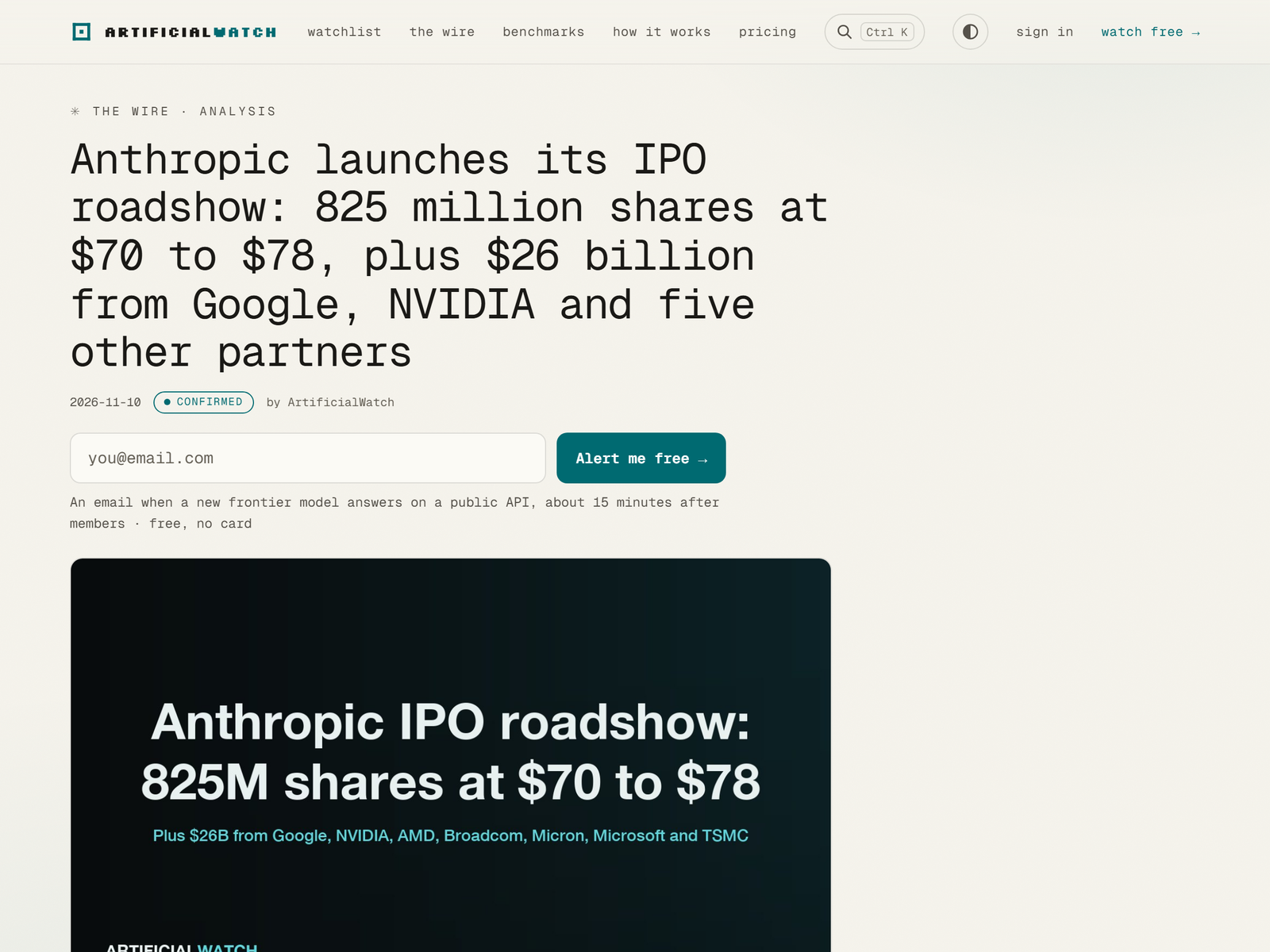
Anthropic's amended S-1, filed with the SEC at 11:29 UTC on November 10, puts 825,000,000 Class A shares on the table: 801,351,354 sold by the company and 23,648,646 sold by existing stockholders, whose proceeds Anthropic will never see. Underwriters hold a 30-day option on another 123,750,000 shares. At $70 to $78, the public offering raises $57.75 billion to $64.35 billion before fees — below the $86.2 billion SpaceX printed in its June listing, which means the "biggest IPO ever" headline is already dead. Anthropic has applied to trade on the Nasdaq Global Select Market under ticker ANT, with Goldman Sachs as lead bookrunner and Morgan Stanley as stabilization agent.
The private placement is the quieter, stranger half of the filing. Seven companies agreed to buy Class N common stock at the IPO price, closing only if the IPO itself closes. Share counts were set by dividing each commitment by the $74 midpoint:
| Buyer | Commitment | Class N shares (at $74) |
|---|---|---|
| $10.0B | 135,135,135 | |
| Nvidia | $10.0B | 135,135,135 |
| AMD | $2.5B | 33,783,783 |
| Broadcom | $1.0B | 13,513,513 |
| Micron | $1.0B | 13,513,513 |
| Microsoft | $1.0B | 13,513,513 |
| TSMC Partners | $0.5B | 6,756,756 |
Class N shares carry no voting rights except where law forces it, count as restricted securities, sit outside the registered offering, and escape the underwriters' lock-up. As Financial Express notes, Anthropic estimates net proceeds of about $84.6 billion at the midpoint from the offering plus placement, rising to roughly $93.7 billion if the greenshoe is exercised in full — about $3.8 billion of which is already earmarked for RSU tax withholding. Board-affiliated entities have flagged up to $303 million of non-binding interest, and retail brokerages from Schwab to Robinhood to SoFi are slated to receive up to 20% of Class A shares, an unusually generous retail allocation.
Your Suppliers Are Now Your Anchor Investors
Why would Google, Nvidia, AMD, Broadcom, Micron, Microsoft and TSMC Partners wire $26 billion into a customer's listing at the same price everyone else pays? Because Anthropic is already their largest invoice. The November 10 filing pegs total compute and infrastructure commitments at about $900.9 billion, up from $895.4 billion eight days earlier, with roughly $451.6 billion expected through 2030 and about $70.7 billion due within twelve months. Counterparties named in prior amendments include Broadcom at $161.2 billion, Google at $114.5 billion, AWS at $110 billion, Microsoft at $44.9 billion and Nscale at $44.6 billion.
The filing also connects the dots explicitly. Google's $10 billion subscription triggers options under its 2026 non-binding purchase agreement with Anthropic, reducing what remains available under it, and AMD's purchase partially satisfies buying obligations it owes under a separate hardware supply agreement. In plain terms: the money cycles. Anthropic signs multi-hundred-billion-dollar compute deals; its suppliers recycle part of that revenue into its equity; the equity raise funds the next compute deal. The business underneath is growing absurdly fast — third-quarter revenue hit $17.0 billion, up 1,127% year over year, nine-month revenue reached $33.2 billion against $2.5 billion a year earlier, and run-rate revenue touched roughly $81 billion on October 31, up $10 billion in a single month. More than 11,900 customers paid $100,000 or more over the trailing year, about 1,900 paid $1 million or more, and roughly 250 crossed $10 million. All of that revenue rides on Claude's enterprise foothold — see how the model itself is catalogued in our AI Chat tools directory. But the same filing shows nine-month operating losses narrowing to $1.3 billion from $5.2 billion only because pricing cuts and donation-matched compute distorted earlier quarters — the machine still burns cash it must keep raising.
Pricing, Trading and What Demand Looks Like
CNBC's sources put pricing on November 18 and first trading on November 19, and Bloomberg reported on November 11 that the book was already several times oversubscribed. At $78, the shares expected to be outstanding after the offering and placement imply a market value near $1.02 trillion; on the fully diluted count in the S-1, about $1.4 trillion. That is above the $965 billion post-money valuation from the May round and well below the $2 trillion bankers floated at midyear — a repricing, but not a collapse. If you want the demand-side mirror image of this listing, our Nscale vs CoreWeave analysis of the $45B Anthropic compute deal shows how much of this book is infrastructure pre-sold before a single share trades, and our earlier IPO vs OpenAI round breakdown tracked how both private marks got cut before this range was ever published.
My Take / The Bottom Line
The placement is a demand anchor, and there is nothing sinister about that — every large listing manufactures some version of it. What is genuinely new is the identity of the buyers: the companies Anthropic pays, not the ones that pay Anthropic. Underwriters love it because $26 billion of committed, IPO-priced demand means the deal cannot fail. Public investors should read it differently: Class N holders have an economic incentive to keep Anthropic buying their chips and clouds at current volumes, and no votes with which to object if strategy changes. My bottom line — the listing will probably clear comfortably, the first-week pop is likely, but the durable question is whether Anthropic can grow into a $900.9 billion commitment stack before the suppliers' patience or the credit markets test it. If you buy at the open, read the Class N conversion terms first; they, not the ticker, decide who the real customer is.
Key Takeaways
- 825 million Class A shares at $70–$78; ANT on Nasdaq; pricing expected November 18, trading November 19.
- Seven suppliers — Google, Nvidia, AMD, Broadcom, Micron, Microsoft, TSMC Partners — take $26 billion of no-vote Class N stock at the IPO price.
- Net proceeds of about $84.6 billion at midpoint, $93.7 billion with the full greenshoe.
- Compute commitments now total roughly $900.9 billion; buyers of the placement are also the largest creditors.
- Q3 revenue $17.0 billion (+1,127% YoY); run-rate revenue about $81 billion as of October 31.
FAQ
Will Anthropic's IPO beat SpaceX's fundraising record? No. At the $78 top of the range the public offering raises about $64.4 billion, under SpaceX's $86.2 billion. Total proceeds including the $26 billion placement can exceed $90 billion, but that figure mixes a registered offering with a private sale.
What are Class N shares? A non-voting share class created for the placement. Holders get the economics of common stock, can convert to Class A after qualifying transfers, and their purchase closes only after the IPO completes.
Why are chipmakers buying stock in their own customer? Anthropic owes them around $900.9 billion in compute commitments. Taking equity at the listing price aligns the suppliers with the buyer and anchors demand, while purchase agreements and supply obligations legally tie the investments back to future hardware spending.
How much stock can retail investors get? Up to 20% of Class A shares are earmarked for retail platforms including Schwab, Fidelity, Robinhood, SoFi and E*TRADE — far above the 5–10% typical for a listing this size.