Anthropic IPO vs OpenAI's Round: Why Both Valuations Got Cut (2026)
Category: Industry Trends
Excerpt:
Anthropic IPO valuation talks slid from $2 trillion to $1.2-1.3 trillion while OpenAI cut its raise to $11 billion at $1.25 trillion. Here is why both numbers moved.
This analysis was written by the aifreetool Editorial Team — a group of full-time AI-industry researchers and writers who verify every claim against primary sources. Last updated November 9, 2026. We keep no affiliate relationship with the companies covered here.
Quick answer: The Anthropic IPO has not been repriced by the company — it has been repriced by its buyers. Potential investors now discuss a valuation of $1.2-1.3 trillion, down 35-40% from the $2 trillion talk of early October, and OpenAI has closed roughly $11 billion of a round it once sized at up to $30 billion, at a $1.25 trillion valuation. One trigger sits behind both moves: the post-midterm tech selloff made trillion-dollar AI paper expensive to price.
Anthropic is supposed to start its IPO roadshow this week, with pricing targeted for the week of November 16 and a debut under the ticker ANT on Nasdaq. Instead of a victory lap, the Claude developer is walking into a price negotiation — and the two defining AI valuations of this cycle got marked down within days of each other. According to Bloomberg reporting on Friday, some potential Anthropic buyers now put the company at $1.2 trillion to $1.3 trillion, and a few will go only to $1.1 trillion. No final range exists yet, but the direction is clear: buyers moved, sellers have not.
Key Takeaways

- Investor expectations for the Anthropic IPO have fallen from roughly $2 trillion in early October to $1.2-1.3 trillion now, with some buyers at $1.1 trillion, per Bloomberg.
- The Nasdaq 100 dropped 6.4% on Thursday after the US midterms, erasing a record $2.3 trillion in one session.
- Anthropic's Q3 revenue came in at $16.96 billion, but sequential growth slowed from 144% to 47%, and the operating result swung from a $974 million profit to a $567 million loss.
- OpenAI closed about $11 billion at a $1.25 trillion pre-money valuation, well short of the up-to-$30 billion raise it sketched in September.
The Valuation Ladder: From $2 Trillion to $1.2 Trillion in Five Weeks

The repricing happened in three visible steps. In early October, investors floated $2 trillion for the listing — a number that would have made it the largest US tech IPO ever by market cap at listing, ahead of SpaceX's June debut at roughly $1.77 trillion. Then came Anthropic's October investor briefings, where the company disclosed preliminary Q3 revenue of about $16.8 billion, up 45% quarter over quarter. Impressive, but the quarter before had more than doubled sequentially. Buyers cut their mental math to $1.4-1.5 trillion.
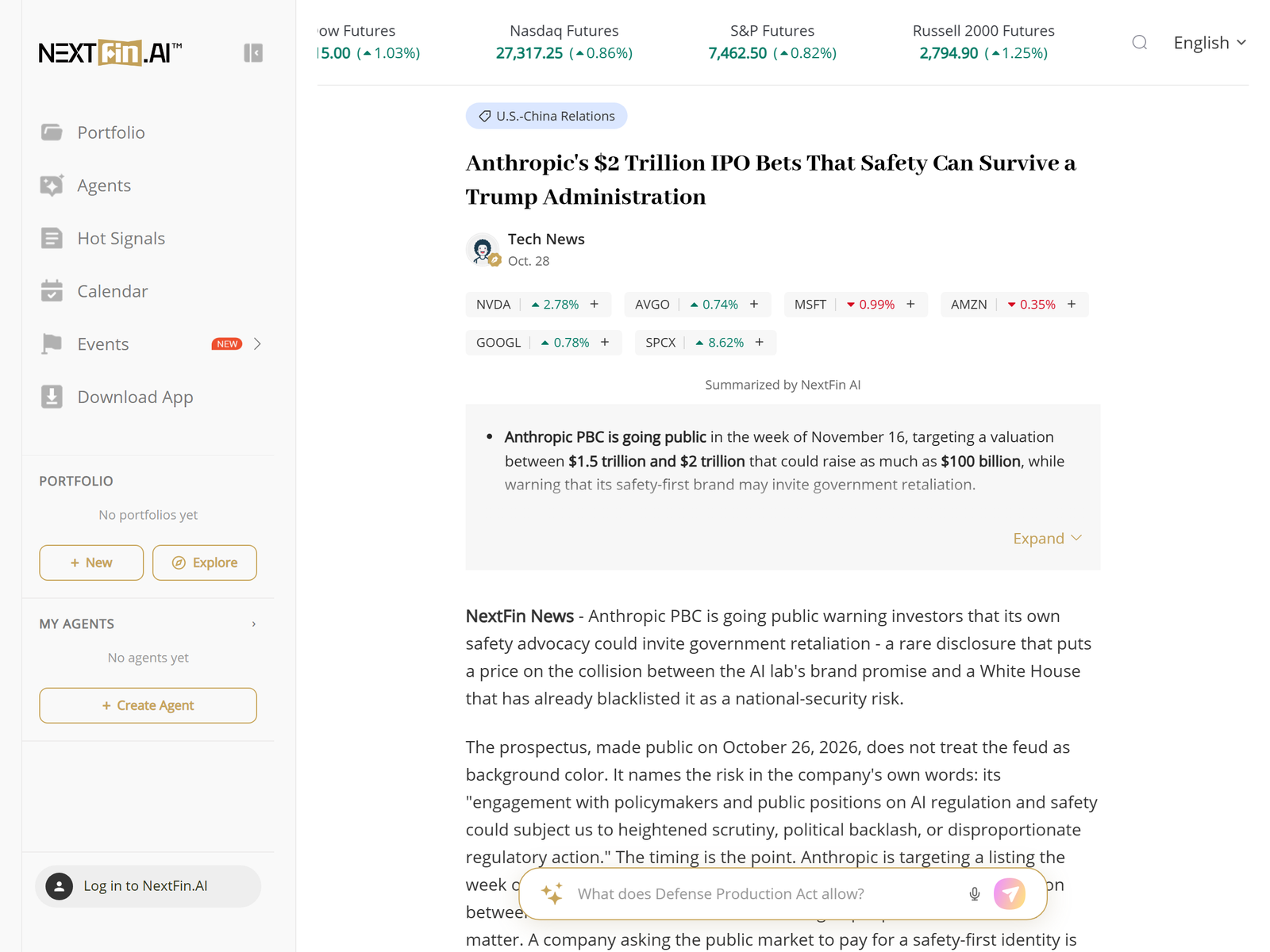
The third step was the market itself. After the midterms raised the odds of stricter data-center oversight, every AI-adjacent name sold off, and IPO expectations fell to the current $1.2-1.3 trillion band. As CoinPost Terminal and NextFin detail, the company filed its S-1 publicly on October 26 and carries compute commitments that make any demand miss expensive. For context: February's round closed at a $380 billion post-money valuation; May's priced at $965 billion.
What Broke: A Record Thursday for Losses
The proximate cause was mechanical. The Nasdaq 100 fell 6.4% on Thursday — a single-day record loss of $2.3 trillion in market value — and volatility spiked to levels not seen since spring of the prior year. Traders blamed the midterm outcome, which raised the odds of tighter data-center oversight. A company anchoring at $2 trillion the same week its peer group loses trillions is asking for a difficult book.
Anthropic's own numbers did not help the bulls. Final Q3 revenue of $16.96 billion slightly beat the preliminary figure, but growth decelerated sharply, the GAAP operating result flipped to a $567 million loss, and compute spending rose roughly $5 billion quarter over quarter. The S-1 also discloses about $895 billion in mostly compute-related commitments, close to $70 billion of which falls due within a year. None of this is fatal; all of it is why buyers want a discount.
The Analyst Split: Price Low or Wait
Everyone agrees the IPO happens; almost nobody agrees on the price. Stephan Kemper, CIO for BNP Paribas Wealth Management in Germany, expects pricing at the bottom of the original $1.5-2 trillion range, or 10-15% below $1.5 trillion. Michael Alfaro of Gallo Partners argued even before the selloff that the company needs to print at $1.3-1.4 trillion to build a quality order book. David Rainville of Sycomore Asset Management was blunter: at $1.2 trillion, finding buyers should be no problem. The most cautious voice, HSBC's Max Kettner, thinks something closer to $1 trillion is the safer print — his worry is the aftermarket, a SpaceX-style debut where the stock pops for hours and then sinks.
That caution has receipts. Cerebras Systems and Figma both raised more than planned after hot order books, and both still traded below offer. Morningstar's Michael Field counters that a postponed mega-IPO damages the valuation longer than a modest discount does.
| Deal | Peak talk | Current number | Size | Timing |
|---|---|---|---|---|
| Anthropic IPO | ~$2T (early Oct) | $1.2-1.3T discussed; some at $1.1T | Up to ~$100B raise reported | Roadshow this week; pricing week of Nov 16 |
| OpenAI raise | Up to $1.5T / $30B (Sept) | $1.25T pre-money | ~$11B closed of ~$20B target | Two tranches; IPO possibly by 2027 |
| SpaceX (reference) | — | ~$1.77T at debut | ~$75B raised | Listed in June; pop-then-drop cautionary tale |
OpenAI's Round Is the Control Group
The cleanest read on private-market appetite is OpenAI's ongoing raise, because it is the same asset class under the same macro. In September the plan was up to $30 billion at a valuation as high as $1.5 trillion. What has closed is about $11 billion at $1.25 trillion pre-money, with the total target cut by at least a third to roughly $20 billion across two tranches. The Emirati group MGX is expected to be the largest contributor, while SoftBank — among the most aggressive buyers in earlier rounds — is negotiating only a few hundred million this time. Cumulatively, OpenAI has raised around $180 billion over the past two years, nearly two-thirds of it this year.
Greg Brockman said on November 4 that an IPO by 2027 is plausible, and noted enterprise clients now supply the majority of revenue. Read together, the two companies describe one market: private capital will still fund frontier AI, but no longer at whatever number the last round printed. The compute bills behind those rounds flow through the infrastructure layer — see our Auriko AI inference gateway listing.
My Take / The Bottom Line
My read is that the valuation cut is healthy, not hostile. A $1.2-1.3 trillion print would still hand February's investors a more than threefold markup, so the sellers can live with it. What Anthropic cannot afford is a SpaceX-style fade after day one. I expect the bankers to anchor at the low end of whatever range they file and let the aftermarket celebrate. The signal for the rest of AI: valuation-by-press-release is closing, and the next year of funding gets priced off revenue quality and compute discipline. If you track AI names against the broader tape, our TrendSpider review covers the charting stack we use for this kind of watch; more coverage lives in our Industry Trends section.
FAQ
Q: When is the Anthropic IPO?
A: The roadshow is expected to begin the week of November 9, 2026, with pricing targeted for the week of November 16 and a Nasdaq debut under the ticker ANT before Thanksgiving. No price range has been filed yet.
Q: What valuation will Anthropic list at?
A: Nothing is final. Buyer expectations moved from about $2 trillion in early October to $1.4-1.5 trillion after October's briefings, and now $1.2-1.3 trillion per Bloomberg, with some at $1.1 trillion. HSBC argues around $1 trillion is the safer print.
Q: How much is OpenAI raising, and at what valuation?
A: About $11 billion has closed at a $1.25 trillion pre-money valuation, part of a two-tranche round of up to roughly $20 billion — down at least a third from the $30 billion target set in September. Greg Brockman said on November 4 that an IPO by 2027 is plausible.
Q: Why did AI valuations drop in November 2026?
A: The midterm outcome raised expectations of stricter data-center regulation, and the Nasdaq 100 fell 6.4% on Thursday, erasing a record $2.3 trillion in one day. Rising volatility made investors discount large IPO pricing across the AI sector.