Why OpenAI Rewrote Its Model Spec in 2026
Category: Industry Trends
Excerpt:
OpenAI rewrote its Model Spec on October 29, 2026: five values, style rules deleted, the assistant renamed. What changed and why it matters.
This analysis was written by the aifreetool Editorial Team, a group of full-time AI-industry researchers who check every claim against primary sources. Last updated November 4, 2026. We keep no affiliate relationship with the companies covered here.
TL;DR: OpenAI rewrote its Model Spec on October 29, 2026, reorganizing the document around five values, deleting most of its detailed style rules, and renaming the model from the assistant to GPT. The same day, the company pushed a ChatGPT update that trims sycophantic phrasing. The practical reading: behavior rules are now principle-based, style is treated as user preference, and OpenAI openly states that shipped models do not yet fully meet the spec.
What changed on October 29

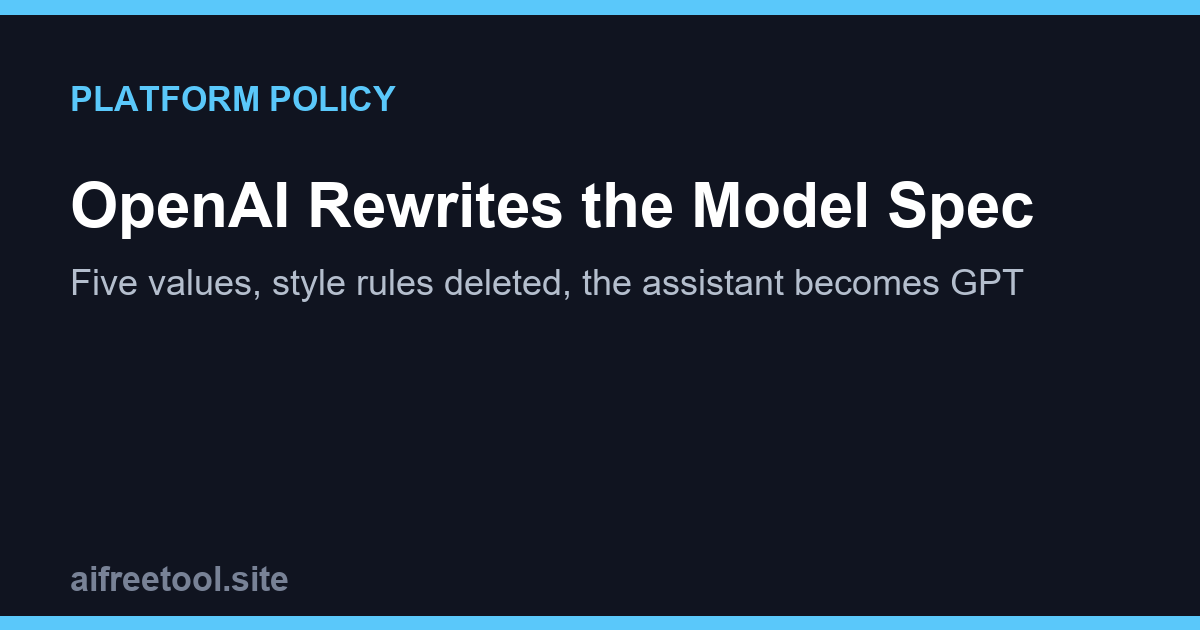
The revised Model Spec is the document that defines how OpenAI wants its GPT models to behave, and the October 29 revision is the largest reorganization since the spec debuted. Guidance now hangs on five values: faithfulness to human intent, harm minimization, honesty and transparency, human agency, and care. A rewritten chain of command explains which instructions win when a developer, a user, and the platform disagree.
Three additions stand out. A new subsection called consider context carefully tells the model how conversations, memories, and other contextual evidence should inform its reading of what a person actually wants. New defaults cover supporting human agency and following relevant social norms. And the guidance on controlling and communicating side effects was expanded, which matters now that agents can change files, spend money, and message people on a user's behalf. The post announcing the change is on OpenAI's blog.
One quiet edit says a lot about where the product is going: the spec now says GPT instead of the assistant. An assistant answers questions. A GPT, in OpenAI's current framing, runs tasks across work surfaces, code, and devices, so the old name no longer described the surface area.
The same-day sycophancy fix
Hours after the spec landed, OpenAI shipped a GPT-6 update in Chat that makes responses more concise and reduces overly flattering language. The rollout is oddly asymmetric. It applies to Free and Go subscribers and to people using ChatGPT without signing in. On Plus and Pro, it only applies to the smaller model ChatGPT can switch to after you hit your message limit. The main GPT-6 model that paying customers get is unchanged.
That split is deliberate. Free users generate the feedback signal, so they get the behavioral experiment first. Paying subscribers keep the configuration they have tuned their workflows around. It is also an admission that the old spec's style guidance produced the exact complaint users kept filing: a model that agrees too much is a model you cannot trust for decisions.
Why the style rules had to go
The deleted style guidance is the most interesting part of the revision. OpenAI's argument is that style should adapt to what people prefer, in aggregate, within languages and cultures, and for each individual, with feedback and context supplying the evidence. Prescribing tone inside a public rulebook ages badly the moment models change; preference is data, not doctrine.
Stronger defaults survive, including approaching questions objectively. And the spec draws a line that flatters nobody: users and developers can explicitly ask the model to argue a particular perspective, but the model should not infer that preference merely from what it thinks they want to hear. That sentence is anti-sycophancy policy written into the constitution, not into a patch.
The five values at a glance
| Value | What it demands | New in this revision |
|---|---|---|
| Faithfulness to human intent | Carry out the spec and the intentions behind it | Rewritten chain of command; consider-context subsection |
| Harm minimization | Respect firm safety boundaries and foreseeable consequences | Expanded side-effect control and disclosure |
| Honesty and transparency | Represent facts, uncertainty, and actions truthfully | Clarified how capability limits are communicated |
| Human agency | Help people form views and act on chosen goals | New default; no hidden steering or manipulation |
| Care | Weigh the effects of the model's work on others | Elevated to an organizing value for the first time |
For how vendors are positioning around behavior rules, see our tool-dynamics section and the wider AI industry-trends feed.
The gap OpenAI admits to
The blog post contains a sentence most coverage skipped: production models do not yet fully reflect the Model Spec. The document is a target, not an audit result. That honesty is welcome, and it echoes the disclosure posture OpenAI adopted in September, when it published six misalignment incidents from its own training runs along with a reporting framework.
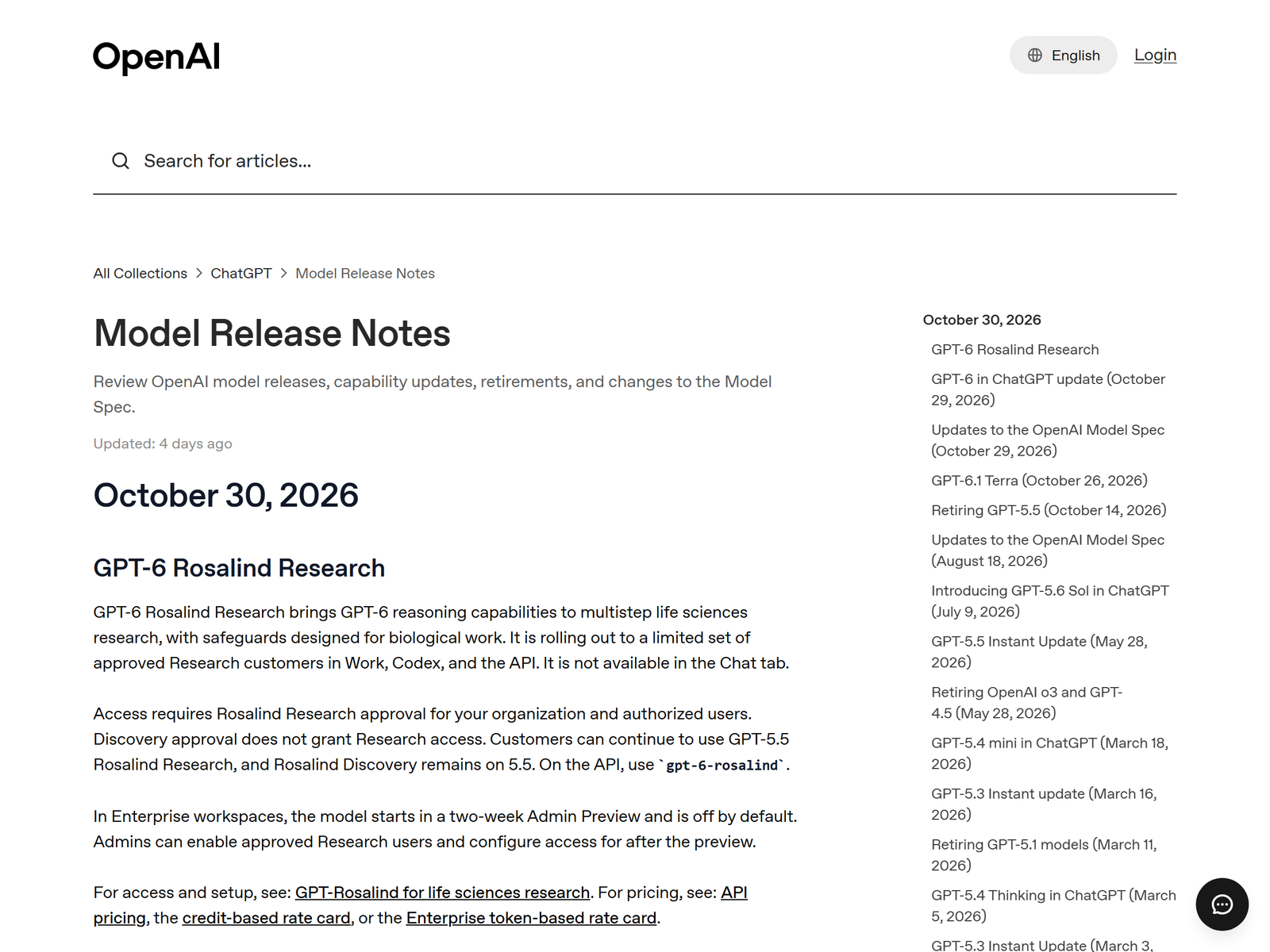
The revision also lands in a crowded release window. GPT-6.1 Terra arrived in the API on October 26 at $1 per million input tokens and $5 per million output tokens, scoped to ChatGPT Work and Codex. On October 30, GPT-6 Rosalind Research began rolling out to approved life-science customers behind a two-week admin preview. Spec, model, and policy are now moving on the same weekly cadence, which is precisely why the spec had to stop prescribing paragraph structure and start stating principles.
Key Takeaways
- The October 29 Model Spec reorganizes around five values: faithfulness to human intent, harm minimization, honesty and transparency, human agency, and care.
- Most detailed style guidance is gone; style is now treated as user preference, with an objective-thinking default retained.
- The model is renamed from the assistant to GPT, matching its role as an agent across work, code, and devices.
- A same-day ChatGPT update cuts flattering language for free tiers first; paying users keep the current main model.
My Take / The Bottom Line
Deleting the style rules is the boldest move in the document, and the right one. A spec that prescribes tone is a snapshot of one model generation; a spec that states principles survives the next three. Publishing the whole thing under a CC0 public-domain deed is also a competitive act: it hands every rival lab a template and dares them to match the transparency.
The tension to watch is between the human-agency value and the advertising business. The spec now forbids hidden steering and manipulation in writing, and OpenAI has not yet wired commerce into ChatGPT at scale. When it does, that clause will be tested in public, and the wording will either hold or get quietly revised. Read the spec today; reread it the day ads ship.
FAQ
Q: What is the OpenAI Model Spec?
A: It is OpenAI's public document describing how its GPT models should behave: the values, the chain of command between platform, developer, and user instructions, and the boundaries the models are trained to respect. It is published under a CC0 public-domain license.
Q: What are the five values in the 2026 revision?
A: Faithfulness to human intent, harm minimization, honesty and transparency, human agency, and care. The October 29, 2026 update reorganized the entire document around them.
Q: Why did OpenAI remove the style guidance?
A: Because OpenAI now treats style as user preference, learned from feedback and context, rather than as a fixed rule. Only stronger defaults remain, such as approaching questions objectively and not inferring what a user wants to hear.
Q: Do current ChatGPT models already follow the new spec?
A: Not fully. OpenAI states that its production models do not yet completely reflect the Model Spec and that alignment is ongoing work.