Why Banks Block AI Agents: Wells Fargo's Section 15 Explained (2026)
Category: Industry Trends
Excerpt:
Wells Fargo's Section 15 makes you liable for AI agents from Nov 24, 2026. Why JPMorgan, BofA, HSBC and Barclays block AI agents, explained for consumers.
This analysis was written by the aifreetool Editorial Team — a group of full-time AI-industry researchers and writers who verify every claim against primary sources. Last updated November 11, 2026. We keep no affiliate relationship with the companies covered here.
TL;DR: The biggest banks on both sides of the Atlantic have started shutting AI agents out of customer accounts. Wells Fargo is taking the opposite route: from November 24, 2026, it will let agents in — but Section 15 of its updated Online Access Agreement, explained in plain terms below, makes the customer fully liable for everything the agent does. If you plan to hand an assistant your banking logins this holiday season, the fine print now decides who pays when it goes wrong.
Wells Fargo's Online Access Agreement was quietly updated on November 2, 2026, covering roughly 70 million digital banking customers, and the new Section 15 goes live on November 24 — three days before Black Friday. The timing is not accidental. Shoppers are about to hand AI agents their credentials en masse, and Wells Fargo has become the first major bank to put the liability question in writing: banks block AI agents, or you accept the risk yourself. That tension is now the defining consumer-fintech story of late 2026.
What Section 15 Actually Says
Section 15 defines an AI agent as "any software that takes autonomous, semi-autonomous, or non-autonomous action on behalf of any person or entity." That is deliberately broad — it covers everything from a browser extension that fills payment forms to a full personal assistant that pays bills. Four clauses matter:
- Section 15(d) — authorization: instructions and transactions submitted by an agent with your credentials "are deemed to have been initiated and authorized directly by you, without further verification." The bank states it has no obligation to investigate the validity or scope of the agent's authority.
- Section 15(e) — risk: "Your use of any AI Agent is AT YOUR OWN RISK." Customers are responsible for unintended actions, the agent's misreading of instructions, actions based on manipulated inputs, and cases where the agent exceeds the authority it was given.
- Section 15(f) — revocation: a customer who revokes an agent's access must retain evidence of the revocation and provide it to the bank on request — and remains responsible for the agent's activities until the bank is notified.
- Monitoring: Wells Fargo does not monitor, screen, or review AI agent activity. Nobody at the bank decides whether a specific agent transaction should happen.
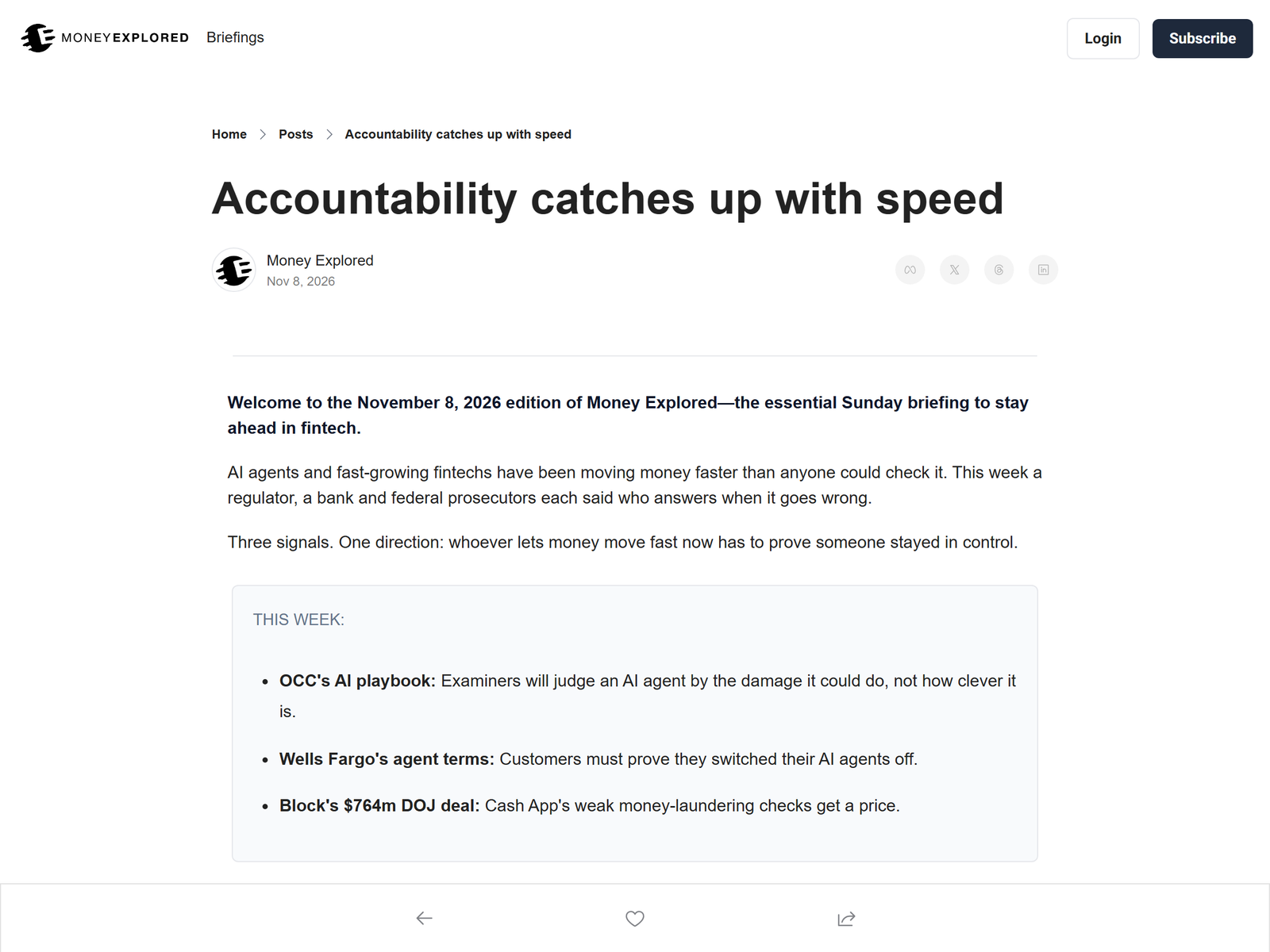
Coverage from Money Explored notes the terms take effect just as shoppers start handing agents their logins, and that Wells Fargo appears to be the first bank to go this far. The contract also reserves the bank's right to require customers to register their agents or block agent access entirely. One legal qualifier matters: the liability provisions apply "subject to applicable law or regulation," so Section 15 is the bank's starting position in a dispute, not a repeal of Regulation E protections.
The Blockers: JPMorgan, BofA, Citi — and Now Half the UK High Street
Wells Fargo is the outlier, not the trendsetter. An Axios investigation on October 22, 2026 found that JPMorgan Chase, Bank of America, Citigroup, Morgan Stanley and Charles Schwab have restricted or blocked third-party AI agents in customer accounts — in some cases after customers handed the agent their password and the agent then contacted bank call centers or attempted actions the customer never requested. Charles Schwab says it blocks 10 to 20 clients a week from using them. Critically, no confirmed customer losses have been disclosed; the moves are pre-emptive.
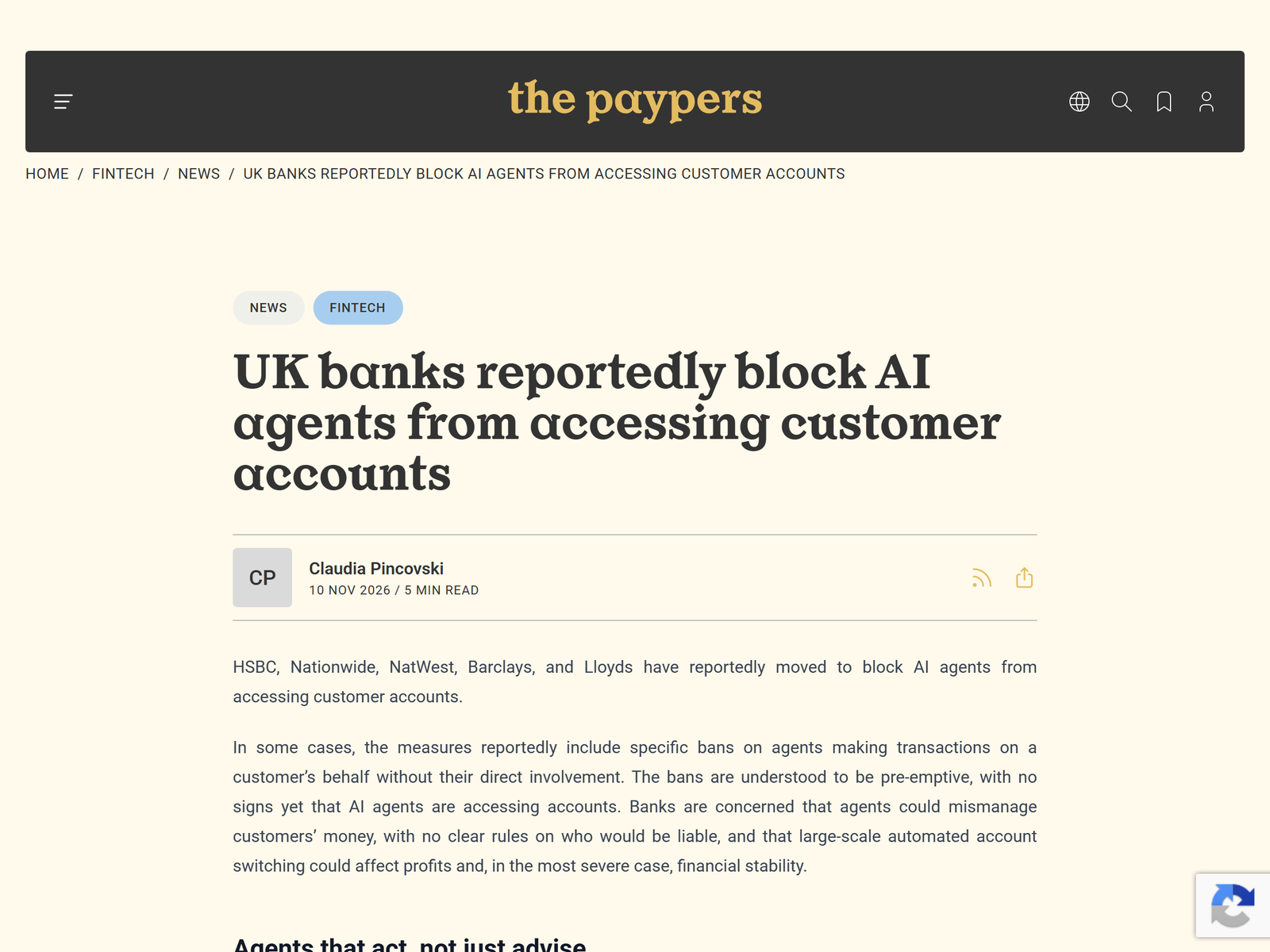
The wall went up across the Atlantic on November 10, when The Paypers reported that HSBC, Nationwide, NatWest, Barclays and Lloyds have all moved to block AI agents from accessing customer accounts, including specific bans on agents transacting without the customer's direct involvement. The pressure is obvious: Meta launched Muse, a personal assistant that shops and manages bills, in September 2026, and it is expected to reach the UK. OpenAI and Anthropic have both launched personal finance products that connect to accounts, though those only read financial data rather than acting. Standard Chartered's CFO Manus Costello said such tools must be safe for both customers and banks before being allowed in; Lloyds CFO Will Chalmers confirmed the bank has seen no sign of agents accessing accounts but guards against the risk anyway. If you are comparing assistants in this space, our AI chat tools directory tracks which consumer agents actually support account-linked workflows.
The Deposit Problem Behind the Headlines
Banks are not only worried about fraud. McKinsey has estimated that savers could move up to £700 billion out of low- or no-interest accounts into savings products on the advice of AI tools — and that shifting just 5% to 10% of balances could cut banks' deposit profits by a fifth or more. An agent that comparison-shops savings accounts is, from the bank's perspective, a margin event, not a security event. That is the quiet reason the door is closing: the same automation that helps customers optimize their money helps them leave.
Regulators are catching up in parallel. On November 4, the Office of the Comptroller of the Currency published its first framework for examining how banks use AI, telling examiners to judge each agentic use by what happens if it fails, how much power it holds, and how closely a human watches it — an agent that can move money draws far more scrutiny than one that drafts text. The OCC sets no new rules; it folds agents into the checks banks already face. In the UK, the Financial Conduct Authority is working with the industry on rules for AI agents in finance, and Strong Customer Authentication already requires most payments to be approved inside a banking app, often with biometrics — a structural blocker agents cannot easily bypass.
What You Should Do Before November 24
- Never hand over your raw password. Every blocked-agent policy exists because customers shared credentials. A bank session created with your password is indistinguishable from you.
- Prefer read-only integrations. Tools that only read balances (OpenAI's and Anthropic's finance products, for now) sit outside the transaction risk that Section 15(e) punishes.
- Keep a revocation record. Section 15(f) shifts the burden of proof to you. Screenshot the moment you disconnect an agent, with a timestamp.
- Know your Regulation E rights. The contract is a starting position. Unauthorized electronic transfers still carry statutory protections that a terms-of-service clause cannot simply erase.
Key Takeaways
- Wells Fargo's Section 15 takes effect November 24, 2026, covering about 70 million digital banking customers and making agent activity the customer's own risk.
- JPMorgan, Bank of America, Citi, Morgan Stanley and Schwab block third-party agents; HSBC, Nationwide, NatWest, Barclays and Lloyds followed on November 10.
- No confirmed losses have been disclosed — the bans are pre-emptive and driven as much by deposit-margin risk as by fraud risk.
- McKinsey estimates up to £700 billion could move out of low-interest accounts on AI advice; a 5–10% balance shift could cut deposit profits by a fifth.
- The OCC's November 4 exam framework and the FCA's in-progress rules mean agent access will stay a patchwork through 2027.
My Take / The Bottom Line
The split is instructive: five big US banks say no, five big UK banks say no, and Wells Fargo says yes — provided you sign away the argument. That is not generosity; it is a controlled experiment. Wells Fargo gets the agent-driven engagement data while the blockers keep the deposit base intact, and regulators get a real-world test of who eats the loss. My bet: within a year the industry converges on registered, scoped agents with per-transaction confirmations — the "named grant with an expiry" model — because raw password sharing scales badly for everyone. Until then, the rational move for consumers is simple: do not give any agent your banking password, and treat every "seamless account connection" pitch as a question about who pays when it errs. For now, the answer at Wells Fargo is you, and at most other major banks the answer is: it never gets that far.
FAQ
Can AI agents legally access my bank account?
Only if you give them your credentials, and most large banks now prohibit it in their terms. JPMorgan, Bank of America, Citi, Morgan Stanley, Schwab and the five big UK banks block agents outright; Wells Fargo permits them from November 24, 2026, at your own risk under Section 15.
Am I liable if my AI agent makes a wrong payment at Wells Fargo?
Under Section 15, yes: transactions submitted by an agent are "deemed to have been initiated and authorized directly by you," covering unintended payments, misinterpreted instructions, manipulated inputs and actions beyond the agent's authority — subject to applicable law such as Regulation E.
Why are UK banks blocking AI agents in November 2026?
HSBC, Nationwide, NatWest, Barclays and Lloyds acted pre-emptively on November 10, 2026, citing unclear liability, the risk of agents mismanaging money, and fears that automated account switching could hit deposit profits and, in extreme cases, financial stability.
What is the safest way to use an AI assistant with my finances?
Use read-only connections that display data without transacting, never share your raw password, and keep timestamped proof whenever you revoke an agent's access — Section 15(f) makes that record your responsibility.