Tidal AI Music Ban Review 2026: 27 Million Tracks Deleted
Category: Tool Dynamics
Excerpt:
Tidal will delete 27 million AI tracks from December 9, 2026. What the ban covers, how detection works, and why 96% of those songs had zero plays.
This review was written by the aifreetool Editorial Team — full-time AI-industry researchers who verify claims against primary sources, including the ones that undercut the story. Last updated November 25, 2026. We hold no affiliate relationship with any company named here.
Quick answer: Tidal will delete roughly 27 million tracks — 6.3% of its catalogue — starting December 9, 2026, and stop accepting new uploads that are entirely AI-generated. Music made with AI assistance and real human direction stays. The company says 96% of the targeted tracks drew zero plays in the past 90 days, which is both the justification for the purge and the reason it is cheap.
The deleted number is the easy headline. The uncomfortable one sits beside it: 43% of everything delivered to Tidal in the past 90 days was fully AI-generated, and on November 6 alone that share reached 60%. A catalogue-wide ban is what a platform reaches for when labelling quietly stops working.
What Tidal Announced, and What It Leaves Out
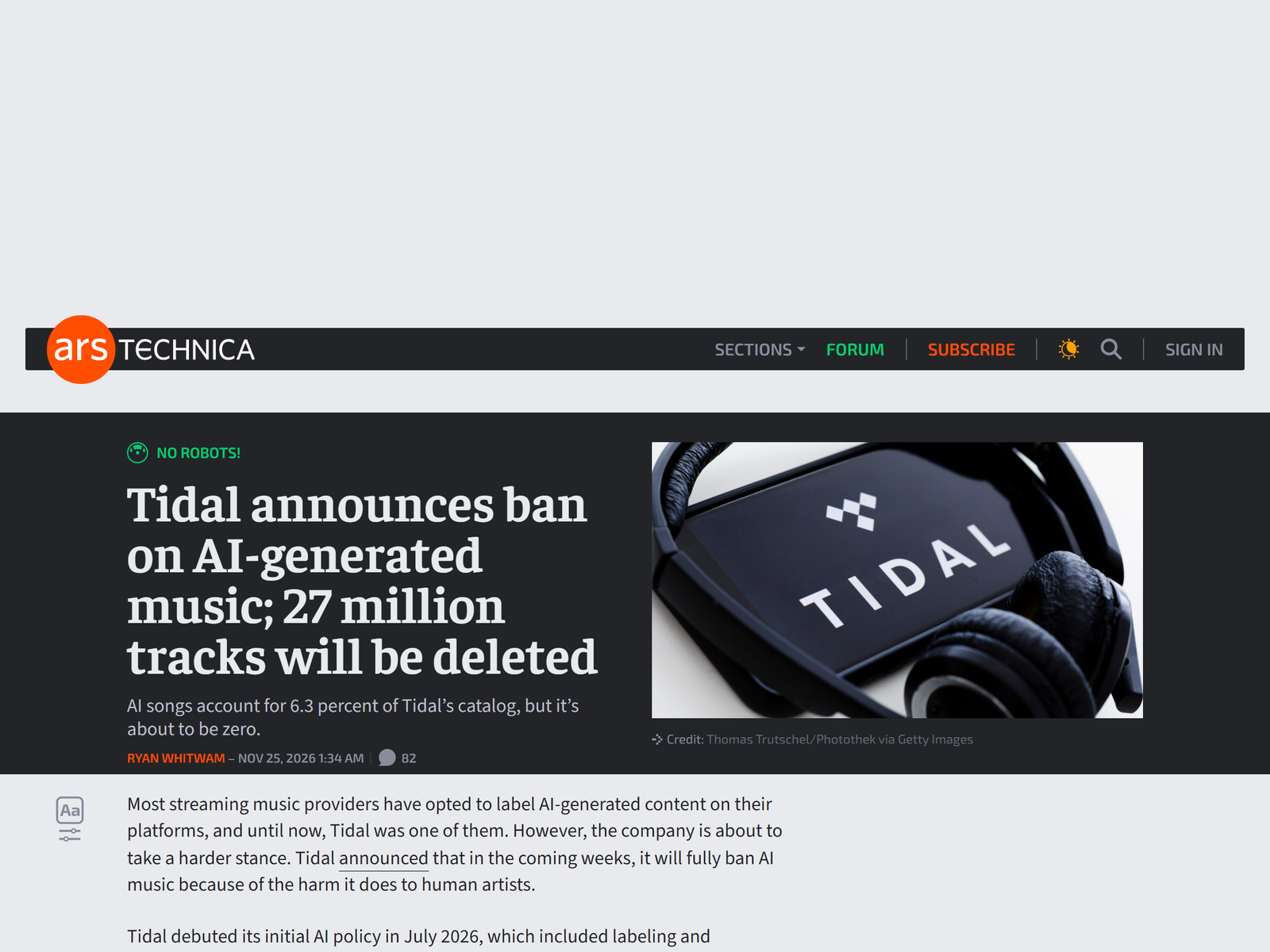
Robert Anderson, who leads Tidal at parent company Block, announced the policy on November 24 and confirmed the details to press the same day, as The Standard reported. Removal begins December 9 and should finish in early 2027. New rejections should run 80,000 to 85,000 tracks a day. Distributors are covered too, and any upload whose metadata names AI as the sole source gets rejected automatically.
This is the second attempt, not the first. A July 2026 policy labelled fully generated tracks and withheld royalties from them. Volume kept climbing anyway, which Anderson cited as the reason for going further. Ars Technica reports the numbers Tidal gave for the shift, including the 60% single-day spike.
The definition is narrow on purpose. Only music generated end to end by AI is removed. If a person wrote, played, sang or produced part of it, the track stays. That line is where every future dispute will land.
Why the Numbers Made This Easy
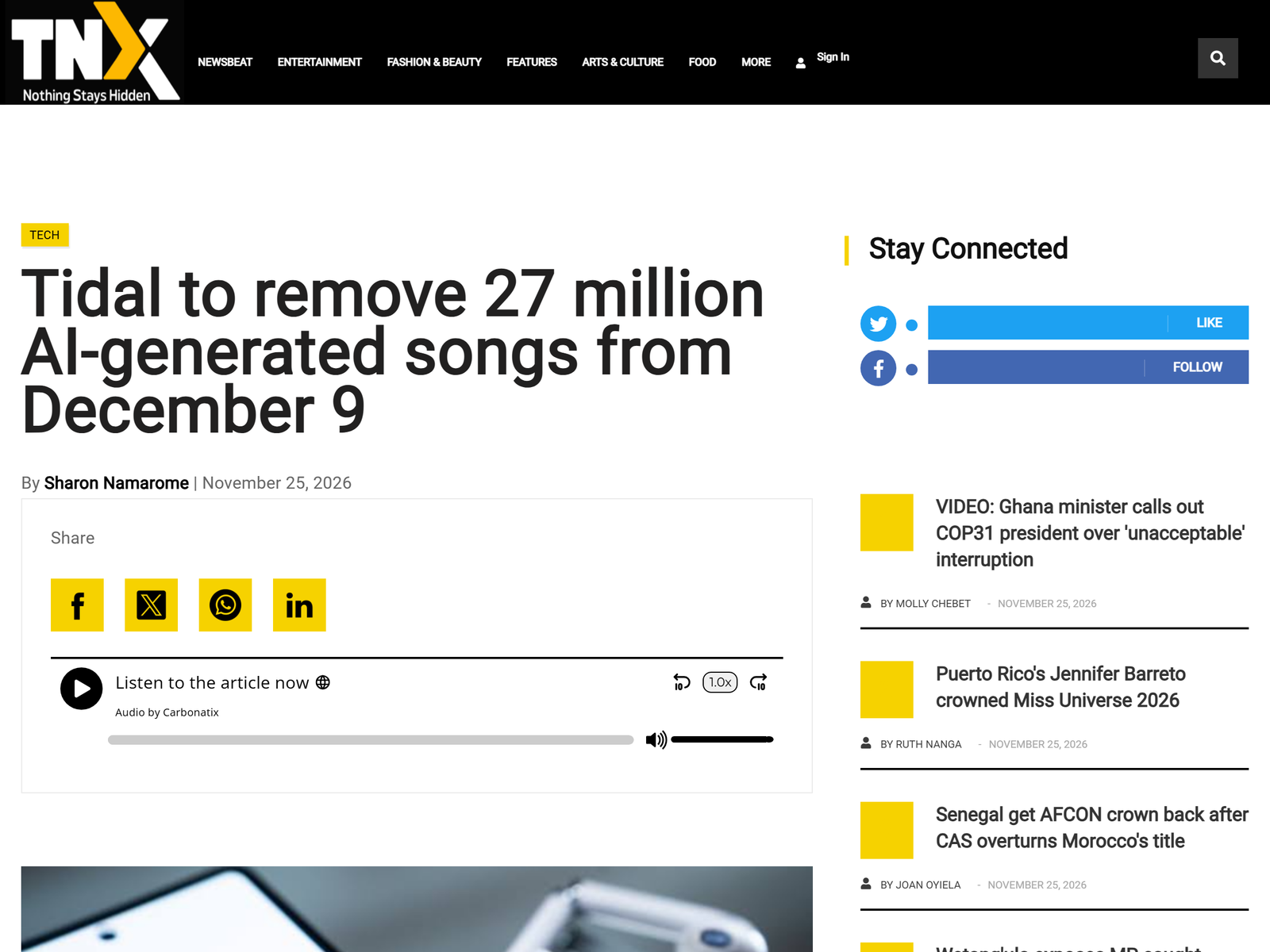
Deleting 6.3% of a catalogue sounds like self-harm. It is not, when the inventory is dead weight. Tidal says 96% of AI-labelled tracks had no streams in 90 days, so the removal costs almost nothing in listening time and frees a large amount of storage, metadata and recommendation surface for records people actually play.
| Metric | Figure | What it tells you |
|---|---|---|
| AI-tagged tracks in catalogue | 27 million (6.3%) | Scale of the cleanup |
| Share of uploads in last 90 days | 43% | Growth rate, not steady state |
| Single-day peak, November 6 | 60% | Bulk uploaders moving in |
| Tracks with zero plays in 90 days | 96% | Why deletion is cheap |
| Tracks pulled for impersonating artists | 66,000 | The fraud layer underneath |
Compare the neighbours. Spotify removed about 75 million junk tracks in 2025, but framed it as a spam cleanup rather than an AI policy. Deezer published numbers in April 2026 showing pure AI tracks took 1% to 3% of platform plays while up to 85% of their own plays were flagged as fraud. Bandcamp banned sales of wholly or mostly AI music outright, though its traffic is small enough that nobody outside music noticed.
The Fraud Layer Nobody Puts in the Press Release
Streaming royalties come from a shared pool split by plays. Every fake play on a fake track takes money from a real one, and AI made that arbitrage cheap enough to industrialise. US musician Michael Smith uploaded hundreds of thousands of AI tracks, ran bot streams against them, took more than $8 million, and was sentenced to 18 months in prison in 2026. Apple Music disqualified roughly two billion manipulated streams from payouts in 2025.
That is the argument Tidal keeps returning to: the harm is not bad taste, it is a transfer of money from working artists. The 66,000 impersonation takedowns fit the same story, and they happened before this ban.
Detection Is Where This Gets Fragile
Tidal is working with Ircam Amplify, the music-tech spinout from French research institute Ircam, on identification. It has help: about 94% of the AI tracks on the service come from Suno, which added watermarking earlier this year, and Google's Lyria models carry SynthID. Watermarks are the cheapest path to a defensible deletion, because you are matching a signature rather than guessing at style.
Watermarks also miss things. Open music models run on a local GPU with no signature attached, and some cloud providers do not watermark at all. Deezer claims its own detector holds a false-positive rate under 0.01%, a claim worth testing before anyone copies it. Tidal has not published its false-positive rate, its appeal path, or what happens when a human-made track gets flagged. Those three omissions are the real test of the policy, and they will be tested within weeks of December 9.
Who Wins, Who Loses
Independent artists and distributors win visibility. Tidal wins a defensible position as the platform that draws a line, which fits a service with no free tier and above-market pricing. Ircam Amplify wins a reference customer. Bulk uploaders and the least careful aggregators lose their cheapest distribution channel.
Listeners are split, and it is worth being precise about how split. A Luminate survey found 24% comfortable with AI-created original songs and 45% uncomfortable, while 42% said knowing a track was AI-made reduced their interest. Yet the virtual artist Xania Monet, built by poet Jones, charted on Billboard radio monitoring in November 2025 and took artist, song and album of the year at the first US AI music awards this November. Audiences will accept AI in the chain. They will not accept it as the whole chain.
For anyone building on these tools, our Suno listing covers what the platform actually produces, and the Lyria 3.5 page covers the DeepMind model whose output now carries SynthID. Our tool dynamics section tracks how platforms change the rules under them.
My Take / The Bottom Line
This is a catalogue-cleaning exercise wearing a principle, and that is fine. It works because the inventory being deleted was worth nothing: 96% zero plays is not an artist community, it is landfill with metadata. The moral framing is real, but the business case is what made the decision easy, and both are true at once.
What the ban does not fix is supply. Attackers and bulk uploaders follow the weakest filter, so the volume moves to whichever service still accepts it, and Spotify's labelling approach looks more attractive to them by the day. The trade-off Tidal accepted is simple: a smaller catalogue that listeners can trust, against being the only platform that has to argue about false positives in public. That argument starts in two weeks. Watch the appeal process, not the announcement.
Frequently Asked Questions
Does Tidal's ban cover music made with AI tools?
No. Only tracks generated entirely by AI are removed. Songs where a person wrote, performed or produced part of the work remain eligible, though uploads whose metadata names AI as the only source are rejected automatically.
When exactly do the deletions start?
December 9, 2026, with the catalogue cleared by early 2027. Tidal expects to turn away 80,000 to 85,000 new AI tracks per day once the policy is live.
Will listeners notice?
Mostly not. Tidal says 96% of the 27 million flagged tracks received no plays at all in the previous 90 days, so the audible change should be small.
Can the detection be beaten?
Yes, for now. Watermarking from Suno and SynthID from Google covers most of the current supply, but locally run models leave no signature. Any platform enforcing this rule is committed to an ongoing detection race.