GPT-6 Protein Design Review: What the Onava Lab Test Proved (2026)
Category: Tech Deep Dives
Excerpt:
OpenAI says GPT-6 designed proteins that bound in the lab: 35 of 322 hits. We check the preprint, the 0.38 TM-score gap and what it means for drug discovery.
This analysis was written by the aifreetool Editorial Team — full-time AI researchers who read the preprint, the blog post and the outside commentary before writing a word. Last updated November 26, 2026. We hold no affiliate relationship with OpenAI, Onava, or any company covered here.
Quick answer: On November 24, 2026, OpenAI published a preprint claiming its GPT-6 family can design protein shapes and sequences using reasoning and ordinary code, without calling specialised biology models. In wet-lab tests with partner Onava, 35 of 322 protein designs (10.9%) bound their targets. That is real but below the 19% the specialist tool RFdiffusion reported in its original paper — and specialised models still supplied the sequences.
Strip the branding away and this is the most interesting protein-design result of the year, for a reason OpenAI does not lead with. The headline is that a general model did chemistry. The substance is that the interface — plain language, steerable constraints, one model instead of five tools — may be worth more than the hit rate, and that OpenAI published a losing benchmark in the same document.
What OpenAI Actually Claimed
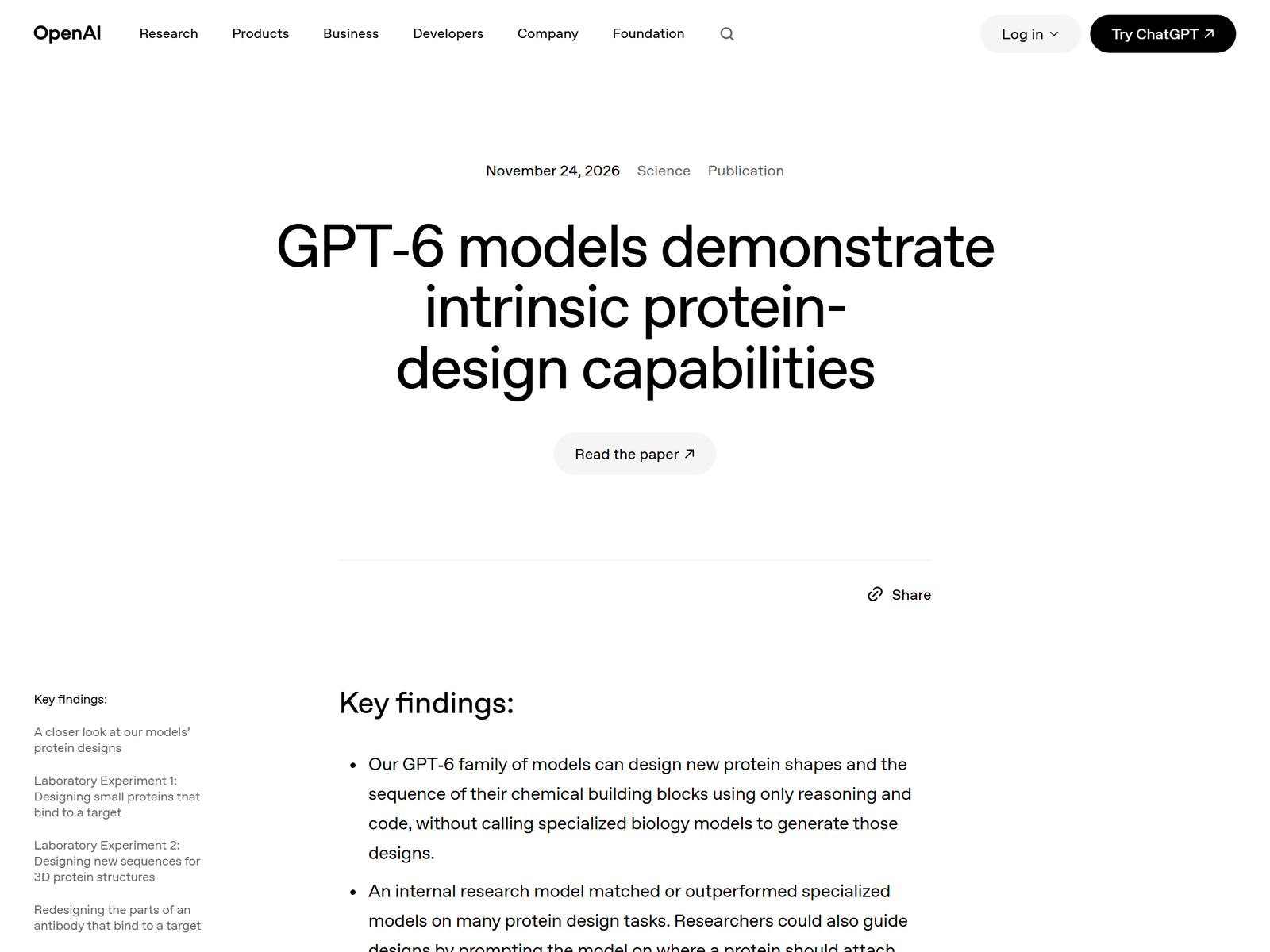
The preprint is titled GPT-6 as a Universal Foundation Model for Protein Biology: Beyond Specialized Models. The claim is narrow and defensible: for generating designs, GPT-6 models need only reasoning and general-purpose coding tools. They write and execute code to explore shapes, they accept constraints in prose ("five coiled sections", "bury this residue at the interface"), and they switch tasks by changing the prompt rather than retraining. The OpenAI research post states that an internal model matched or beat specialists on most of 14 protein tasks.
What the claim is not: end-to-end autonomy. In the lab pipeline, a specialist model called SolubleMPNN turned GPT-6.2's three-dimensional backbones into amino-acid sequences, and other specialists — Boltz-2, OpenDDE, ESMFold2 — filtered candidates before anything was synthesised. OpenAI says so plainly, which is more than most vendors do.
The Lab Numbers, Including the Bad Ones
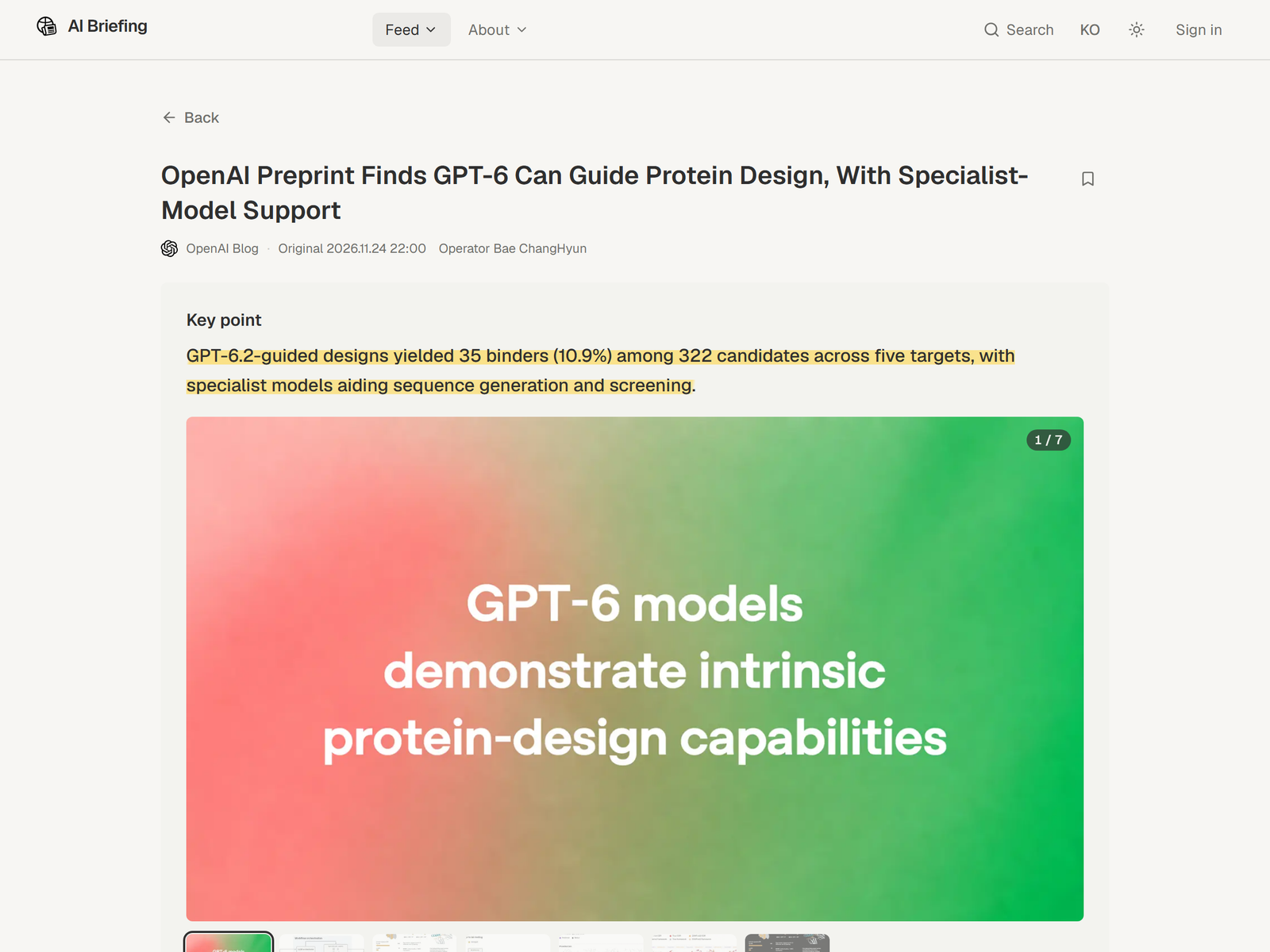
Onava built 322 minibinders from GPT-6.2 designs across five targets. Thirty-five bound: 5 for PD-L1, 3 for IL-7Rα, 1 for TrkA, 8 for VEGF-A and 18 for IL-17A. Every target produced at least one hit. In a second experiment the model rewrote sequences for existing binders with the originals hidden — MDM2 75 of 88 (85%), VEGF-A 26 of 42 (62%), PD-1 8 of 59 (14%) — while changing a median 43%, 50% and 15% of residues respectively. Antibody work looked better still: 128 of 182 redesigned nanobody loops (70%) kept binding IL-4Rα, and 179 of 272 therapeutic-antibody fragments (66%) kept binding PD-1 or PD-L1 despite roughly half their loop residues being swapped.
Then the number OpenAI did not have to publish. Full structure prediction from sequence remains a chasm: mean TM-score was 0.16 for GPT-5.6, 0.26 for GPT-6.2, 0.38 for the newest internal model, against 0.93 for ESMFold2. Anything under 0.5 fails to capture the overall fold, so this is not a gap of a few points — it is a different category of capability. OpenAI's own phrase for it is a "jagged capability frontier", and AI Briefing's itemised summary is the cleanest place to see the seams.
Key Takeaways
- 35 of 322 designs bound their targets (10.9%) across five proteins, with at least one hit per target.
- Redesigning existing scaffolds works far better than inventing new ones: 70% and 66% retention on antibody loops, 85% on MDM2 sequences.
- Computational wins, experimental losses: 43.7% on MotifBench versus 27.8% for RFdiffusion, but a lower wet-lab hit rate than RFdiffusion's original 19%.
- Specialist tools are still in the loop. SolubleMPNN wrote the sequences; Boltz-2 and ESMFold2 did the filtering.
- Biosecurity is now a pricing input, not an afterthought: GPT-6.2 Astra already carries a High biological rating under OpenAI's Preparedness Framework.
Where the Benchmarks Actually Land
The computational results are genuinely strong in specific places. On 30 MotifBench tasks, 43.7% of the newest internal model's designs satisfied both motif preservation and overall shape, against 27.8% for RFdiffusion — while GPT-6.2 itself scored slightly below RFdiffusion on raw three-dimensional design. On PoseBusters small-molecule docking, GPT-6.2 reproduced the observed binding pose in 93% of predictions and the internal model 96%, against 50% for DiffDock-L. Antibody-protein docking quality (mean DockQ) climbed from 0.05 at GPT-5.6 to 0.81 at the internal model.
Read that as a capability that is unevenly distributed rather than absent. It is excellent at reasoning about an interface it can see and mediocre at inventing a fold from scratch. That is precisely why the antibody-loop numbers are the story: 70% retention while rewriting half the binding loops is the kind of result medicinal chemists care about, because it maps onto real affinity-maturation work.
Outside scientists are not convinced the ability is biology. Nature's reporting on the same day quotes Martin Paçesa, a structural biologist at the University of Zurich, saying that "in most cases, a specialist will always perform better than a generalist for a given task", and notes that some researchers suspect memorisation of public structures. OpenAI concedes the point about training data in its own limitations section. Our write-up of GPT-6's offensive-security results ran into the same reviewer split: striking numbers, no independent replication.
My Take / The Bottom Line
The interface is the product. If a scientist can say "block this interface, bury this residue, keep the fold" and get a synthesizable candidate back, the bottleneck moves from tool expertise to lab throughput — and lab throughput is a problem money can solve. That is a bigger deal than a 10.9% hit rate, and it is why OpenAI is pairing protein design with an explicit biosecurity frame.
The honest verdict, though, is "promising, unproven". One preprint, one lab partner, no external reproduction, and a hit rate below the specialist baseline it is being compared to. Compare DeepMind's AlphaGenome line, which builds the model for the biology instead of prompting a generalist into it. Both approaches will exist in 2027; only one has a validation record. Watch the follow-up: harder targets, and whether the designs do anything after binding. Binding is attachment. Medicine is not.
Frequently Asked Questions
Did GPT-6 really design proteins on its own? Partly. GPT-6.2 generated the three-dimensional backbones without a specialist design model. Specialist models then supplied amino-acid sequences and screened candidates before Onava synthesised them. OpenAI describes the work as a proof of principle, not an end-to-end pipeline.
How does 10.9% compare with existing tools? The original RFdiffusion paper reported about 19% success across 95 designs against five targets, including IL-7Rα. OpenAI attributes the gap partly to how strictly designs were filtered and how binding was defined, which is a fair caveat and also an admission that the comparison is not apples to apples.
Is a binding protein a drug? No. Binding shows attachment. Specificity, stability, biological activity, manufacturability, safety and efficacy all remain unproven, and OpenAI lists testing those as future work.
Should this worry people about biosecurity? It is the right question. GPT-6.2 Astra carries a High biological rating under OpenAI's Preparedness Framework, and the same reasoning that shortens a drug-design cycle could shorten a harmful one. The company says safeguards and evaluation are part of the release path; independent scrutiny of that claim is thin.
Where can I try GPT-6 for research work? Through OpenAI's API and the GPT-6 Astra product line. For biology-adjacent reading, our tech deep dives archive collects the benchmark-level breakdowns. The Times of AI report is a good independent round-up.