Google Suncatcher Orbital Data Center Review 2026
Category: Tech Deep Dives
Excerpt:
Google's Suncatcher orbital prototype ran Gemma 4 on a TPU in low Earth orbit and sent a haiku home. The launch economics still do not close until 2035.
This analysis was written by the aifreetool Editorial Team — a group of full-time AI-industry researchers and writers who verify every claim against primary sources. Last updated November 1, 2026. We keep no affiliate relationship with the companies covered here.
TL;DR: Google's Suncatcher orbital prototype ran the Gemma 4 model on a Tensor Processing Unit in low Earth orbit on October 30, 2026 and sent a haiku back to a ground station over Svalbard, Norway. The token cost was about $0.000012. The satellite carrying it costs roughly $7,000 per kilogram to launch at today's retail rate. The economics only close if launch drops to $200 per kilogram, and Google does not expect that until around 2035.

The poem arrived on a Friday and the internet did what the internet does. What got less attention is the number underneath it. At the $200 per kilogram launch price Google says it needs, orbital compute amortizes to roughly $810 to $7,500 per kilowatt-year. US data centers pay about $570 to $3,000 per kilowatt-year for electricity alone. Those ranges overlap, and that overlap is the entire thesis of putting data centers in space.
What Actually Happened Above Svalbard
The prototype lifted off on October 1, 2026 on a SpaceX Transporter-18 rideshare, built with imaging company Planet. Engineers spent three weeks on a commissioning checklist — powering the host, powering the TPU trays, running early machine learning tests — before uplinking the first real prompt this week.
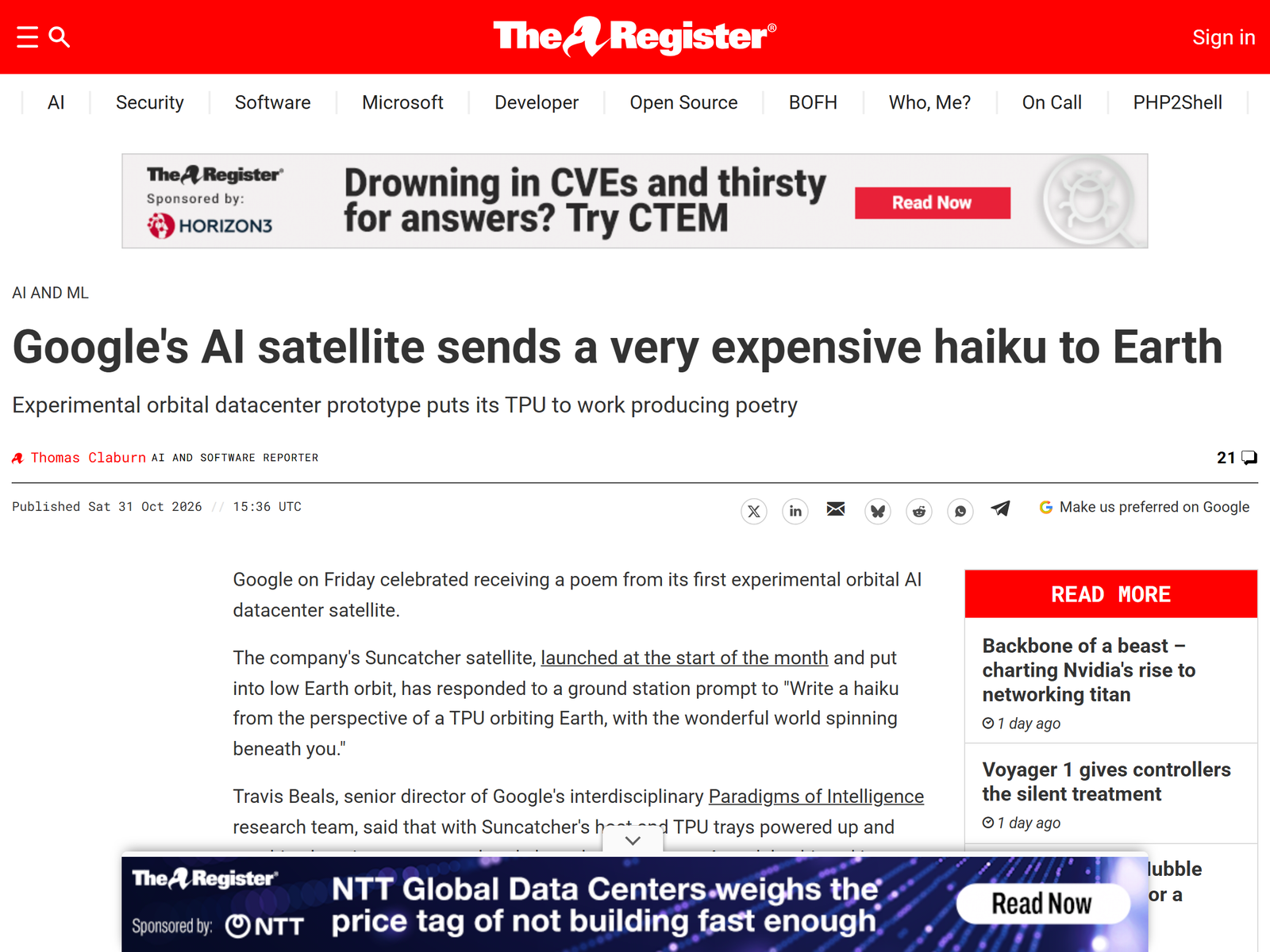
That prompt asked the onboard model to "write a haiku from the perspective of a TPU orbiting Earth, with the wonderful world spinning beneath you." The answer came down as the satellite passed over Norway's Arctic archipelago:
Blue marble below,
Data streams in silent grace,
Starlight feeds my core.
Travis Beals, senior director of Google's Paradigms of Intelligence research team, called it the project's "Hello World" moment in a blog post summarised by TechCrunch. After the haiku came space-themed limericks and, more usefully, prompts asking the payload to report its own technical status — how you would monitor a rack nobody can walk up to.
Four TPUs, about one kilowatt of generation, with power and thermal budgets tight enough that only one runs at a time, for roughly twenty minutes per session. That constraint reframes the problem: not a compute deployment but a scheduling exercise, where the workload must fit inside a ground-station pass window.
The Haiku Costs Nothing. The Orbit Costs Everything.
Twenty output tokens on Gemma 4 26B, priced at $0.15 per million input tokens and $0.60 per million output, comes to roughly $0.000012 through the Cloud API, as The Register worked out. Now amortize a 500-kilogram satellite at a retail launch price near $7,000 per kilogram and the same poem costs somewhere between a few dollars and several million, depending on how you treat hardware that can never be serviced.
Google's own paper is more disciplined, and its framing is narrower than the headlines. The claim is not that orbital data centers are cheap now. It is that at $200 per kilogram, launch cost spread across a satellite's useful life lands in the same range as a US power bill, and orbital solar has no fuel line, no weather, and no interconnection queue.
| Suncatcher economics | Figure |
|---|---|
| Current retail launch price | ~$7,000 per kg |
| Launch price needed for parity | $200 per kg |
| Amortized launch at $200 per kg | $810–7,500 per kW-year |
| US terrestrial electricity | $570–3,000 per kW-year |
| Google's expected date for $200 per kg | ~2035 |
| Estimated Starship flights to get there | ~1,800 |
That price is not a product anyone can buy. Google is betting SpaceX reaches it around 2035, on the trajectory reusable rockets have followed for a decade. A peer-reviewed analysis by the Suncatcher researchers estimated Starship needs roughly 1,800 flights to deliver the learning-driven cost reductions earlier vehicles achieved. Alphabet also holds a significant stake in SpaceX, which makes this a hedge on a supplier's manufacturing curve.
Radiation Is the Real Test, Not the Poetry

A chip in orbit gets hit constantly. Google ran its Trillium Cloud TPU and an AMD host server through a 67 MeV proton beam on the ground to find out how badly. High-bandwidth memory was the weak point, showing irregularities after a cumulative total ionizing dose of 2 krad(Si) — only about three times Google's minimum requirement for survival at 750 rad(Si).
For inference, the numbers hold up. Silent data corruption appeared at roughly one event per 17 rad of dose. At an estimated 150 rad(Si) per year in orbit, that works out to about one corrupted inference in three million at one inference per second. For training, Google is blunt: the impact of single-event effects on training jobs "requires further study."
Why Two Satellites in 2027 Is the Milestone That Matters
The next step is a pair of interconnected satellites in 2027, with optical links and higher power generation. That is the real test. One satellite running inference is a curiosity. A cluster that splits a model across two spacecraft and reassembles the output is infrastructure.
Google has said it is designing for fleets of more than eighty satellites flying in close formation. Rivals work from different assumptions. SpaceX asked the FCC in January for authority to launch up to one million satellites for orbital data centers, while Starcloud and Cowboy Space plan inference on single satellites and skip the interconnect entirely.
The differentiator is not compute. It is the right to be wrong about the cost curve early, while hardware is cheap to iterate.
- Key Takeaways:
- The Suncatcher prototype ran Gemma 4 on an orbital TPU and returned a haiku on October 30, 2026 — the first inference response produced in space by a data-center-class chip.
- A 20-token haiku costs $0.000012 through the API. The satellite that produced it costs about $7,000 per kilogram to launch.
- Break-even sits at $200 per kilogram of launch cost, roughly 1,800 Starship flights away on Google's own model.
- Radiation testing suggests about one corrupted inference in three million. Training effects remain unmeasured.
My Take / The Bottom Line
Best for: workloads with loose latency requirements and no data-residency home — batch inference, satellite imagery triage, and eventually models too large to move. Trade-off: every one of those workloads already has a terrestrial answer that costs less today, and orbital capacity cannot be repaired, upgraded or expanded on a quarterly cadence.
Google spent real money to prove a chip survives orbit and got a marketing asset for free. That is a good trade. What it did not prove is that space is cheaper than Iowa. The honest version of this story is a company buying optionality on a launch price that does not exist yet, from a supplier it partly owns, a decade before the price is supposed to arrive.
Our infrastructure coverage lives in the tech deep dives hub, and the model that flew is profiled on the Google Gemini tool page. For the grid constraint it is trying to escape, see why AI data centers want 100GW of grid space.
FAQ
Q: Did Google really put a data center in space?
No. It launched one prototype satellite carrying four TPUs with about one kilowatt of generation and ran a small model for roughly twenty minutes at a time. A data center implies sustained, repairable, scalable capacity. This is a test article.
Q: How much did the haiku cost?
About $0.000012 in token fees at Gemma 4 26B list pricing. The honest number is launch cost: roughly $7,000 per kilogram at retail, so the poem's real price depends on how you amortize the spacecraft.
Q: When will orbital data centers be cheaper than terrestrial ones?
Google's published model needs $200 per kilogram to low Earth orbit before launch amortization matches US electricity costs. Google expects that around 2035, and estimates roughly 1,800 Starship flights to push costs that far down.
Q: Does radiation destroy the chips?
Not for inference. Ground testing with a 67 MeV proton beam suggests about one silent data corruption event per three million inferences at expected orbital dose rates. High-bandwidth memory degrades after 2 krad(Si), about three times Google's minimum survival requirement.