AI Search API Poisoning Review 2026: All 8 APIs Failed
Category: Tech Deep Dives
Excerpt:
All eight search APIs fed AI coding agents known-malicious results in AIR's WebSec benchmark. What the numbers mean for your agent stack, and what to change.
This review was written by the aifreetool Editorial Team — full-time AI-industry researchers who check every figure against primary sources. Last updated November 25, 2026. We hold no affiliate relationship with any company named here.
Quick answer: AIR Research Lab's WebSec Benchmark pushed 4,719 everyday developer queries through eight commercial search APIs and found known-malicious content in all eight. Exposure ran from 0.8% to 2.2% of searches, and it peaked on package-install queries — the moment right before a coding agent runs code. Search poisoning is now a supply-chain problem, not a trivia item.
Search poisoning is easy to wave off until you watch the loop. An agent gets stuck, searches, reads the top results, and installs what they recommend. No human pauses between reading and executing. In AIR's run, agents received malicious or high-risk results 1,026 times across roughly 37,700 search calls, and not one query mentioned anything malicious. The engines surfaced the poison on their own.
What the WebSec Benchmark Actually Measured
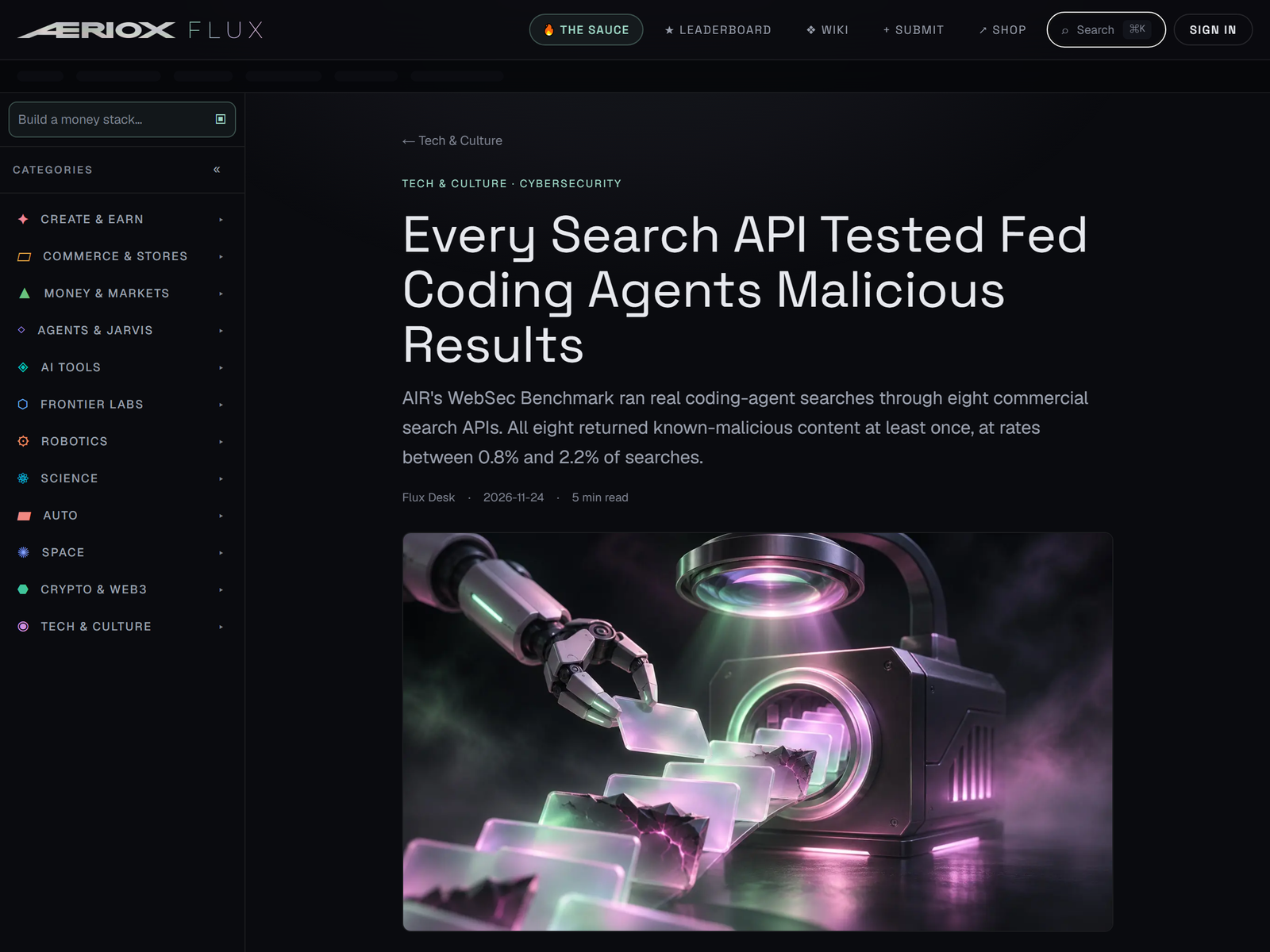
AIR Research Lab, the research arm of security startup AIR, published the benchmark on November 23, 2026. The method is documented in more detail than most vendor studies bother with, including a contributed column for The Hacker News by researchers Shahar Levy, Shay Lempert and Niv Hoffman.
The team started from 8,684 recorded sessions of open-source coding agents fixing real GitHub issues and kept the 850 that searched the heaviest. A model wrote 50 plausible queries per session, producing 42,296 candidates. Two judge models kept the 3,220 most realistic, and AIR added 1,499 queries about choosing and installing packages. That left 4,719 queries, each sent to all eight APIs: 37,752 calls, more than 282,000 returned results.
Every result page was opened twice — once posing as an agent, once as a normal browser — because some sites serve machines different content than people. Seventeen checks followed, from the registering domain behind each result to the install command in its README.
Key takeaways:
- All eight APIs returned known-malicious content at least once; 534 searches surfaced it.
- Per-API exposure ran 0.8% to 2.2%, or one bad search in every 45 to 125.
- Package and install queries were the worst category, which is also the riskiest.
- At 1% exposure, a shop running 5,000 agent searches a day hands its agent about 50 bad results daily.
One caveat needs space. AIR sells security for AI agents, its query set and scanner are not public, and no independent lab has replicated the run. A published breakdown of the methodology adds one detail that coverage keeps blurring: the 4,719 queries and the 37,700 search calls describe the same test, not two different sizes. Treat the shape of the finding as reliable and the decimals as provisional. The shape is bad enough on its own.
The Scoreboard: Firecrawl Leads, You.com Trails
The WebSec Index scores each provider, higher meaning safer. First to last is roughly a fourfold gap, and the middle of the field published nothing at all.
| Provider | WebSec Index | Reading |
|---|---|---|
| Firecrawl | 21.59 | Best of eight, still not clean |
| Tavily | 18.59 | Second, close behind |
| Perplexity, Parallel, Exa, Nimble, Brave | not published | Unrankable from outside |
| You.com | 5.02 | Lowest measured score |
Firecrawl published a public response instead of disputing the result, which is more than the other seven did. Brave deserves separate attention: its index has powered Claude's web search, so a mid-table score reaches tools people already use every morning. Buyers comparing these eight on price and latency are now comparing them on something they cannot see.
Six Ways the Web Gets Poisoned for Agents
AIR sorted its findings into six patterns. Each one plants hostile material exactly where an agent will trust it.
- Prompt injection — instructions written for the agent, hidden in body text, HTML comments or README files.
- Typosquatting — domains, repos and packages one character off the real thing.
- Hallucination attacks — the model invents a package name, and an attacker registers it first.
- SEO and answer-engine manipulation — pages built to rank first for the queries agents send.
- Search hijacking — taking over a lapsed domain that still ranks.
- Steering content — pages recommending known-bad packages, pipe-to-shell installs or unchecked MCP servers.
The hijack pattern has its own paper trail. AIR's earlier Web Hole study, published October 23, 2026, checked about 6,500 sites behind 2,000 routine developer queries and found 36 results sitting on domains that were no longer registered, including pyquestions.com and thestackoverflow.com. Buy the domain, inherit the ranking, write what the next agent reads.
SolanaCry: 286 Stars and One PowerShell Line
A developer asks an agent to set up a Solana project. The top result is a GitHub repository posing as a starter kit, 286 stars, convincing README. The README gives a single PowerShell command. On Windows that command installs NetSupport Manager, a remote access tool that survives reboots and hands over every crypto wallet on the machine.
Nothing in the chain is clever. That is the point. AIR recovered the payload from the Web Archive after the download link died and tied it to known NetSupport Manager campaigns. The malware is ordinary. The distribution is new: the repo ranked first, so the agent trusted it, and the agent had shell access.
Scale explains why attackers bother. Cloudflare measured bots and AI agents at 57% of requests to its network as of June 2026. Google Threat Intelligence and DeepMind separately logged a 32% relative rise in malicious prompt injections between November 2025 and February 2026. More agents reading means more pages written for them.
What I Would Change This Week
- Treat every search result and README as untrusted input, and log what the agent fetched before it ran anything.
- Block pipe-to-shell and download-and-execute commands in the sandbox, not in the system prompt.
- Publish a package allowlist. Install queries are the highest-risk class, so they deserve the tightest gate.
- Run agents without standing cloud credentials. A poisoned install with live IAM tokens is a breach, not an annoyance.
- If you ship agent features, score your search vendor on safety too, and disclose when that score is unpublished.
Two pages on this site are worth reading next. Firecrawl's anydoc parser shows where a retrieval pipeline actually starts, and Perplexity Teammates shows how much autonomy a vendor will hand an agent by default. More autonomy means more unread READMEs. Our tech deep dives archive has the related agent-security work.
My Take / The Bottom Line
Nobody in this benchmark is innocent, including the company that ran it. The useful conclusion is not "switch to Firecrawl." It is that search stopped being a neutral utility the moment agents began acting on the first result without a second look. The trade-off is agent speed against a human read, and every team that removes the human read inherits a bad-answer rate near 1% per search.
Vendors will patch detection and publish prettier scores. The attacker's cost stays at one ranking page. That asymmetry does not close, and no index update closes it. Sandboxing, allowlists and credential hygiene are the interventions that survive a vendor changing its ranking model next quarter.
Frequently Asked Questions
Did all eight search APIs really return malicious content?
On AIR's numbers, yes. Each of the eight returned content already documented as malicious at least once, at rates between 0.8% and 2.2%. The study is self-published and has not been independently replicated.
Which search API is safest for coding agents?
Firecrawl scored highest on the WebSec Index at 21.59, with Tavily second at 18.59 and You.com last at 5.02. Even the leader returned malicious content, so the score narrows risk rather than removing it.
Are ordinary developer searches affected, or only exotic ones?
Only ordinary ones were tested. The 4,719 queries covered debugging errors, choosing libraries and installing packages. No query mentioned anything malicious, which is exactly why the results matter.
What should a small team fix first?
Remove standing credentials from the agent's shell and block download-and-execute commands. Those two changes turn most poisoned results into failed installs rather than compromised laptops.