WatchGuard VPN Review 2026: Private Self-Hosted Firewall Edge
Category: Best Privacy VPN
Excerpt:
WatchGuard VPN Review 2026: Firebox mobile VPN with SSL, IPsec and IKEv2 keeps remote access private on a firewall you own and control.
Reviewed by the aifreetool testing team. Last updated November 2026. WatchGuard VPN is the remote-access and site-to-site encryption built into WatchGuard Firebox firewalls and Fireware. This privacy review looks at why an organization would terminate VPN tunnels on a firewall it owns instead of routing staff traffic through an outside consumer provider. The core idea is control: identities, policies, and connection records stay on equipment your team administers.
TL;DR
WatchGuard Firebox supports mobile VPN with SSL, IPsec, L2TP, and IKEv2, plus Branch Office VPN for linking sites in hub-and-spoke, full-mesh, or partial-mesh layouts. Because the gateway is your own firewall, authentication, segmentation rules, and logs stay under your control rather than with a third-party VPN brand. Best for: small and mid-sized organizations, often served through a managed service provider, that want a private self-hosted remote-access edge. The trade-off is that this is firewall infrastructure sold through partners, not a lightweight privacy app you install in minutes.
How We Tested
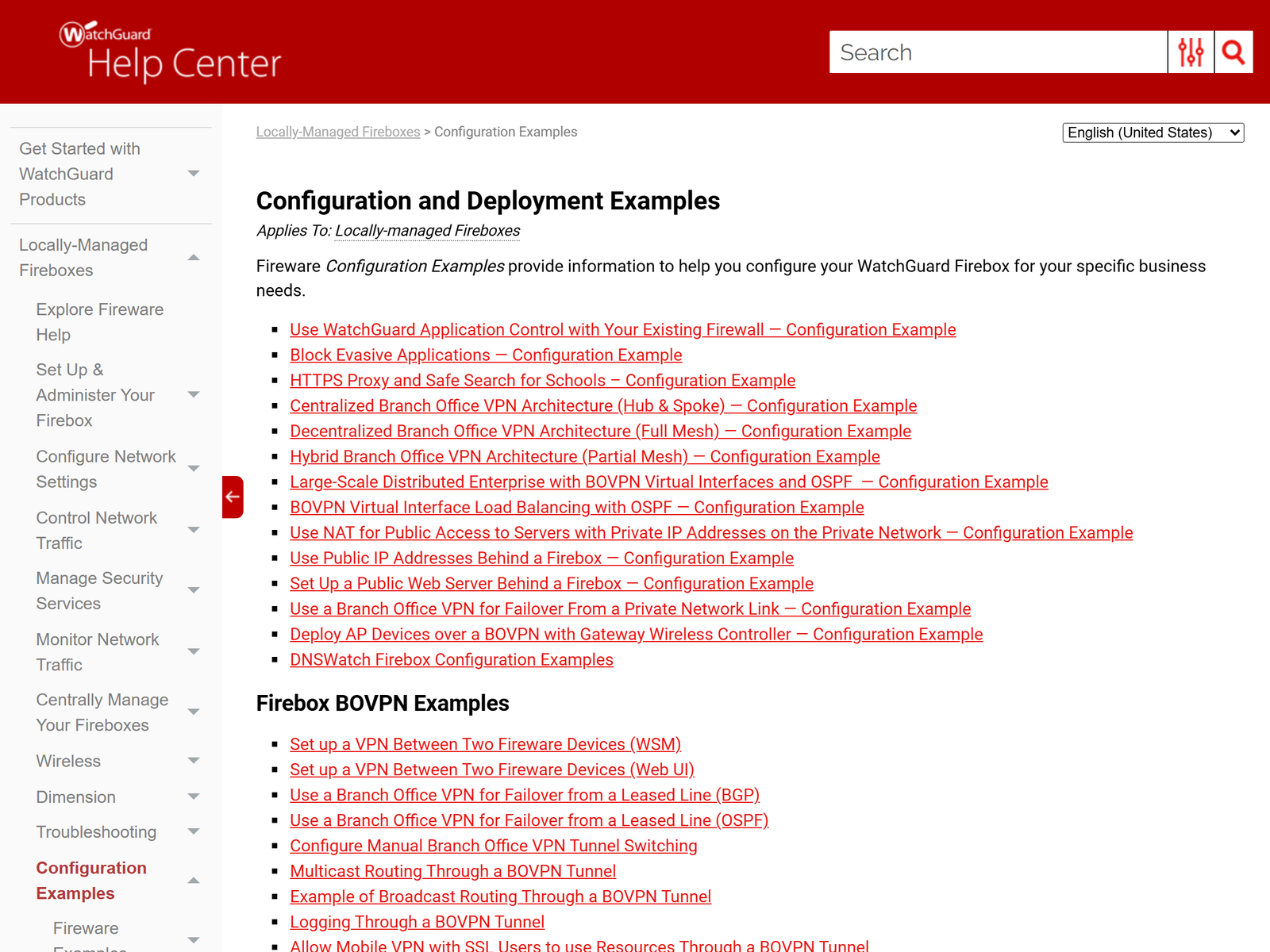
We read WatchGuard's public Fireware documentation on mobile VPN configuration, branch office VPN examples, and network segmentation, then checked the company's current product overview. We compared the ownership model with other self-hosted options already reviewed in this category. Our focus was which VPN protocols are available, how policies restrict what a remote user can reach, and where logs and keys reside. We did not operate a live Firebox for this review, so we describe documented capabilities rather than a measured speed result.
Speed & Performance
VPN encryption happens on the Firebox, so throughput depends on the appliance model, the chosen protocol, and the internet path to the user rather than a single advertised figure. SSL VPN is often the easiest to deploy because it works through common web ports, while IKEv2 and IPsec suit managed devices and stable site links. Branch Office VPN examples cover hub-and-spoke and full-mesh designs, letting administrators pick a topology that matches latency needs. Configuration guidance also warns against overlapping VPN address pools with home networks, a practical detail that prevents silent routing failures.
Security & Privacy
The privacy case rests on ownership. Because the VPN terminates on your Firebox, tunnel keys, user groups, and connection records live in your environment instead of with an outside provider. Policies can be narrowed so a mobile VPN group reaches only the DNS server or application it needs, rather than the entire network by default. Authentication can use the local Firebox database or an external directory such as Active Directory, and certificates can be issued from your own public key infrastructure. Be candid about the limit: a self-hosted firewall is not an anonymity tool, and we do not treat it as an independently audited no-logs consumer service.
Streaming & Unblocking
WatchGuard VPN is built for reaching your own network, not for switching a streaming region. A lawful everyday use is connecting to the office firewall from hotel or cafe Wi-Fi so that email, files, and internal tools travel inside an encrypted session. We do not describe any method for bypassing regional content controls, and we do not market the Firebox as an unblocking device. If catalog access while abroad is your priority, a consumer streaming review is the right place to look.
Device Compatibility
The range of mobile VPN protocols covers a mixed fleet. SSL, IPsec, L2TP, and IKEv2 clients are available across major desktop and mobile platforms, so administrators can choose the method that fits each device and management policy. Site-to-site links connect Firebox appliances and can extend to cloud or branch appliances through the documented topologies. Multi-tenant administration through WatchGuard Cloud gives managed service providers a single console for many customers, which matters because the company sells primarily through a partner network rather than directly to end users.
Pricing & Value
WatchGuard does not sell a simple month-to-month consumer VPN plan. Firebox hardware, Fireware licensing, and security subscriptions are quoted through an authorized reseller or managed service provider, and the final cost depends on appliance size and the services enabled. For a business that already needs a firewall, adding remote-access VPN on the same device is good value because identity, inspection, and logging share one platform. The trade-off is partner-led procurement and the need for someone qualified to configure policies — there is no $0 free tier here, and value comes from consolidation rather than a cheap sticker price.
Pros & Cons
- Pros: SSL, IPsec, L2TP, and IKEv2 mobile VPN, flexible branch office topologies, granular per-group policies, and logs and keys on your own firewall.
- Cons: Partner-led sales and support, real configuration complexity for newcomers, and no simple consumer subscription or free tier.
How WatchGuard Compares
| Option | Role | Privacy model | Best for |
|---|---|---|---|
| WatchGuard Firebox | Firewall VPN | Keys and logs on your gateway | SMB and mid-market |
| Sophos Firewall | Firewall VPN | Self-hosted edge | Home and small office |
| SonicWall | Firewall VPN | On-premises control | SMB remote access |
For another firewall-owned gateway, see our Sophos Firewall review, or read the SonicWall review for a comparable approach. All three appear in our Best Privacy VPN category.
Frequently Asked Questions
Which VPN protocols does the Firebox support?
Mobile VPN options include SSL, IPsec, L2TP, and IKEv2, with Branch Office VPN for site-to-site links.
Where are connection logs kept?
On the Firebox and the management tools your team operates; they are not handed to an external VPN provider.
Can I limit what remote users reach?
Yes. Policies can be narrowed to specific user groups and resources instead of allowing access to the whole network by default.
Is this an anonymous browsing tool?
No. It encrypts access to a gateway you control; it does not promise anonymity from your internet provider.
My Take / The Bottom Line
WatchGuard VPN is a privacy-minded, self-hosted remote-access edge for organizations that would rather keep identities, policies, and logs on their own firewall than trust a consumer VPN brand. Its limit is that someone must operate the device. Explore more in our Best Privacy VPN category, or read the Cisco Secure Client review for another governed approach.
Who Should Use WatchGuard VPN
WatchGuard suits small and mid-sized businesses, frequently with a managed service provider, that want encrypted access to their own systems from public Wi-Fi. An administrator can give remote staff a policy-controlled route into internal tools while keeping authentication and logs at the office edge. It is a poor fit for an individual who wants a point-and-click app with no hardware to manage. For a team that values a self-controlled privacy boundary, the Firebox is a solid, flexible choice.
Sources:
WatchGuard official site,
WatchGuard Fireware configuration examples.