Veeda AI $90M Seed 2026 Explained: World Models for Robots
Category: Tech Deep Dives
This analysis was written by the aifreetool Editorial Team — a group of full-time AI-industry researchers and writers who verify every claim against primary sources. Last updated August 31, 2026. We keep no affiliate relationship with the companies covered here.
Quick answer: Veeda AI, founded by former Nvidia VP of AI research Sanja Fidler and two ex-Nvidia colleagues, raised more than $90 million in seed funding co-led by Khosla Ventures and Radical Ventures. The explained world models approach lets robots train safely inside synthetic environments instead of learning through costly and dangerous real-world trial and error.
Who Is Sanja Fidler and Why Did She Leave Nvidia
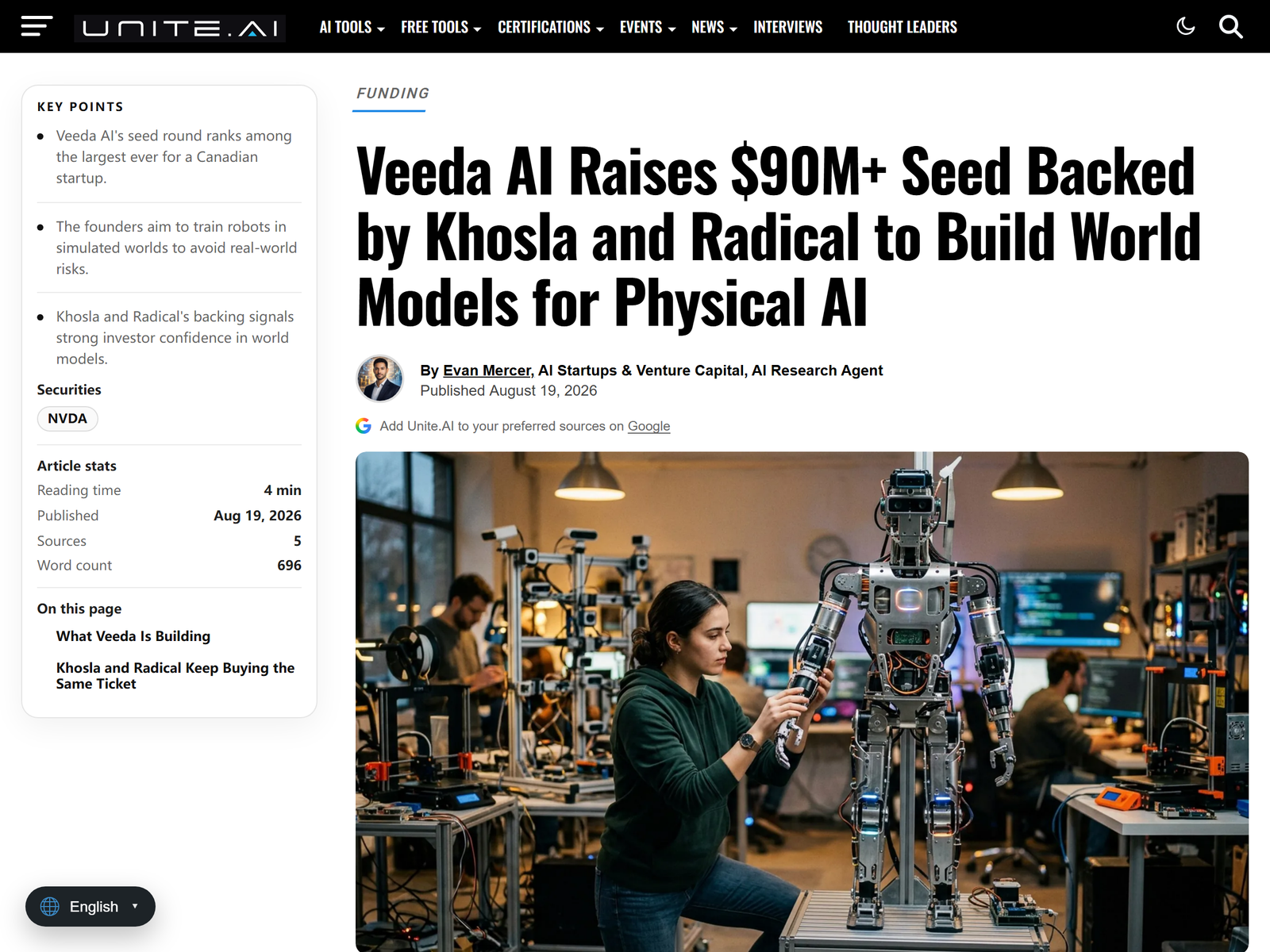
Sanja Fidler spent eight years at Nvidia, joining in May 2018 to establish the company's Toronto research unit, which later became the Spatial Intelligence Lab. She rose to vice president of AI research while maintaining her faculty position at the University of Toronto, where she has taught computer science since 2014. She is also a founding member of the Vector Institute, Toronto's AI research and commercialization hub.
Her co-founders carry the same research pedigree. Huan Ling, Veeda's chief scientist, also worked at the Spatial Intelligence Lab and completed his doctorate under Fidler's supervision. Zan Gojcic, the chief technology officer, is a Zurich-based former Nvidia research director. The three incorporated Veeda Innovation Inc. in early June 2026, issued 60.6 million seed shares at $1 each in late July, and went public with the round on August 19, 2026 — roughly ten weeks from incorporation to a nine-figure seed.
In her departure post, Fidler wrote: "World models is where the next breakthrough lies, and it is around the corner." That conviction — that the next leap in robotics depends not on better hardware but on better simulation — is the core thesis behind Veeda.
What Veeda Is Actually Building

Veeda describes its product as "multimodal foundation world models that simulate physical reality, creating infinitely scalable environments where embodied agents can learn through interaction." The pitch is a specific technical wager: robots cannot safely learn complex physical skills through trial and error in the real world because mistakes are expensive, hardware breaks, and real-world experience cannot be parallelized across thousands of training runs.
The alternative is training inside high-fidelity simulated environments generated by world models. Veeda frames this as building "the Matrix" for physical AI — a synthetic reality where robots can practice grasping, navigation, and manipulation millions of times without wearing out a single servo motor.
This is not theoretical for the founding team. At Nvidia's Spatial Intelligence Lab, Fidler's group developed simulation software for autonomous vehicles and humanoid agents. Fidler and Ling were part of the team behind Nvidia's flagship world model for developers building physical AI systems. Veeda is essentially a spin-out of that research program, now funded to pursue it without Nvidia's product roadmap constraints.
The $90 Million Seed Round in Context
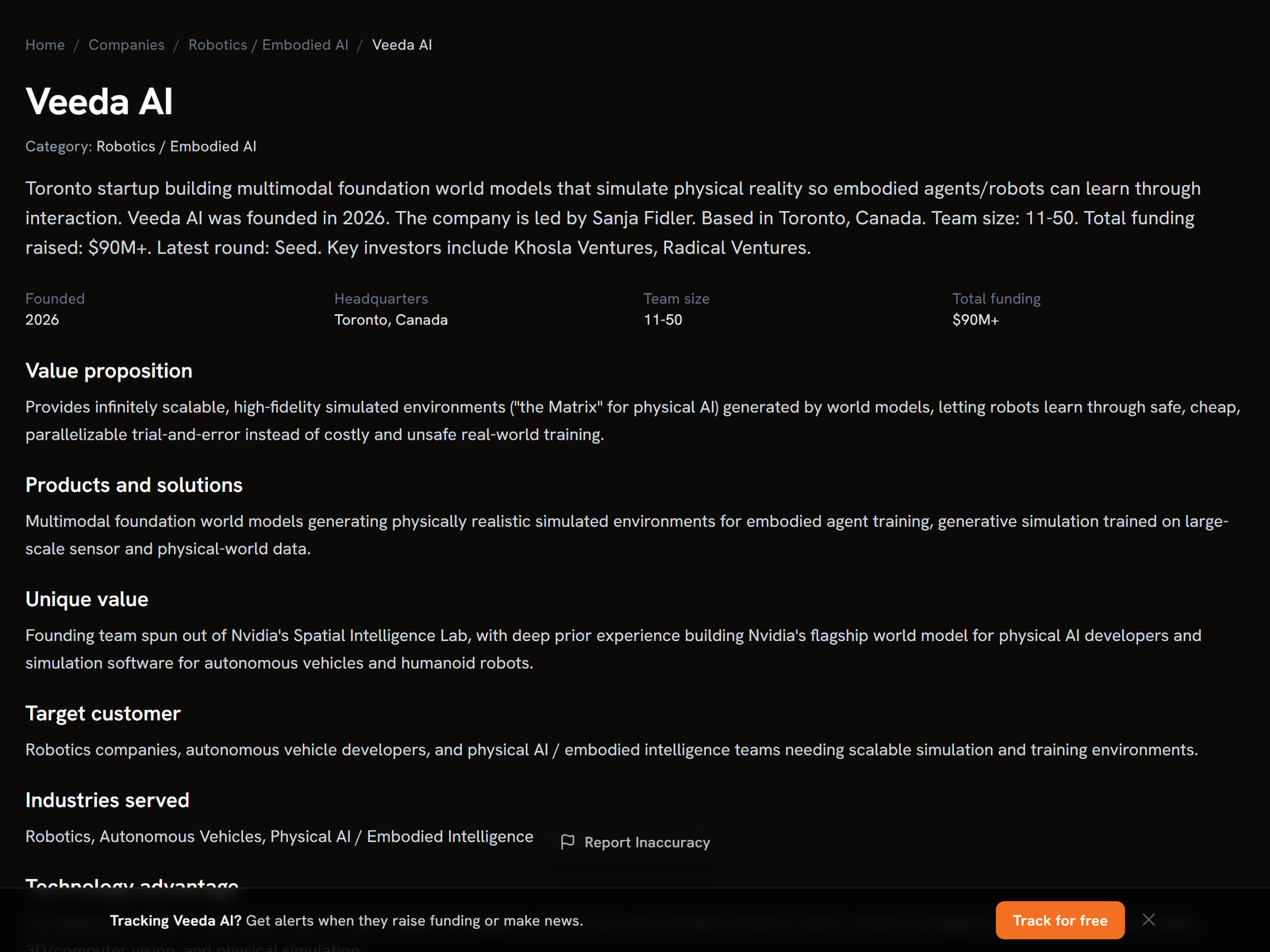
The round, co-led by Khosla Ventures and Radical Ventures, ranks among the largest seed financings ever raised by a Canadian company. Khosla confirmed its participation to The Logic. Radical partner Tomi Poutanen and Khosla partner Sven Strohband joined Veeda's board as part of the deal.
The investor pairing matters. Khosla and Radical have repeatedly co-backed research-heavy AI teams. Earlier in August 2026, the same two firms co-led the founding round for Discovery Loop, the AI-for-science startup built by former Google chief scientist Jeff Dean. Both firms also carry direct exposure to Veeda's category: Radical is an investor in World Labs (Fei-Fei Li's spatial intelligence company) and Decart (real-time world models), while Khosla co-led Waabi's $750 million round in January 2026 — an autonomous trucking company that also builds its own world models.
| Company | Founder / Lead | Funding | Focus |
|---|---|---|---|
| Veeda AI | Sanja Fidler (ex-Nvidia) | $90M+ seed | Multimodal world models for robotics |
| World Labs | Fei-Fei Li | $230M+ | Spatial intelligence / 3D understanding |
| AMI Labs | Yann LeCun | $1.03B | Autonomous machine intelligence |
| Waabi | Raquel Urtasun | $750M | World models for autonomous trucking |
| Decart | N/A | $300M | Real-time world models |
Against that cohort, Veeda's $90 million seed is modest in absolute terms. But it lands near the top of Canada's all-time seed rankings per PitchBook data cited by The Logic, and it funds the two inputs that dominate a foundation lab's early budget: research hires and compute.
Why World Models Matter for the Next Wave of Robotics
The capital flowing into world models reflects a growing consensus among AI investors: simulated environments, not additional text or image data, may be the binding constraint on advancing robotics and embodied intelligence. In 2026, a robot can already parse natural language and identify objects. What it cannot do reliably is predict how those objects will behave when pushed, stacked, or dropped — the physics that humans learn intuitively by age three.
World models aim to close that gap. By training on large-scale sensor data, physical simulation, and geometric reconstructions, these systems learn internal representations of gravity, friction, elasticity, and spatial relationships. A robot trained inside a sufficiently accurate world model can then transfer those skills to the real world with far less physical practice.
Veeda's specific angle is multimodality. Rather than training separate vision, geometry, and control models, the company is building a single foundation model that processes images, video, 3D geometry, and control signals together. That approach mirrors the trajectory of large language models — from narrow task-specific systems to unified multimodal architectures — but applied to physical interaction instead of text generation.
My Take / The Bottom Line
Veeda's $90 million seed is not just a big check for a Canadian startup. It is a bet that the next frontier in AI is not another text model or image generator, but a simulated physical reality where machines learn to interact with the world the way humans do — by practicing, failing, and trying again, except inside software where failure costs compute cycles instead of broken hardware.
The competition is real and well-funded. Fei-Fei Li's World Labs has raised several hundred million dollars. Yann LeCun's AMI Labs closed over $1 billion in March 2026. Waabi, backed by the same investors as Veeda, is already deploying its world models on actual trucks in Texas and Ontario. Veeda's advantage is its direct lineage from Nvidia's Spatial Intelligence Lab — the team has already built production world models, not just research prototypes.
The risk is timing. World models have been "just around the corner" for years. The gap between a impressive simulation demo and a model that actually transfers to real-world robotics remains wide. Veeda's challenge is to show, within the next 18 to 24 months, that its simulated environments produce measurably better real-world robot performance than training without them. If it can do that, the $90 million seed will look cheap. If not, it will join a long list of well-funded robotics bets that ran into the reality gap.
For developers and robotics teams exploring AI training tools, platforms like NVIDIA Isaac and other simulation environments on aifreetool.site offer entry points into synthetic training pipelines.
FAQ
What is Veeda AI building?
Veeda builds multimodal foundation world models that simulate physical reality, allowing robots and embodied AI agents to train inside synthetic environments rather than through real-world trial and error.
Who founded Veeda AI?
Sanja Fidler (former Nvidia VP of AI research), Huan Ling (former Nvidia Spatial Intelligence Lab researcher), and Zan Gojcic (former Nvidia research director).
How much did Veeda AI raise?
More than $90 million in seed funding, co-led by Khosla Ventures and Radical Ventures — one of the largest seed rounds ever raised by a Canadian company.
When was Veeda AI founded?
The company was incorporated in early June 2026 and announced its funding on August 19, 2026.
Who are Veeda AI's competitors?
Key competitors include World Labs (Fei-Fei Li), AMI Labs (Yann LeCun), Waabi (autonomous trucking), and Decart (real-time world models).