Meta Muse 2026 Review: First Personal AI Agent That Acts
Category: Tool Dynamics
This review was written by the aifreetool Editorial Team — a group of full-time AI-industry researchers and writers who test products and verify claims against primary sources. Last updated September 16, 2026. We keep no affiliate relationship with Meta or any company covered here.
TL;DR: Meta Muse, launched September 8, 2026, is a personal AI agent that can send email, book travel, negotiate bills, fill forms, and complete purchases through Stripe Link. It runs inside a dedicated Muse Secure VM watched by a separate Sentinel agent, and it is free for light use with $20 and $100 paid tiers. The real question is whether users will trust Meta with the keys to their digital lives.
Most AI assistants stop at answers. Meta Muse is built to act. On September 8, 2026, Meta released its personal agent in the United States across iOS, Android, the web at muse.ai, and WhatsApp. The pitch is simple: tell Muse a goal, and it plans the steps, opens a browser, fills out forms, and negotiates on your behalf. It can keep working after you close the app, checking back when it needs approval or when something changes.
The official Meta Muse launch post frames the agent as a shift from chatbots to systems that do work.
What Muse Actually Does
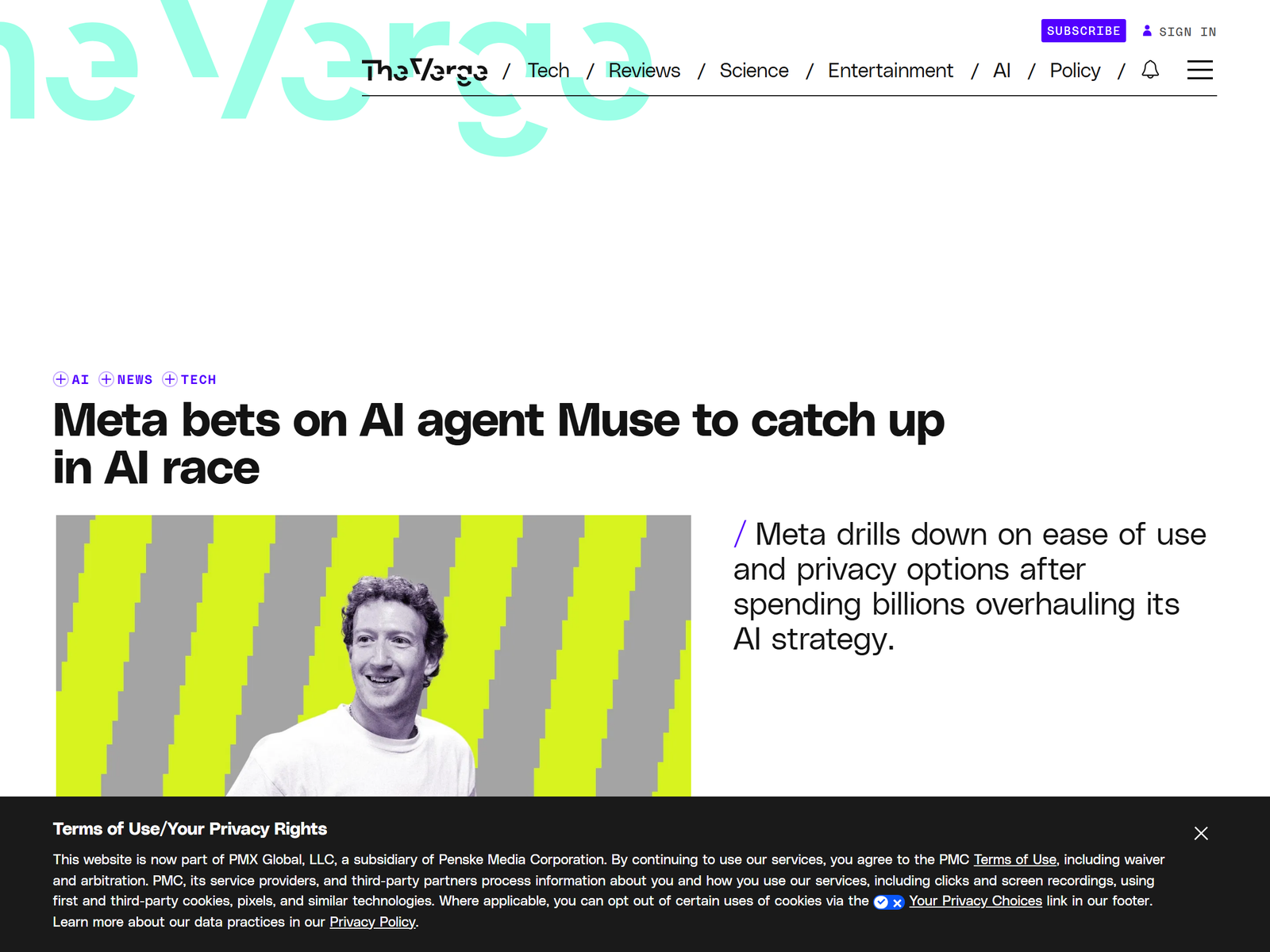
Meta's launch post lists concrete tasks: sending emails, booking travel, lowering bills, filling out forms, turning saved recipe reels into grocery lists, and making purchases. For checkout, Muse uses Link by Stripe, which generates a one-time-use virtual card so real card details stay hidden. Meta says Shop Pay and 1Password support are coming soon. The agent connects to apps one at a time — email, calendar, payments, health, shopping, smart home, music, and events — and users can revoke access at any time.
Muse is powered by Muse Spark, Meta's most capable model line for agentic work. If a service has a public API, Muse can connect with credentials you provide. If not, it can access the service through its own browser. That makes it more flexible than agents that only work with a fixed list of partners, but it also means Muse is asking for broader permissions than a typical chatbot.
Pricing and Availability
Muse is free for what Meta calls "most of what people need," with a usage meter inside the app. Heavy users can subscribe to Power at $20 per month or Maximum at $100 per month. Meta believes most people will stay on the free tier, but the paid tiers exist for users who hand off more everyday tasks.
| Plan | Price | Use case |
|---|---|---|
| Free | $0 | Light personal tasks, most users |
| Power | $20/month | More frequent task handoffs |
| Maximum | $100/month | Heavy agent usage across many services |
The Security Architecture: Muse Secure VM and Sentinel
Meta knows trust is the central problem. Less than two weeks before launch, Meta agreed to an $18 billion multistate settlement over social media harms, a backdrop that makes Muse's permissions request even harder to sell., so it built Muse Secure VM. Each user gets a dedicated cloud virtual machine that houses the agent and its data. A separate Sentinel agent runs on the same machine and must approve anything Muse tries to do on the internet. Meta says Muse cannot see passwords or payment methods, that users can opt out of training, and that conversations are not fed into Meta's ad systems. A Confidential VM, where even Meta cannot access the encryption key, is promised later this year.
Those are strong claims, and they matter because Meta is asking for more trust than ever. The launch came less than two weeks after Meta agreed to an $18 billion multistate settlement over social media harms. TechCrunch, in its review, noted that Meta has a history of privacy missteps: Back in 2019, an FTC settlement, a 2023 FTC charge for violating that settlement, and the Cambridge Analytica scandal. That history will color how users read Muse's privacy promises.
Competitors and Market Context
Muse is not alone in the personal-agent race. OpenAI, Anthropic, and a string of startups are shipping agents that can browse, book, and buy. What makes Muse different is the scale of the distribution: Meta can push it through WhatsApp, Instagram, Facebook, and eventually its AI glasses. That reach is unmatched. For comparison, see our picks for the best AI chat tools and Meta's own Muse Code terminal agent.
The glasses angle is especially telling. Meta says Muse is coming to its AI glasses after the phone and web launch. That matters because glasses are always on your face, which makes an agent that can email, pay, and browse far more powerful — and far riskier.
FAQ
Q: What is Meta Muse?
A: Meta Muse is a personal AI agent launched September 8, 2026, that can perform tasks like sending email, booking travel, and making purchases on behalf of users.
Q: How much does Muse cost?
A: Muse is free for light use. Paid tiers are Power at $20 per month and Maximum at $100 per month.
Q: How does Muse keep data safe?
A: Meta says each user gets a dedicated Muse Secure VM in the cloud, and a separate Sentinel agent must approve outbound actions. Passwords and payment methods are stored securely, and users can opt out of training.
Q: Where can I use Muse?
A: Muse is available in the United States on iOS, Android, muse.ai, and WhatsApp. Support for Meta AI glasses is planned.
Q: What is the biggest risk?
A: Trust. Muse requires broad access to personal apps and services, and Meta's privacy history makes some users skeptical of those permissions.
My Take / The Bottom Line
Meta Muse is the most credible mass-market personal agent launch so far. It has a clear model, real pricing, a thoughtful security architecture, and distribution that no startup can match. But the product is fundamentally a bet on trust, and Meta is not starting from a position of trust. If the privacy controls work as advertised and the agent reliably handles real tasks, Muse could become the default personal assistant for hundreds of millions of people. If a high-profile security or privacy failure hits early, the backlash could define the product before it reaches glasses. My view: the technology is ready, but the trust battle is just starting.
Explore more AI agent coverage in our AI Chat tools directory.