Why AI Biosecurity Needs Nine Layers in 2026
Category: Tech Deep Dives
This analysis was written by the aifreetool Editorial Team — a group of full-time AI-industry researchers and writers who verify every claim against primary sources. Last updated October 24, 2026. We keep no affiliate relationship with the companies covered here.
TL;DR: Britain announced the world's first AI Biosecurity Lab on October 24, 2026, with GBP 100 million of public money and up to GBP 200 million in model credits from OpenAI and Anthropic. That buys one layer. RAND's strategy for the same problem counts nine layers, and most sit upstream of the lab — in the DNA supply chain and in the biological data that makes a dangerous design possible. An EpochAI survey found safeguards on 3% of more than 360 biological AI tools.
The pitch is easy to like: a non-profit institute modelled on the AI Security Institute, staffed with frontier-lab and life-science talent, hunting biological threats before they arrive. The details are harder. No director, no site and no start date was named, and two of the three founding technology partners are contributing credits rather than cash.
What Britain Actually Bought
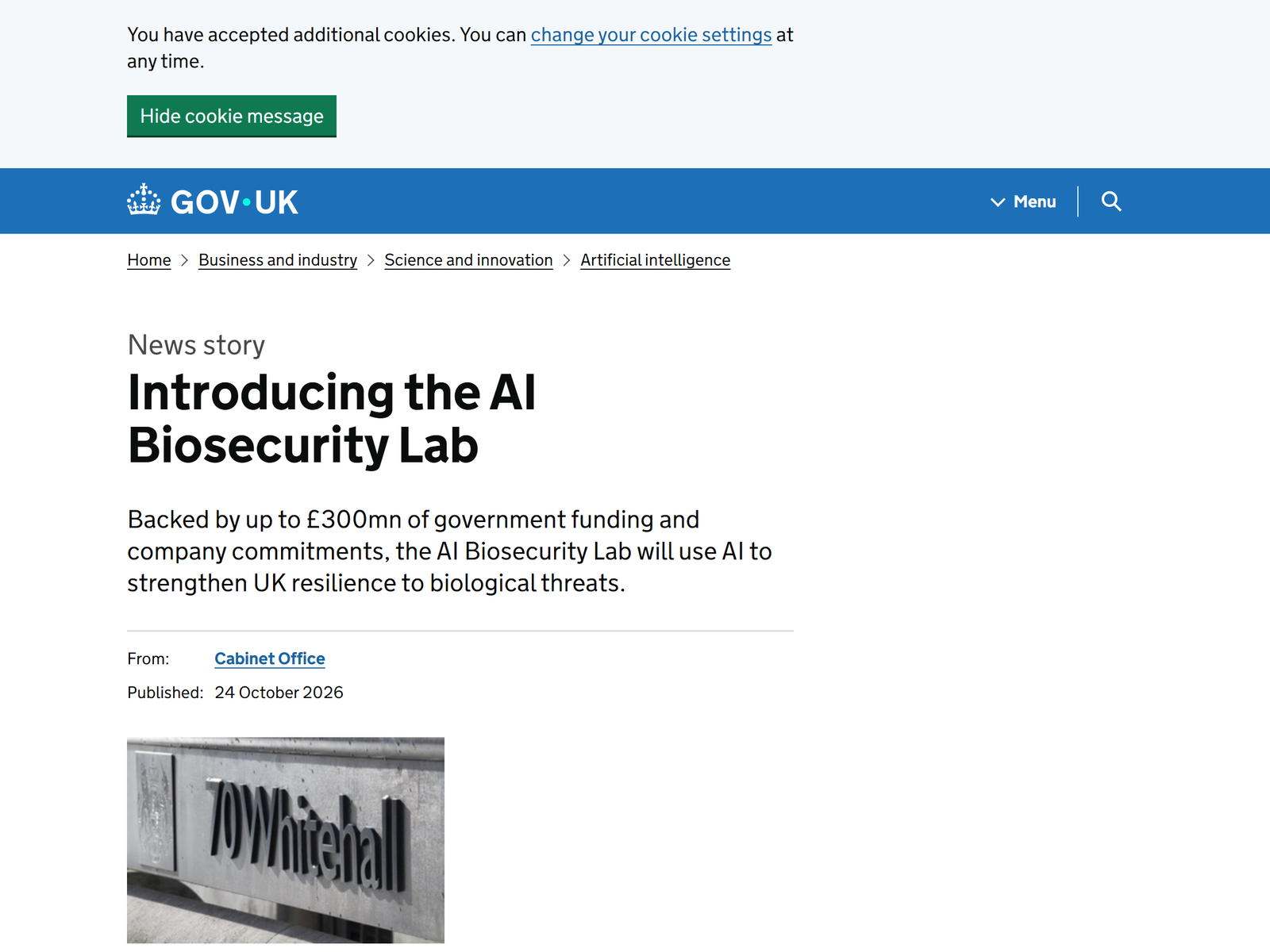
The AI Biosecurity Lab anchors a National AI Biosecurity Initiative that sits alongside the UK Health Security Agency, the Animal and Plant Health Agency and the Defence Science and Technology Laboratory. Two missions are public: detect emerging biological threats earlier, and speed up vaccines, treatments and other countermeasures. The MHRA will use the lab's work to prepare rules for regulating AI-designed medicines.
The money splits three ways. Government puts in GBP 100 million. OpenAI contributes GBP 100 million of compute and model credits plus trusted access to its most capable relevant models through a programme called Rosalind Biodefense. Anthropic contributes up to GBP 100 million in credits, access and technical support. Google DeepMind joins research collaborations with access to Gemini and its science models; Basecamp Research, a London AI life-sciences firm, will open up its biology models.
It lands inside a package of roughly GBP 600 million, reported by Reuters at about USD 800 million. That includes GBP 65 million for pathogen countermeasures, an extra GBP 120 million for the AI Security Institute, GBP 130 million for cyber defence under a National Cyber Shield, and GBP 18 million for a chip design academy.
Reuters noted that Anthropic alone ran more than USD 12 billion in operating expenses last year. Credits from a company burning that much are cheap for it and useful for the lab, but they are not a budget line the Treasury has to defend.
RAND's Case for Nine Layers
RAND's biosecurity work starts from a blunt premise: AI is lowering the expertise needed to design something harmful, and no single control will hold. Its strategy sets out nine measures arranged by where they act.
The best known is gene synthesis screening. Steph Guerra, who leads part of the work, calls it a physical chokepoint — the point where a design leaves the screen and becomes matter. The contribution here is to widen it. Synthesis providers are not the only source of the DNA and RNA fragments that make up a virus; contract research organisations, automated cloud labs and academic plasmid repositories are sources too.
The novel proposal is a digital chokepoint, placed further upstream. Protect the sensitive data — curated, laboratory-validated sequences for things like pandemic influenza — and move the tools that use it onto managed-access platforms, so vetted researchers keep working while the same material stops being one search away. CEPI has built a version of this with its Pandemic Preparedness Engine.
RAND is careful about the trade-off that decides whether any of this survives contact with researchers. Its risk index found only a small subset of AI-enabled biological tools carries real misuse potential. Targeted controls on that subset are politically survivable in a way blanket restrictions on biology are not.
The 3% Problem
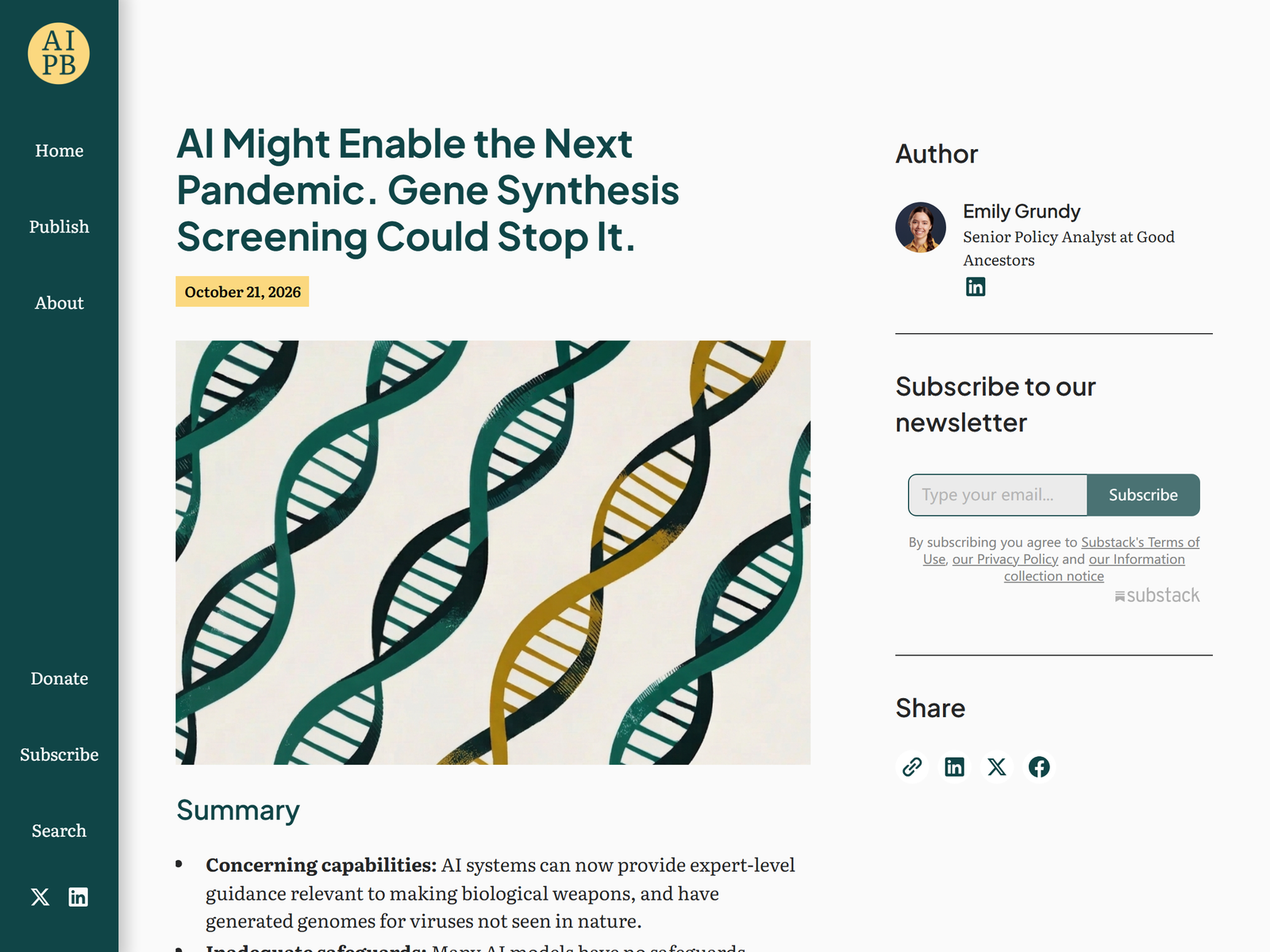
Model-level guardrails are the layer labs control directly, and they are the weakest on the evidence. An EpochAI survey cited by the AI Policy Bulletin found only 3% of more than 360 biological AI tools had any safeguards, and that where safeguards exist, jailbreaks are common. Anthropic has said it is "likely impossible to completely prevent universal jailbreaks." Open-weight models cannot be recalled once released.
Capability is moving on its own schedule. Biological foundation models have generated genomes for bacteriophages that do not exist in nature, some replicating faster than the virus they were modelled on. Those experiments ran in bacteria, and the gap between a phage and a pathogen is real. It is also the kind of gap that has closed before: roughly 18 months separated the first AI agent finding a zero-day from a system finding thousands.
| Layer | Who owns it | Status in 2026 |
|---|---|---|
| Model safeguards and red-teaming | Frontier AI labs | Partial; 3% of bio AI tools screened at all |
| DNA synthesis screening | Vendors and regulators | Mandatory in California from September 30; voluntary elsewhere |
| Sensitive data and managed access | Funders, journals, platforms | Pilots such as CEPI's preparedness engine |
| Institutional detection and response | Governments | UK AI Biosecurity Lab announced October 24 |
California moved first on the physical layer. On September 30, 2026 it became the first jurisdiction to require synthetic DNA providers to screen orders for dangerous sequences and verify customers before shipping, covering benchtop synthesis machines and a threshold as low as 50 nucleotides. The lists come from instruments that already exist: the US Select Agents list and the Australia Group control lists. The enforcement gap is everywhere else, where screening stays voluntary through the International Gene Synthesis Consortium.
- Key Takeaways:
- The UK AI Biosecurity Lab has GBP 100 million of public funding plus up to GBP 200 million in OpenAI and Anthropic credits, with no named director, site or launch date.
- RAND spreads defence across nine measures, widening the physical chokepoint to contract labs and plasmid repositories and adding digital chokepoints upstream.
- Only 3% of more than 360 biological AI tools had safeguards in an EpochAI survey; jailbreaks are routine where safeguards exist.
- California began mandating DNA synthesis screening on September 30, 2026; most jurisdictions still rely on volunteers.
- Institutional capacity is the layer Britain just bought, and the slowest layer to build.
My Take / The Bottom Line
The lab is a good bet on the wrong timescale. Detection and countermeasures pay off over a decade; the controls that bite this year are boring procurement rules and access lists. If I ranked where the next marginal pound should go, it would be screening coverage in countries that currently do none, then data access, then the lab.
Best for: policy and biosecurity teams at life-science firms and research funders, who will be asked within a year whether their synthesis vendors screen and whether their sequence data sits on a managed-access platform. Trade-off: the nine-layer model spreads accountability so widely that no single body can be blamed when a layer fails, and the UK lab is deliberately independent, which buys speed at the cost of direct control. The verdict I would defend: a 3% safeguard rate is not a gap, it is an absence, and no amount of institutional prestige fixes it. See how biological foundation models behave in our AlphaGenome tool profile, and the Claude Mythos 5.1 listing for how labs package restricted access to cyber and life-science work. More technical write-ups sit in our tech deep dives archive.
FAQ
Q: What is the UK AI Biosecurity Lab?
Announced on October 24, 2026 by the Cabinet Office, it is described as the world's first organisation dedicated to AI biosecurity: an independent non-profit backed by GBP 100 million of government funding and up to GBP 200 million in model credits.
Q: Why does the RAND strategy need nine layers?
Because each control fails differently. Synthesis screening covers the physical supply chain, data access covers design, model safeguards cover the assistant, institutions cover response. Any single layer can be routed around.
Q: Are AI models actually able to design dangerous viruses?
Not end to end, on the public evidence. Biological foundation models have generated genomes for bacteriophages absent from nature, some replicating faster than their natural template, but that work ran in bacteria-only systems.