ChatGPT Codex Shared Token Budget Review 2026: One Pool
Category: Tool Dynamics
Excerpt:
From December 2026, ChatGPT and Codex share one token budget on Plus, Pro, and Business. What counts, what stays free, and how heavy users should plan.
This analysis was written by the aifreetool Editorial Team — a group of full-time AI-industry researchers and writers who verify every claim against primary sources. Last updated November 5, 2026. We keep no affiliate relationship with the companies covered here.
TL;DR: From December 2026, ChatGPT Plus, Pro, and Business subscribers will draw from one shared token budget covering both ChatGPT conversations and Codex coding work. Instant-model chats stay outside the meter, OpenAI has published no exact start date or allowance sizes, and heavy users are already debating whether the change is a simplification or a quiet repricing.
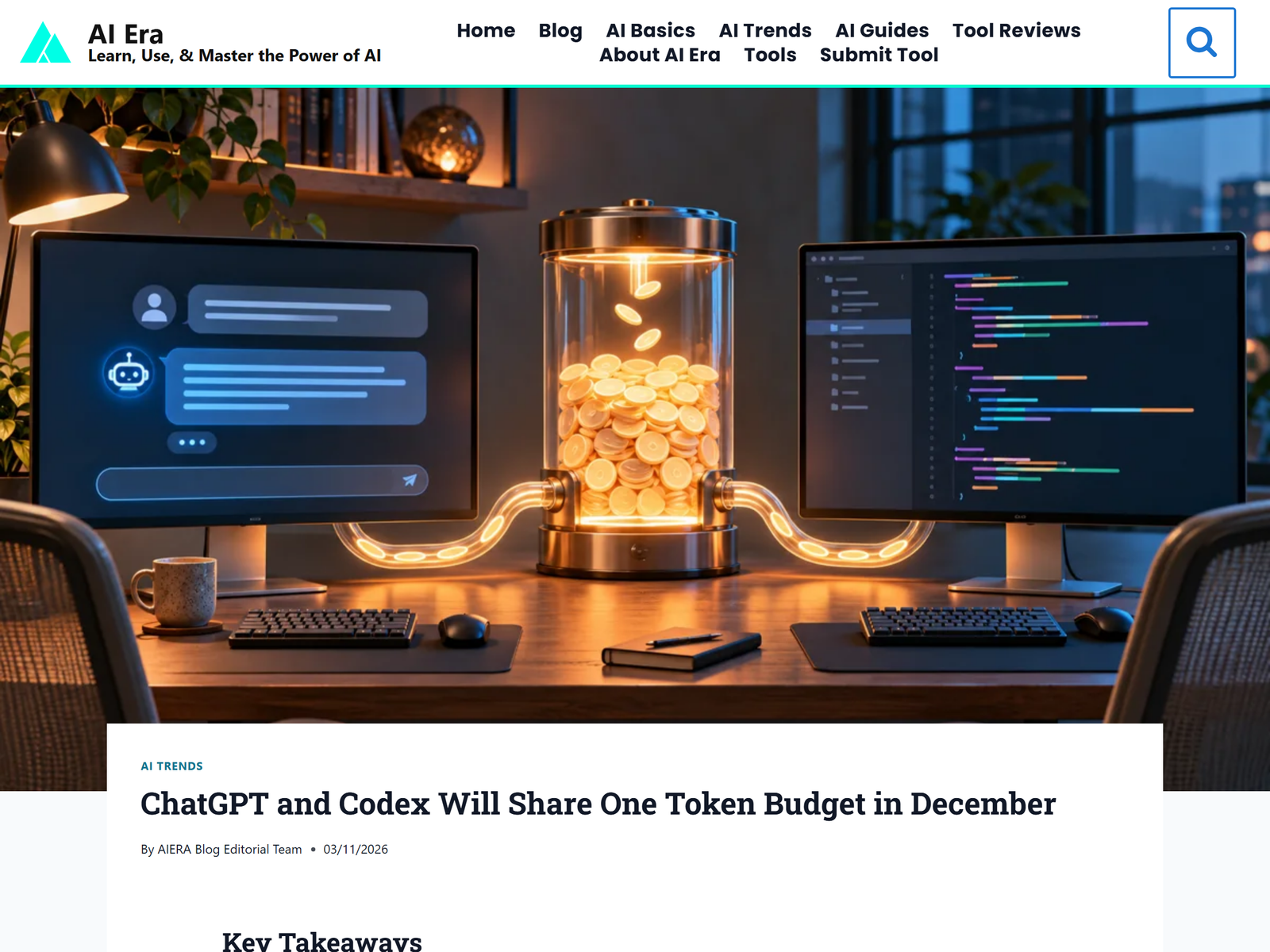
OpenAI just changed how millions of subscribers will pay for AI work, and it did it without a keynote. On October 31, OpenAI quietly updated a Help Center article titled "Understanding ChatGPT and Codex usage limits," and by November 1 independent outlets including AI Era had parsed the change sentence by sentence (we cover these shifts in our AI industry trends coverage). The upshot: the shared token budget arrives in December, and your afternoon of agent coding will now compete directly with every question you ask in the chat window afterward. This is the usage-limit side of a much bigger product shift, and it deserves more attention than the release notes it arrived in.
What OpenAI Actually Changed
The Help Center sentence doing all the work reads: "Starting in December, Plus, Pro, and Business plans' usage allowance will be shared across ChatGPT and Codex as we bring the agentic capabilities of Work into the main ChatGPT experience." Three things are packed into that line. First, the plans: Plus, Pro, and Business only — the published wording says nothing about Free, Enterprise, or Edu, so those users' terms are unchanged for now. Second, the unit: usage is measured in tokens, what a model processes and generates, replacing the old message-count approach. A short question and a multi-step agent task are no longer roughly equivalent; they drain the pool at different rates, and OpenAI notes that "more advanced models and complex tasks generally use more of your allowance."
Third, the mechanics. Chats routed through Instant models will not draw from the budget at all, so light conversation stays effectively unlimited. When the shared allowance runs out, the documented options are the same three as before: wait for the reset, upgrade your plan, or buy additional credits. Combined remaining usage and reset times now appear in one place, under Settings, then Usage.
Why OpenAI Merged the Budgets
This is not a standalone pricing move — it is the billing half of the Chat-and-Work interface merger OpenAI announced earlier this year. Work mode, the longer, multi-step, deliverable-focused mode, already shared an allowance with Codex, so extending that sharing to all Plus, Pro, and Business chat usage closes the loop. An OpenAI engineer wrote on October 28 that the team was working on the merge but that it was "not rolling out just yet" and the company would "proceed carefully." The timing fits: on October 29, OpenAI doubled usage limits for higher-priced plans, a move widely read as softening the landing before one budget governs everything.
Two supply-side facts explain the urgency. Codex usage has exploded across the AI coding tools category — multiple reports describe weekly active usage growing roughly fivefold in recent months, straining OpenAI's compute allocation. And the interface itself had become a maze: users currently choose between two operating modes and eleven model settings, a level of complexity OpenAI itself has acknowledged even experienced users struggle to navigate. One budget that drains faster or slower depending on model choice is, whatever else it is, simpler to explain than two balances and eleven toggles.
What Counts Toward the Budget — and What Doesn't
Here is the practical picture for a paying subscriber once December arrives:
| Activity | Draws from shared budget? | Notes |
|---|---|---|
| Instant-model chats | No | Stays uncapped for light use |
| Standard ChatGPT conversations | Yes | Token-metered; bigger models burn faster |
| Codex coding and agent tasks | Yes | Long multi-step jobs consume the most |
| Work-mode agentic tasks | Yes | Folding into main ChatGPT experience |
| Free, Enterprise, Edu plans | Unchanged | Not covered by the December wording |
Notably, Anthropic already merged Chat and Cowork in Claude, which means OpenAI is following a competitor's playbook while framing it as product vision — we track both platforms in our tool dynamics coverage. When the two biggest AI subscription platforms converge on the same billing structure, that is not coincidence — it is the industry settling on a standard: flat-rate light use, metered heavy use.
How Heavy Users Should Plan for December
OpenAI has published no exact day in December and no token allowance for any plan, so the only reliable planning input right now is your own measured split between chat and Codex usage — check your Usage page and log a typical week before the change lands. If you run agents on a Plus or Business plan, three moves make sense. Route high-volume, low-stakes steps through Instant models, which stay outside the meter. Budget for credits if your workload is bursty, since buying credits is the third documented escape hatch. And note the critics' concern, flagged by outlets like TokenFeed: heavy users on cheaper plans may find themselves pushed toward lower-quality outputs once the budget runs dry, which is the practical cost of a metered model hierarchy. Developers building on these plans should track tokens per task now, because one long-running Codex job can exhaust the allowance for everything else that day (AI Agent News).
- Key Takeaways:
- From December 2026, Plus, Pro, and Business share one token budget across ChatGPT and Codex.
- Usage is token-metered, not message-counted; advanced models and complex tasks drain it faster.
- Instant-model chats are excluded, and OpenAI doubled higher-tier limits on October 29 ahead of the change.
- No exact date, no allowance sizes published; Anthropic already made the same merge in Claude.
My Take / The Bottom Line
Call this what it is: a capacity-management move wearing a simplicity costume. The framing that "most people" will hit limits no more often is doing a lot of load-bearing work, because the people who will notice are exactly the ones who got five-x growth out of Codex — developers, for whom a shared pool means their best tool now has a rival inside their own subscription. My verdict: light and moderate users genuinely win here, with one dashboard and uncapped Instant chats; heavy users should expect to either upgrade or consciously budget, and OpenAI knows it. The order of the documented escape hatches — wait, upgrade, buy credits — is not accidental. If you live in Codex, spend November measuring your usage split, because in December the meter starts running on everything.
FAQ
Q: What is the ChatGPT and Codex shared token budget?
A: Starting in December 2026, ChatGPT Plus, Pro, and Business plans share a single usage allowance across ChatGPT and Codex, measured in tokens instead of messages, as OpenAI folds Work's agentic features into the main ChatGPT interface.
Q: Is ChatGPT still unlimited after the merger?
A: Chats with Instant models do not count toward the budget, so casual use stays uncapped. Heavy use of advanced models and Codex consumes the shared allowance until it resets.
Q: What happens when the shared token budget runs out?
A: OpenAI documents three options: wait for the reset, upgrade to a higher plan, or purchase additional credits for eligible features. Remaining usage and reset times appear under Settings, then Usage.
Q: Does this change affect Free or Enterprise plans?
A: The published wording covers Plus, Pro, and Business only. Free, Enterprise, and Edu plans are not mentioned, so their terms are unchanged based on what OpenAI has said so far.