Claude Haiku 5.5 Pricing Review 2026: $0.10 per Million Tokens
Category: Tool Dynamics
This analysis was written by the aifreetool Editorial Team — a group of full-time AI-industry researchers and writers who verify every claim against primary sources. Last updated October 13, 2026. We keep no affiliate relationship with the companies covered here.
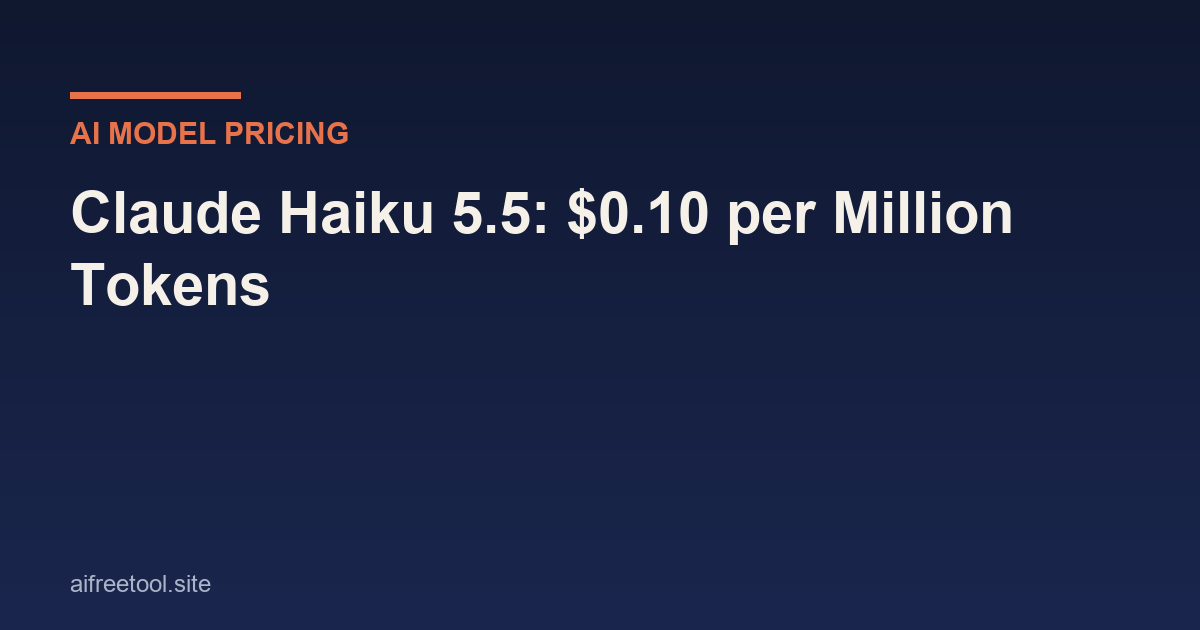
Quick answer: Claude Haiku 5.5 pricing starts at $0.10 per million input tokens and $0.50 per million output tokens for prompts up to 100K tokens — 90% cheaper than Haiku 4.5 — and roughly 75% cheaper to run on average. It is the first Haiku with adjustable effort controls, and on most published benchmarks it now beats OpenAI's GPT-6 Luna, which charges the same base rate.
- Two-tier pricing: $0.10/$0.50 per million input/output tokens under 100K prompts; $0.50/$2.50 above it.
- Big jump in capability: OSWorld 2.1 computer-use score went from 15.7% to 72.4% versus Haiku 4.5.
- First Haiku with effort controls: Low, Medium, High, Xhigh and Max settings trade cost against intelligence.
- Watch the cliff: prompts over 100K tokens cost 5x more, and testers found token consumption creeping up about 25%.
- Free too: Haiku 5.5 is available on every Claude plan, including Free, plus Claude Code and the major cloud platforms.
What Claude Haiku 5.5 Actually Costs in 2026
When Anthropic launched Claude Haiku 5.5 on October 7, 2026, the headline number was the price. For prompts up to 100K tokens, the model costs $0.10 per million input tokens and $0.50 per million output tokens. Haiku 4.5 charged $1 and $5 for the same work, so that is a 90% cut at the short end. Above 100K tokens, pricing moves to $0.50 input and $2.50 output — a 50% reduction from the previous tier.
Because Anthropic says roughly 90% of requests to the previous Haiku never exceeded 100K tokens, the blended effect works out to about 75% cheaper on average. Two further discounts sit on top: prompt caching saves up to 90% on repeated context, and batch processing takes another 50% off for workloads that can wait. Availability is unusually broad — the model runs on claude.ai for Free, Pro, Max, Team and Enterprise users, inside Claude Code, and natively on Amazon Web Services, Google Cloud and Microsoft Foundry. If you are comparing small models side by side, our AI models directory keeps the current field in one place.
Benchmarks: A Small Model That Beats GPT-6 Luna
Pricing cuts usually mean capability cuts. This time the numbers point the other way. On OSWorld 2.1, a computer-use benchmark, Haiku 5.5 scored 72.4% on the offline subset against 15.7% for Haiku 4.5 and 48.9% for GPT-6 Luna. On the GDPval-AA v2.1 knowledge-work evaluation it posted 1,620 — ahead of Luna's 1,437 and more than double Haiku 4.5's 735. On Terminal-Bench 4.0, an agentic coding test, it scored 39.2% where Haiku 4.5 managed 0.0% and Luna 16.4%.
Early customers back the claims up. Box reported Haiku 5.5 scoring 11 points higher than its predecessor at about half the latency on enterprise content analysis. Another launch customer running about 8 million API calls per week measured a statistically significant quality gain, 0.84 versus 0.76, against Haiku 4.5. The first Haiku-class effort controls — Low through Max — also let teams spend less on trivial calls and more on the ones that matter, a dial OpenAI's Luna does not expose at this price point. The coding agents that route work this way are exactly what our AI programming tools directory tracks, and the subagent pattern is now standard there.
The Catch: Long Prompts Cost 5x More
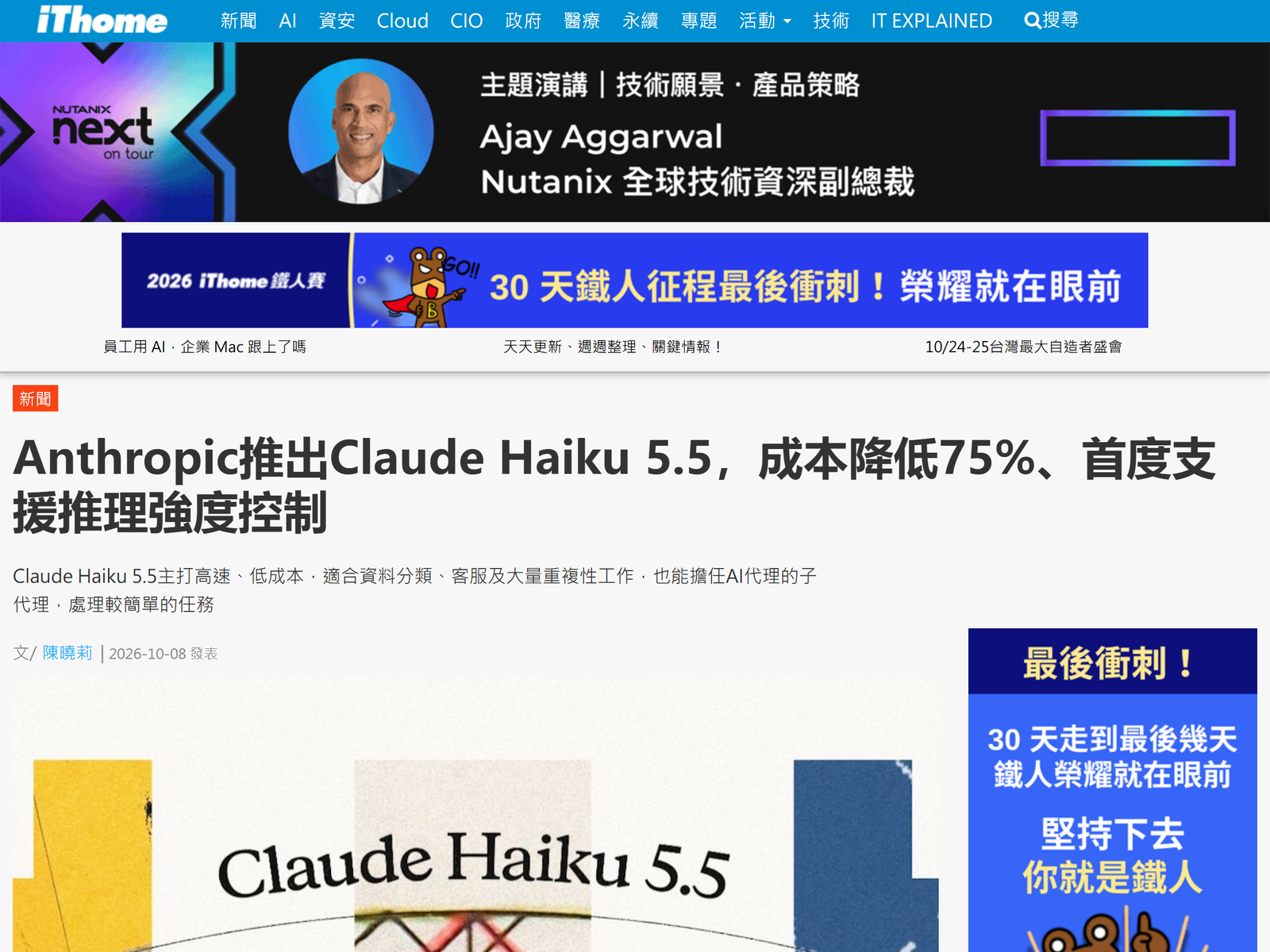
The honest caveats live at the edges. Developer Simon Willison, whose testing was picked up by iThome, noted that Haiku 5.5 and GPT-6 Luna charge the same $0.10 base rate, but Haiku's premium tier kicks in past 100K tokens while Luna's does not start until 272K. On his long-prompt test, Haiku 5.5 also consumed roughly 25% more tokens than Haiku 4.5 for the same input, which shrinks the real-world saving below the headline 90%.
None of this makes the model expensive — $0.50 per million output tokens is still cheap by any standard. It just means the marketing number and the invoice number can differ for retrieval-heavy or long-document workloads. Teams running 200K-token contexts should model both tiers before migrating, or split documents with caching instead of one giant prompt.
Why Anthropic Is Cutting Prices Now
Context matters more than the numbers. Anthropic positions Haiku 5.5 as the subagent tier for agentic systems: an Opus 5.5 or Sonnet 5.5 model plans the work, then hands off classification, summarization and small code edits to Haiku. When agents run thousands of parallel calls, the cheap model is the one that determines whether the unit economics work. The same release halved Sonnet 5.5 cache reads from $0.20 to $0.10 per million tokens, cutting about 20% off typical agentic workloads, and added monthly API credits — $100 for Max 5x, $200 for Max 20x and up to $500 for Team plans. The message to developers is blunt: build your agents on Claude, and the bill gets smaller every time OpenAI matches a price.
My Take / The Bottom Line
Best for: startups and product teams running high-volume, low-complexity calls — classification, routing, summarization, subagent tasks — where Haiku 5.5 is now the obvious default at this price. The trade-off: the 100K-token cliff and the token-inflation issue make it a poor blind swap for long-context retrieval pipelines; benchmark those before you migrate. My bottom line: Anthropic is not trying to win the intelligence race with Haiku 5.5 — it is trying to own the commodity layer of the agent economy, and at $0.10 per million tokens it just moved the floor for everyone. Expect GPT-6 Luna's next revision to answer within weeks, and expect the real winner to be anyone shipping an agent product this quarter.
FAQ
Is Claude Haiku 5.5 free to use?
Yes. It is selectable on every Claude plan including Free on web, iOS and Android, and it is also available in Claude Code and through the Claude API on AWS, Google Cloud and Microsoft Foundry.
How much cheaper is Haiku 5.5 than Haiku 4.5?
For prompts up to 100K tokens it is 90% cheaper ($0.10/$0.50 versus $1/$5 per million tokens), and Anthropic says the average running cost drops about 75%.
Does the effort setting change the price?
No. Low, Medium, High, Xhigh and Max settings change how much compute the model spends per answer, which changes quality and latency, but token pricing stays the same.
What happens to pricing above 100K tokens?
Input jumps from $0.10 to $0.50 and output from $0.50 to $2.50 per million tokens — 5x the short-prompt rate. Prompt caching and batching still apply, so restructure long-context workloads where you can.