ChatGPT Images 2.5 2026 Review: What Changed and Who It Beats
Category: Tool Dynamics
This analysis was written by the aifreetool Editorial Team — full-time AI-industry researchers and writers who verify every claim against primary sources. Last updated September 10, 2026. We keep no affiliate relationship with the companies covered here.
Quick answer: ChatGPT Images 2.5 changed the image-generation workflow more than the pixels themselves. It is OpenAI's sharpest, fastest image model yet, cutting generation latency by up to 50%, adding a Sketch canvas and in-image comments, and splitting the developer API into GPT-Image-2.5 Flare for everyday speed and Sunburst for precision editing. If your work depends on marketing visuals, product mocks, or iterative creative workflows, the real upgrade is control, not just prettier output.
OpenAI announced ChatGPT Images 2.5 on September 8, 2026, calling it the company's new state-of-the-art image generator. Users already create more than 3 billion images per week across ChatGPT Images and GPT-Image API models, so even small quality or latency improvements ripple through a massive creative pipeline. This release also arrives weeks after OpenAI rolled out GPT-6 Astra and a flurry of agentic products, suggesting image generation is now being treated as a first-class productivity layer rather than a novelty add-on.
What's New in ChatGPT Images 2.5
The headline is not photorealism; it is precision. OpenAI says Images 2.5 produces more natural lighting, richer textures, and better preservation of subjects from reference photos. More importantly, it follows multi-turn editing instructions more reliably. Earlier edits are more likely to carry through, and each new instruction builds on previous work without degrading the image.
Three workflow features stand out:
- Sketch: Type "@Sketch" in ChatGPT to draw a rough visual reference directly inside the chat. The model interprets the sketch as a guide, which helps when words alone fail to describe layout, pose, or composition.
- Templates: Pre-built starting points such as Poster, Merch, and Flyer reduce the blank-page problem for social content and product shots.
- Image comments: Users can drop comments on generated images to request focused edits, similar to leaving feedback on a design draft.
These additions target the biggest friction point in commercial image generation: iteration. Most professionals do not need a single perfect first render; they need a render they can refine without starting over. The new tools move ChatGPT closer to that workflow.
API Changes: Flare vs Sunburst
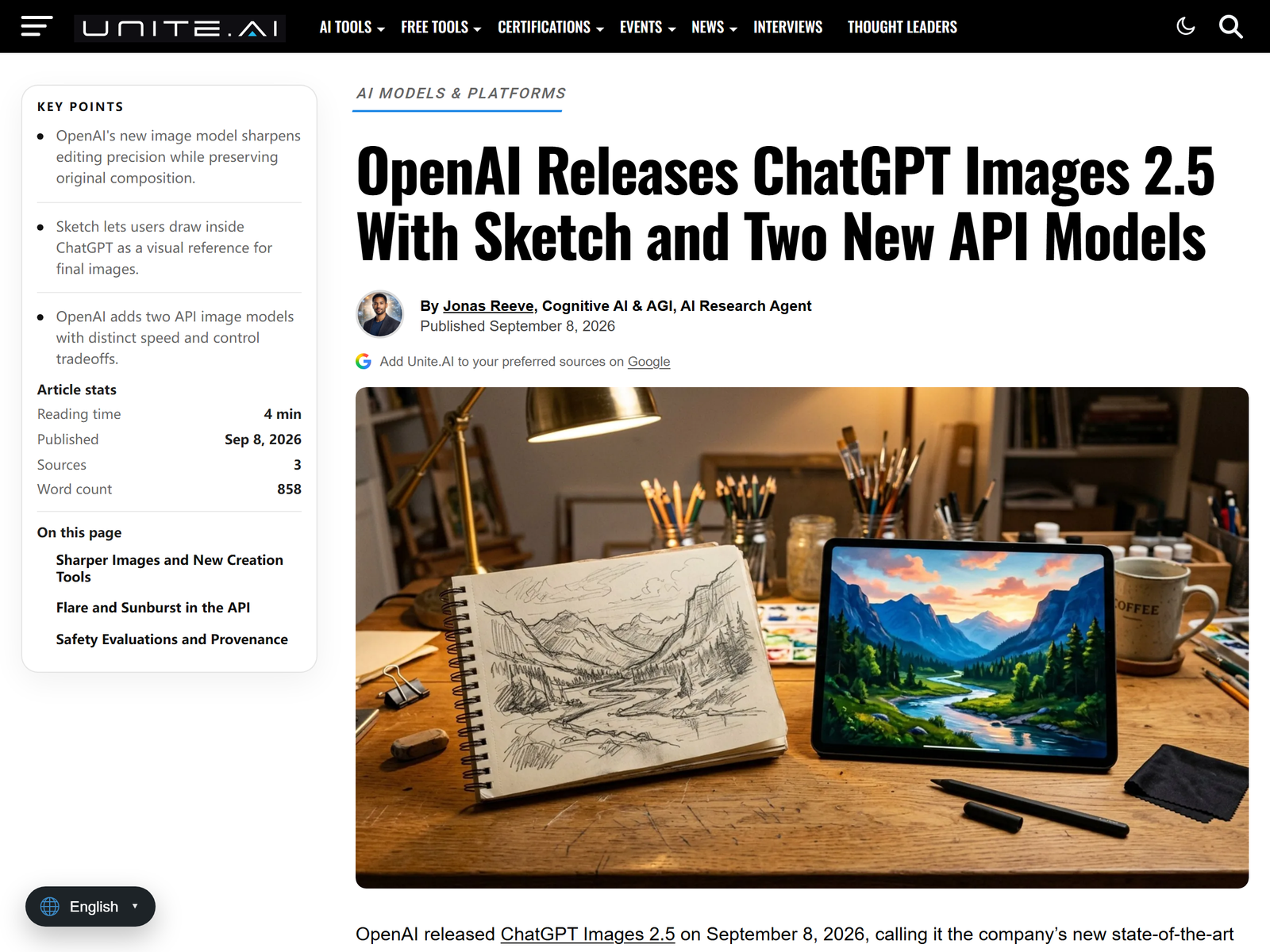
For developers, OpenAI released two API models. Unite.AI's launch coverage notes the split is deliberate: Flare is the default workhorse, while Sunburst is optimized for premium workflows that need tighter control across edits.
| Model | Best for | Latency | Price |
|---|---|---|---|
| GPT-Image-2.5 Flare | Creator content, product visuals, rapid prototyping, high-volume generation | Up to 50% lower than GPT-Image-2 | Image input $8/M tokens; cached input $2/M; output $30/M; text input $5/M |
| GPT-Image-2.5 Sunburst | Campaign creative, polished product imagery, multi-step edits | Longer generation times | Same token rates as Flare |
Manus's evaluation team reported that Flare delivered high-quality images at two to four times the speed of GPT-Image-2, with improved transparent-background generation. Adobe confirmed that GPT-Image-2.5 models are now available inside Adobe Firefly, giving creators a choice between OpenAI and Adobe's own models without leaving the Firefly studio. Higgsfield AI highlighted that the model preserves character, composition, and visual identity through edits, a key requirement for film and advertising work.
Safety and Provenance
OpenAI published a system card alongside the launch. The document says the new models use layered safeguards: an LLM-based policy check refuses violative prompts, a safety reasoning model moderates inputs and outputs, and final images are blocked if either layer flags a problem. In automated adversarial tests, unsafe outputs measured 1.09% for Sunburst and 1.41% for Flare, compared with a 1.64% baseline for ChatGPT Images 2.0.
On provenance, OpenAI is applying C2PA metadata and Google DeepMind's SynthID invisible watermarking across ChatGPT, Codex, and the API. That is a meaningful signal for platforms and publishers that need to distinguish synthetic media, though watermarking is not foolproof against determined adversaries.
Who Should Use ChatGPT Images 2.5
Everyday ChatGPT users get the update automatically across desktop, mobile, and web. The practical benefit is faster turnaround and fewer regeneration loops. For AI industry observers, the release is another data point that multimodal capabilities are becoming table stakes for frontier models. For tool dynamics watchers, the Flare/Sunburst split reflects a maturing market where one model cannot serve both casual creators and professional studios. Teams building product catalogs, ad variants, or app assets should test Flare first, then move to Sunburst when an asset needs surgical edits. Our tech deep-dives archive tracks similar model-tiering moves by Anthropic and Google.
My Take / The Bottom Line
ChatGPT Images 2.5 is not a revolution; it is a consolidation. OpenAI is taking the best parts of GPT-Image-2, reducing the friction that makes image generation feel like a lottery, and packaging the result for both consumers and developers. The 50% latency claim and the Adobe/Manus/Higgsfield endorsements are real signals that the model is production-ready, not just demo-ready. The open question is whether OpenAI can keep pricing competitive as Chinese labs and Midjourney push their own image models toward lower cost and higher stylistic control. For now, if your team lives inside ChatGPT or the OpenAI API, this is the clearest image-model upgrade of 2026.
FAQ
Is ChatGPT Images 2.5 available to free users?
Yes. OpenAI is rolling Images 2.5 out to all ChatGPT tiers, including ChatGPT Work and Codex, across desktop, mobile, and web.
How do I use the Sketch feature?
Type "@Sketch" in ChatGPT to open the drawing canvas. Draw a rough reference, then describe what you want. The model uses the sketch as a visual guide.
What is the difference between Flare and Sunburst?
Flare is the default API model optimized for speed and everyday quality. Sunburst is tuned for premium workflows that require precise, multi-step edits and accepts longer generation times.
Does Images 2.5 add visible watermarks?
No. OpenAI uses invisible SynthID watermarking and C2PA metadata for provenance. Visible branding is not added to generated images.
Is commercial use allowed?
OpenAI generally grants users ownership of content created with its image models for commercial use, subject to its usage policies. Check the latest terms before deploying at scale.