Claude Opus 5 vs GPT-5.6 Sol: Which AI Model Actually Wins in 2026?
Category: Tool Dynamics
This analysis was written by the aifreetool Editorial Team — a group of full-time AI-industry researchers and writers who verify every claim against primary sources. Last updated September 4, 2026. We keep no affiliate relationship with the companies covered here.
Quick answer: Claude Opus 5 and GPT-5.6 Sol are so close on most benchmarks that calling a single winner is misleading. Opus 5 actually leads on reasoning breadth and agentic tasks, while GPT-5.6 Sol edges ahead on terminal-based coding and price-to-performance. Your winner depends on whether you value depth or speed.
How We Compared Them
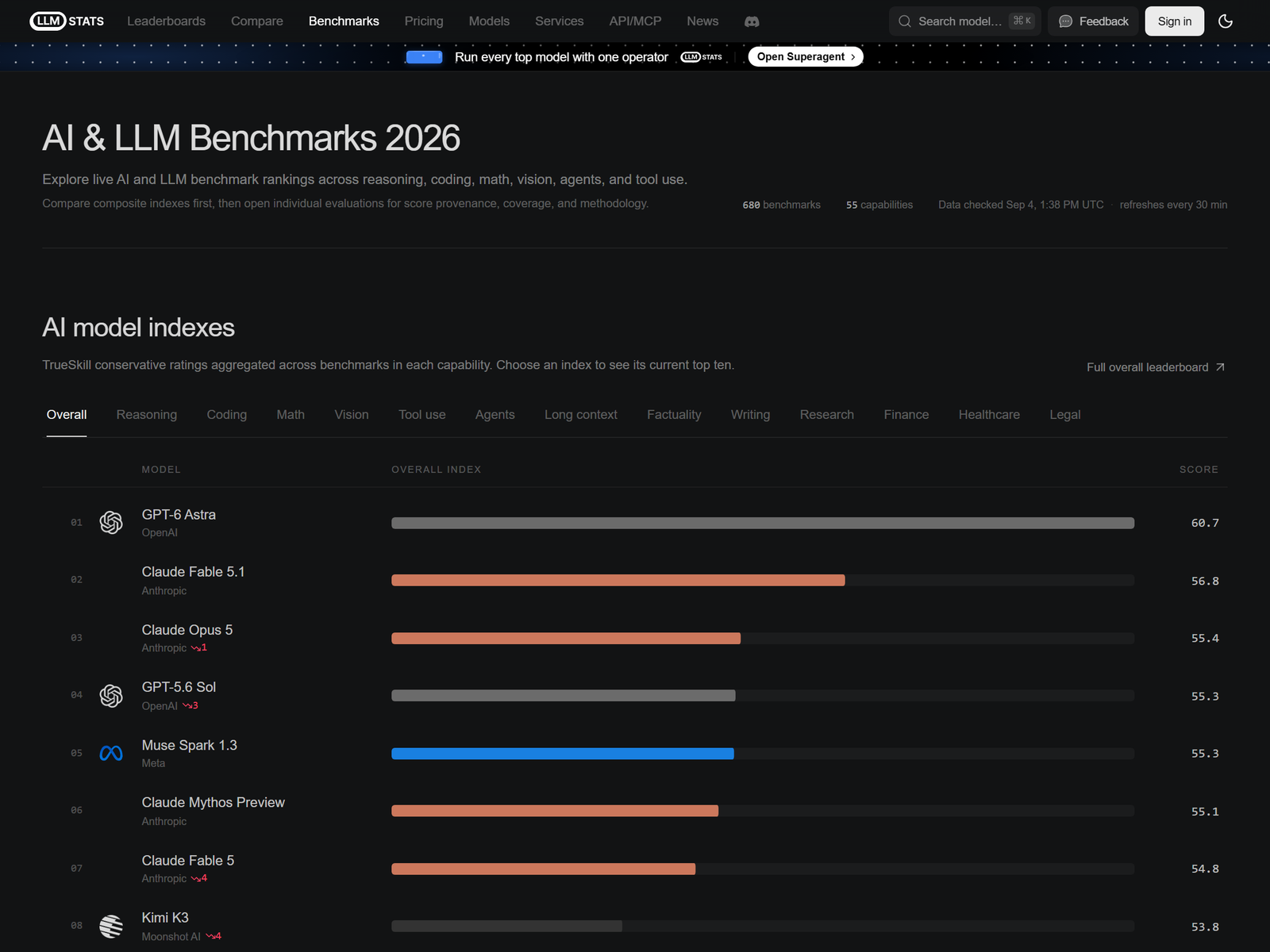
Ranking AI models in 2026 is harder than ever. In the twelve weeks before this writing, Anthropic shipped Claude Sonnet 5, Claude Fable 5, and Claude Opus 5. OpenAI shipped the entire GPT-5.6 family — Sol, Terra, and Luna — and cut prices again on August 21. The leaderboard shifts monthly, if not weekly.
We weighted four criteria: coding and agentic benchmark performance (40%), general reasoning breadth (25%), price-to-performance on published API rates (20%), and context window plus availability (15%). All benchmark figures were cross-checked against Artificial Analysis's live tracker and the Hugging Face-hosted LMArena leaderboard rather than vendor press releases alone, because self-reported and independently run numbers diverge significantly.
Coding Benchmarks: The Data
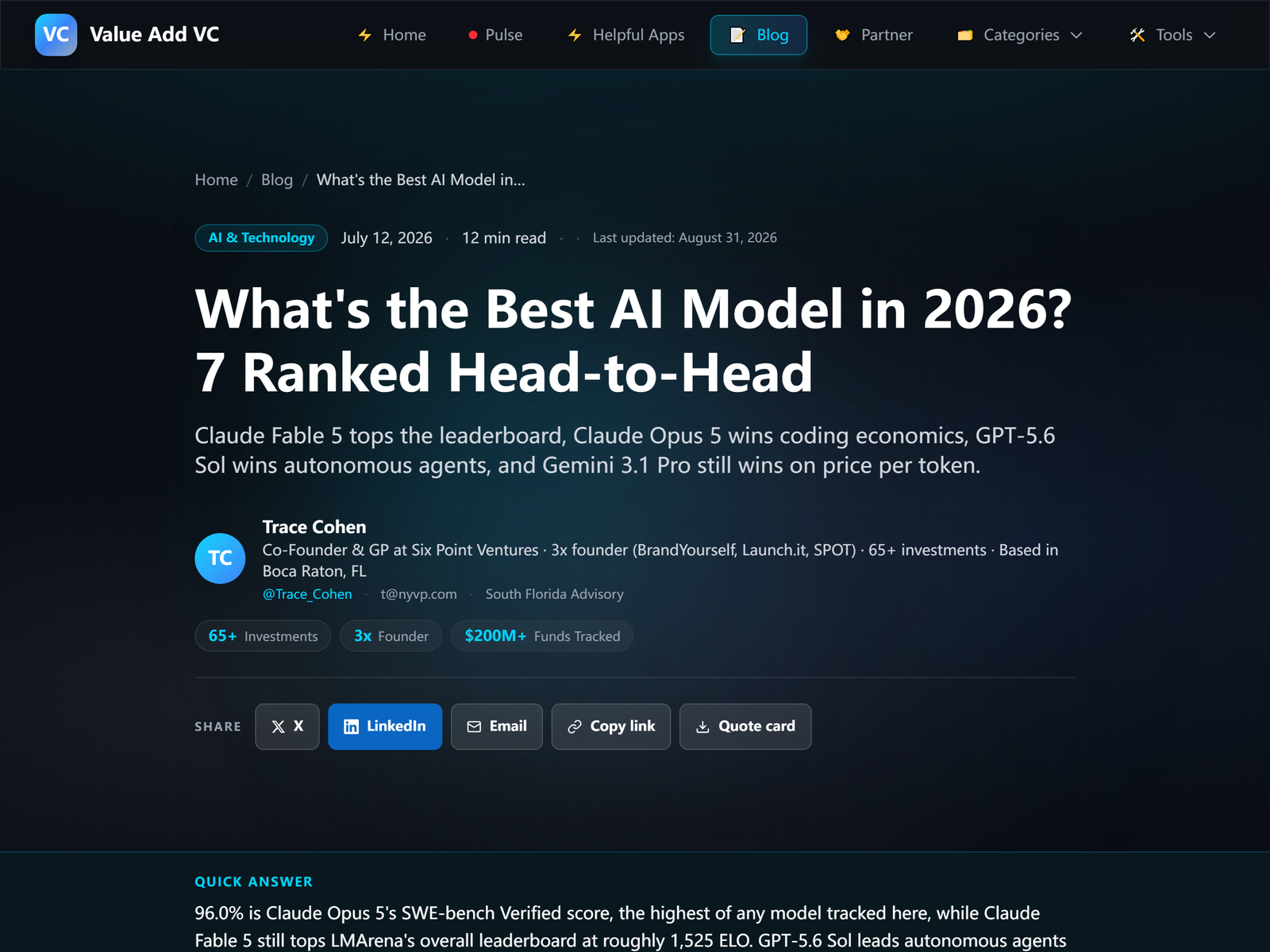
On SWE-bench Verified — the single most-watched coding benchmark for enterprise buyers — Claude Opus 5 scores 96.0%, while GPT-5.6 Sol scores 82.2%. That looks like a blowout until you check the Artificial Analysis Coding Index, where GPT-5.6 Sol narrows the gap to 78.3 versus Opus 5's 78.0. The difference is within the margin of benchmark variance.
Where GPT-5.6 Sol pulls ahead is Terminal-Bench 2.1, a multi-tool command-line benchmark that tests planning, iteration, and recovery from mistakes. GPT-5.6 Sol scores 88.8%, reflecting OpenAI's heavier investment in agentic coding workflows. On OSWorld-Verified, the two land nearly tied around 78%.
For pure coding, the honest verdict is that both models are elite. If you are building autonomous agents that iterate on terminal commands, GPT-5.6 Sol has an edge. If you are refactoring large codebases where deep reasoning matters, Opus 5 is the safer bet.
Reasoning, Agents, and Real-World Use
On the Artificial Analysis Intelligence Index, Claude Opus 5 leads 63 to 61. On the Agentic Index, Opus 5 reads 59 against GPT-5.6 Sol's 54.0. Anthropic's model also wins in blind head-to-head preference tests on creative fiction and professional drafting, according to independent evaluations by Tom's Guide and LMArena voters.
Claude Opus 5 carries a 1-million-token context window, same as GPT-5.6 Sol's ~1.05 million. Both handle long documents, multi-repo codebases, and extended video analysis. The practical difference is not window size but how they use it. Anthropic's model tends to maintain coherence better over very long contexts, while OpenAI's model is faster at retrieving specific facts from the middle of a large prompt.
Price vs Performance
This is where the comparison gets interesting. Claude Opus 5 costs $5 per million input tokens and $25 per million output tokens. GPT-5.6 Sol costs $5 per million input tokens and $30 per million output tokens. For high-volume applications, that $5 output gap adds up fast.
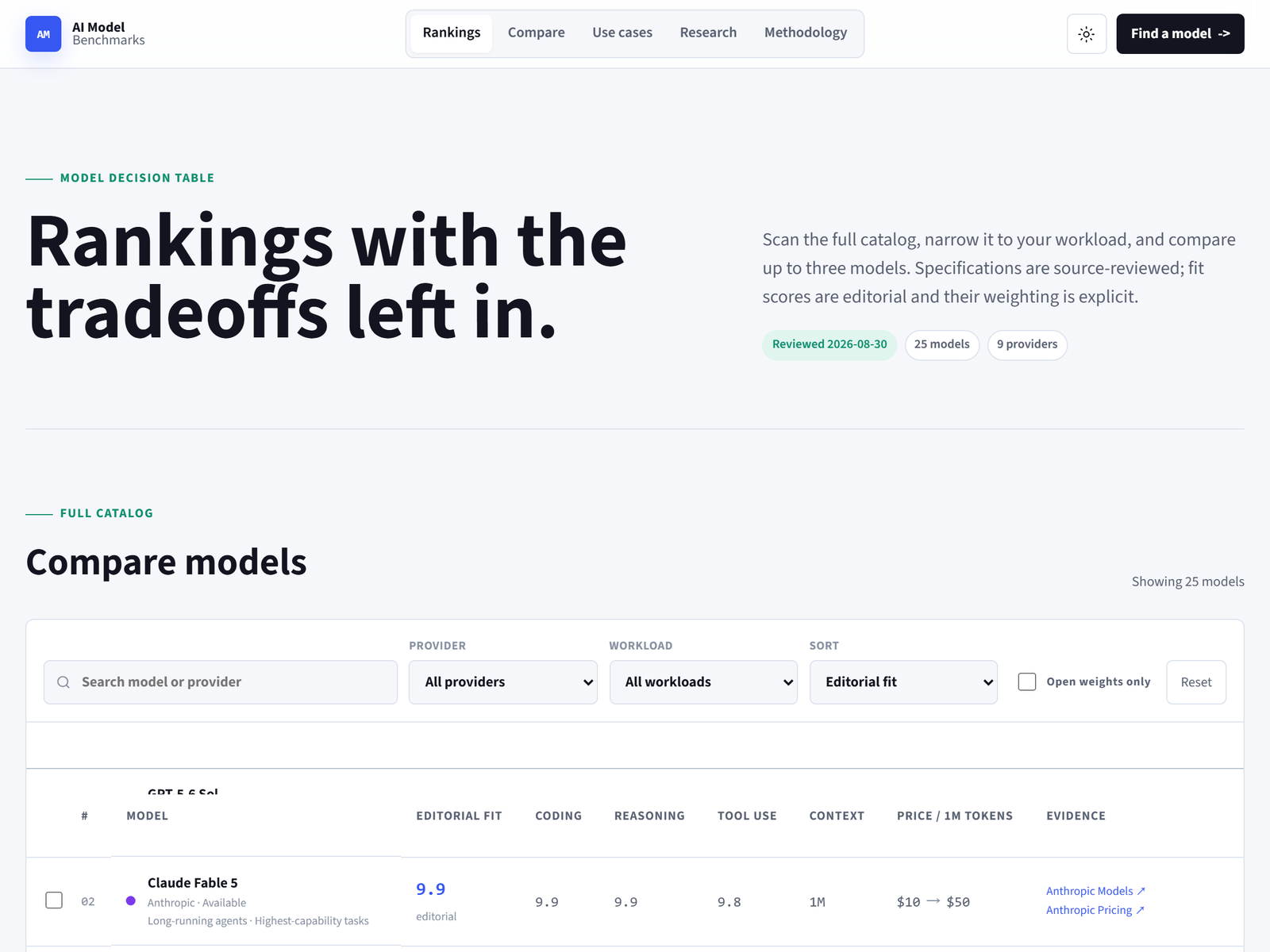
However, price is not just the API rate. Claude Fable 5 — Anthropic's highest-capability model — charges $10/$50 per million tokens, making GPT-5.6 Sol look cheap by comparison. Meanwhile, GLM-5.2 and Qwen3.8 Max deliver 80% of frontier performance at roughly 5-10% of the cost, according to 2026 price-to-performance data. If budget is tight, neither Opus 5 nor GPT-5.6 Sol is the obvious choice.
| Model | Input / Output ($/1M) | SWE-bench Verified | Context Window |
|---|---|---|---|
| Claude Opus 5 | $5 / $25 | 96.0% | 1M |
| GPT-5.6 Sol | $5 / $30 | 82.2% | ~1.05M |
| Claude Fable 5 | $10 / $50 | 95.0% | 1M |
| Gemini 3.1 Pro | $2 / $12* | 80.6%* | 1,048,576 |
*Gemini 3.1 Pro pricing rises above 200K tokens; its SWE-bench figure is Google's self-reported number, with independent runs landing 69.6-75.6%.
My Take / The Bottom Line
The frontier is too close to call. Anyone selling you a definitive winner is quoting one benchmark and ignoring the rest. Claude Opus 5 is the deeper thinker. GPT-5.6 Sol is the faster agent. If your workflow is research, writing, or complex reasoning, Opus 5 is worth the subscription. If your workflow is coding, terminal automation, or high-volume API calls, GPT-5.6 Sol is the rational default.
The smarter move is not to pick one model for everything. It is to route tasks by type. Use Opus 5 for the hard problems and GPT-5.6 Sol for the high-volume ones. That is what the best engineering teams are already doing, and it is why the "which model is best" debate is becoming less relevant than "how do I route prompts to the right model."
If you want to test both without committing to a full enterprise contract, you can explore Claude and ChatGPT through their consumer tiers first. Benchmarks are useful, but your own data is the only metric that matters. For more AI models, check our AI engine and model directory.
FAQ
Is Claude Opus 5 better than GPT-5.6 Sol at coding?
On SWE-bench Verified, Opus 5 scores 96.0% versus 82.2% for GPT-5.6 Sol. On terminal-based agentic coding, GPT-5.6 Sol leads 88.8% to Opus 5's unpublished Terminal-Bench score. It depends on the coding task.
Which model is cheaper?
Claude Opus 5 is slightly cheaper on output at $25 per million tokens versus GPT-5.6 Sol's $30. Both charge $5 per million input tokens.
What is the best value AI model in 2026?
For raw price-to-performance, GLM-5.2 and Qwen3.8 Max deliver roughly 80% of frontier capability at a fraction of the cost. For frontier tasks, Claude Sonnet 5 and Gemini 3.1 Pro offer strong middle-ground pricing.
How often do these benchmarks change?
Very frequently. In the twelve weeks before September 2026, Anthropic shipped three major models and OpenAI shipped the entire GPT-5.6 family plus a price cut. Verify current numbers before committing production spend.
Should I use one model or multiple?
Multiple. The best engineering teams route tasks by model strength rather than forcing every prompt through a single API. Opus 5 for deep reasoning, GPT-5.6 Sol for agentic coding, and a cheap fast model for simple queries.