Apple Intelligence China 2026: Why Qwen Powers Siri
Category: Tool Dynamics
Excerpt:
Apple Intelligence China runs on Alibaba's Qwen: Siri, Compose with Qwen and Ask Qwen go into beta November 4, shipping with iOS 27.3 in December 2026.
This analysis was written by the aifreetool Editorial Team, a group of full-time AI-industry researchers who verify platform changes against company statements and regulator filings. Last updated November 2, 2026. We hold no affiliate relationship with Apple or Alibaba Group.
TL;DR: Apple Intelligence in China will run on Alibaba's Qwen, the two companies confirmed on October 31, 2026. Qwen powers Siri answers, a Compose with Qwen writing tool and an Ask Qwen visual lookup. A developer beta opens November 4 and the public build ships with iOS 27.3 in December. The feature is opt-in, it asks permission before each request, and Alibaba says it will not train on prompts or replies. Apple is buying a compliant model layer, not a differentiated one.
What Apple and Alibaba actually announced
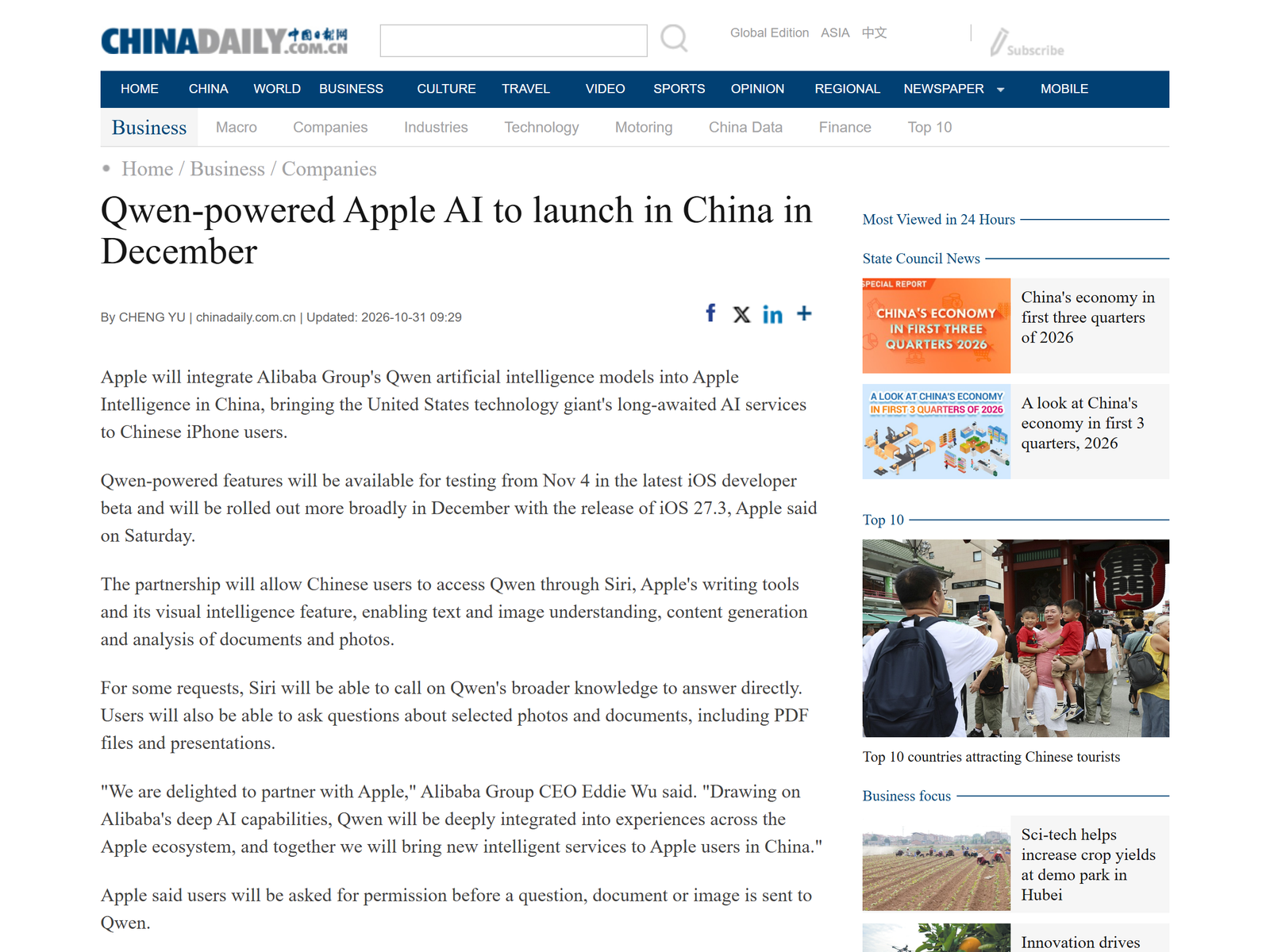
Qwen appears in three places inside Apple Intelligence. Siri can route questions to Qwen's broader knowledge base and answer directly. Writing Tools gains a Compose with Qwen option that drafts text and generates images from a prompt. Visual Intelligence gains an Ask Qwen entry point for identifying objects and places, reachable from Camera Control, the Action button or Control Center.
The plumbing matters more than the feature list. The integration is opt-in, users sign in with either Sign in with Apple or an existing Qwen account, and Apple asks for consent before a question, document or image leaves the device for Qwen. Users can also send selected photos, PDFs and presentations into that Qwen call. Alibaba committed that requests and generated replies are not used for model training.
Timing is fixed. A developer beta opens November 4, and the public release arrives with iOS 27.3 in December, according to China Daily. Alibaba chief executive Eddie Wu framed it as Qwen being integrated deeply across the Apple ecosystem for users in China.
Why it took two years
Apple Intelligence was unveiled at the Worldwide Developers Conference in 2024. It never shipped in China, because a generative model pipeline has to clear a filing process before it can sit inside a phone sold there. That process moved in stages through 2026.
In July, China's cyberspace administration published a list of seven on-device generative AI services that had completed filing, and Apple Intelligence was on it, registered to Apple Technology Development (Shanghai). In October, the industry ministry approved Alibaba's models for use in several Apple handsets, including the new iPhone Duo. The December release is the visible result, as Global Times reported.
The December update is a subset, not the whole product. Real-time translation, photo object removal, notification and email summaries, smart replies, and rewriting or proofreading tools all arrive. The advanced Siri capabilities and the other Apple Intelligence features shown at this year's developers conference do not.
Who actually gets it
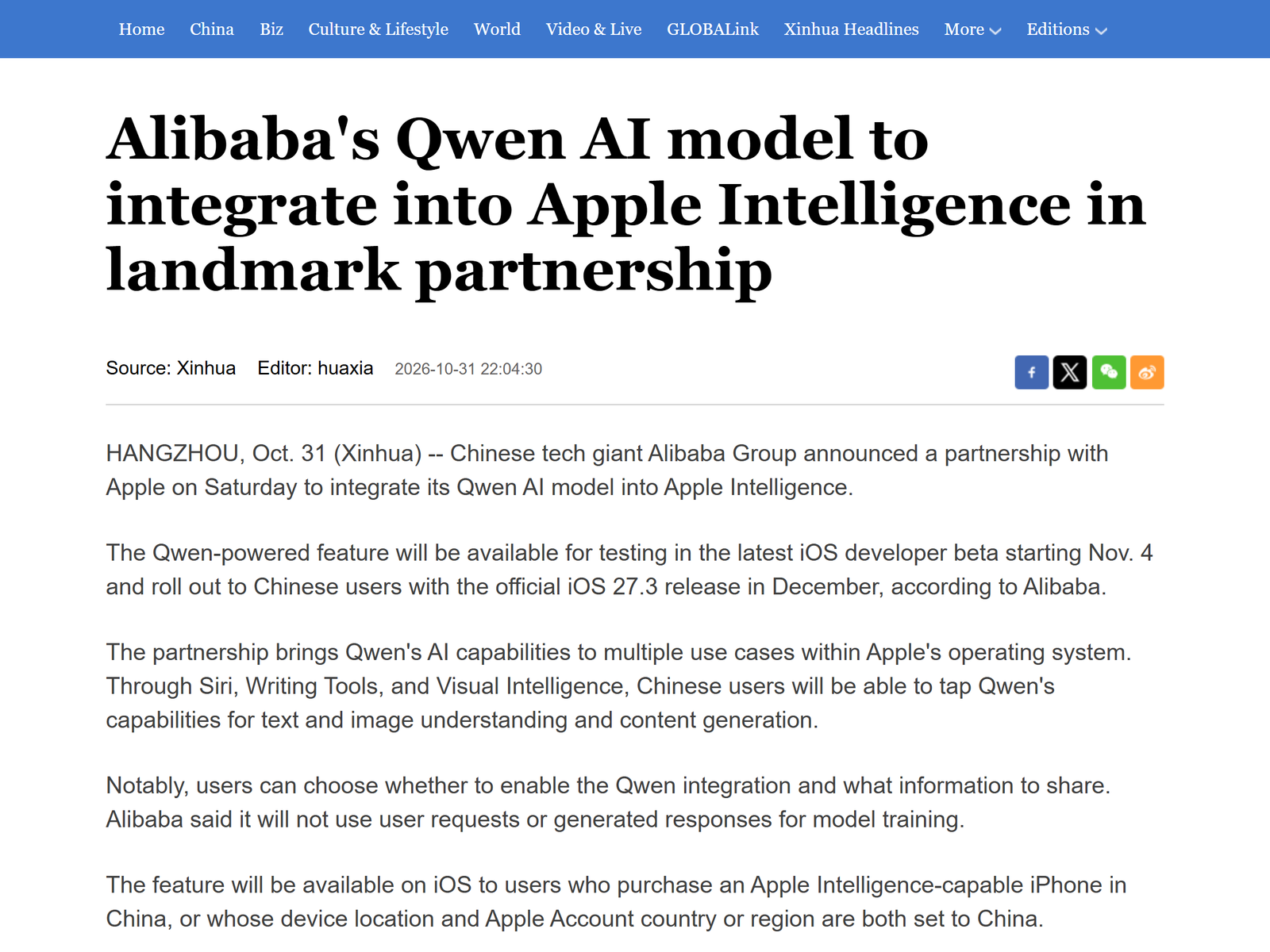
| Requirement | Detail |
|---|---|
| Device | iPhone 15 Pro and Pro Max, iPhone 16 and later, iPhone Air, iPhone Duo |
| Where bought | An Apple Intelligence-capable iPhone purchased in China |
| Region settings | Device location and Apple Account country both set to China |
| Languages | Device and Siri language set to English or Simplified Chinese |
| Platform | iOS first; iPadOS, macOS and visionOS follow after further approvals |
Apple gets a functioning assistant in one of its largest hardware markets. Alibaba gets something harder to buy than an app install: a default slot inside the operating system that hundreds of millions of people already use. The company described the plan as covering iOS, iPadOS, macOS and visionOS as clearances land.
What each side gave up
Apple gave up model differentiation in China. Its own on-device foundation models still handle local tasks, but the interesting requests, the ones needing world knowledge or fresh content generation, now route to a partner's model. Wang Xiaojie, an AI researcher at Beijing University of Posts and Telecommunications, called it the first time a top global hardware maker has used a Chinese model as the primary system-level AI backbone in that market.
Alibaba gave up data. No training on requests, no training on replies, and no visibility into anything the user declines to share. That concession is what made the deal workable, and it is also why Qwen improves from this partnership more slowly than a western lab would.
Third parties lost the default. Every Chinese AI writing app that lived on the App Store's writing-tools shelf now competes with a button inside the text field. The same applies to visual lookups and to the standalone assistant market.
Key Takeaways
- Qwen enters Apple Intelligence through Siri, Writing Tools and Visual Intelligence, with a November 4 developer beta and an iOS 27.3 release in December 2026.
- The December build ships a subset. Advanced Siri and the newer Apple Intelligence features stay out of scope for now.
- Consent is per request, the integration is opt-in, and Alibaba cannot train on user traffic.
- Model choice stops being a differentiator for Apple in China and becomes a procurement decision, the same shift we track across the tool dynamics beat.
My Take / The Bottom Line
This is a distribution deal disguised as a product launch. The model layer in China is now a commodity input that a phone maker can source, file and ship. The durable asset is the permission surface: the camera button, the text field, the assistant that answers before an app opens. Whoever owns that surface sets the terms, and Apple still owns it.
For builders, the practical change is architectural. If you ship anything in China, assume Siri becomes a Qwen front end and that users will ask your product to hand work to it. Design for the handoff instead of fighting it. If you call Qwen directly, the Qwen model listing on our site covers the capability spread, and multi-model routing layers like Intrascope 2.0 exist precisely because no single vendor wins every request.
The uncomfortable part: Apple spent two years to reach parity with what Huawei and Xiaomi already shipped on domestic models. Parity is the floor now, not the goal.
FAQ
Is Qwen replacing Siri in China? No. Siri stays the interface. For some requests it calls Qwen for world knowledge, document questions and content generation, after asking the user for permission.
Can I turn Qwen off? Yes. The integration is opt-in and can be disabled after enabling. Users choose which questions, documents and images reach Alibaba's model.
Does Alibaba train on my prompts? The company says no. Requests and generated replies from the Apple integration are excluded from model training, a narrower commitment than the default terms on the Qwen app.
When do Mac and iPad get it? After further approvals. Alibaba has said the plan covers iOS, iPadOS, macOS and visionOS, with iOS shipping first in December 2026.
Does this affect iPhone sales outside China? Not directly. The integration is region-locked to devices bought in China with both location and account country set there, so Apple's other markets keep their existing model setup.