Gemini 4 Argon Review: How Google Priced Its 2026 Comeback Model
Category: Tool Dynamics
This analysis was written by the aifreetool Editorial Team — full-time AI researchers who cross-check every benchmark against the original source. Last updated October 7, 2026. We keep no affiliate relationship with any company covered here.
TL;DR: Gemini 4 Argon is Google's first Gemini 4-generation frontier model, announced September 30 with a 1-million-token output limit and a $2/$10 introductory price per million input/output tokens. It tops the Vals Index at 68.9% and posts the lowest hallucination rate of any high-scoring model — but almost nobody can use it yet.
Google needed a comeback, and Gemini 4 Argon is the bid. After a stretch in which Gemini 3.5 Pro was delayed into oblivion and rivals shipped model after model, DeepMind chief AI architect Koray Kavukcuoglu announced Argon on September 30, 2026 as a frontier SKU built for long-horizon coding, enterprise knowledge work, and defensive cybersecurity. We reviewed the launch data, the independent benchmarks, and the rate card. The numbers are strong; the access story is the catch.
What Gemini 4 Argon Actually Is
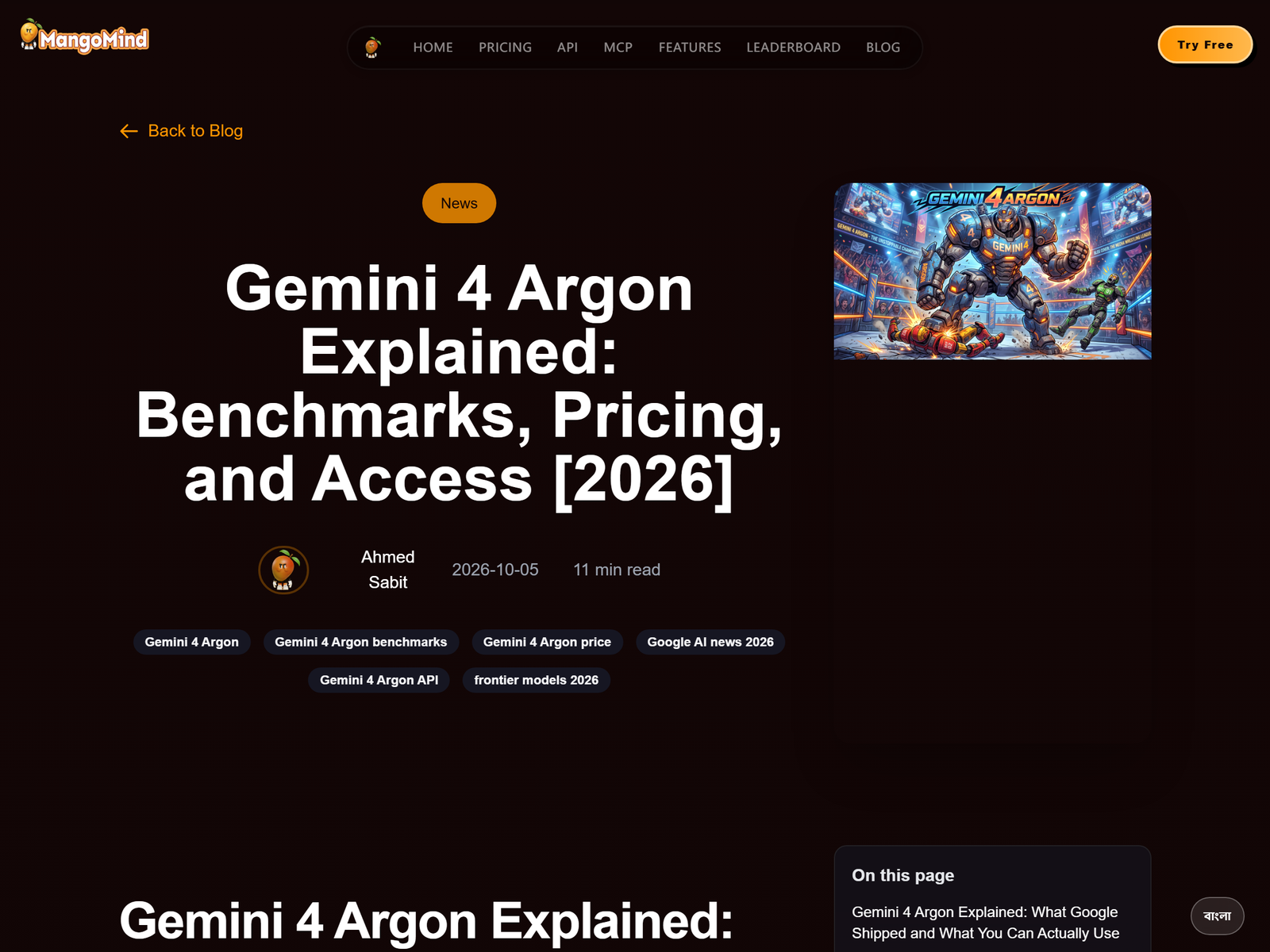
Argon is not in the public Gemini API catalog as of this week. Access starts with trusted testers in the Fairwind Program — aimed first at cyber defenders — plus a U.S. government pre-release process. Paid API customers and Google AI Ultra subscribers come later, with no announced date. The headline specs: up to 1 million output tokens (15x the previous 64K ceiling), built for audits, code migration, and agent workflows that run past a single response. Google also added Long Decode Continuation, an API feature that pauses long responses and resumes them across follow-up calls — the mechanism launch trackers documented in detail.
The Benchmark Record: Strong, Not Sweeping
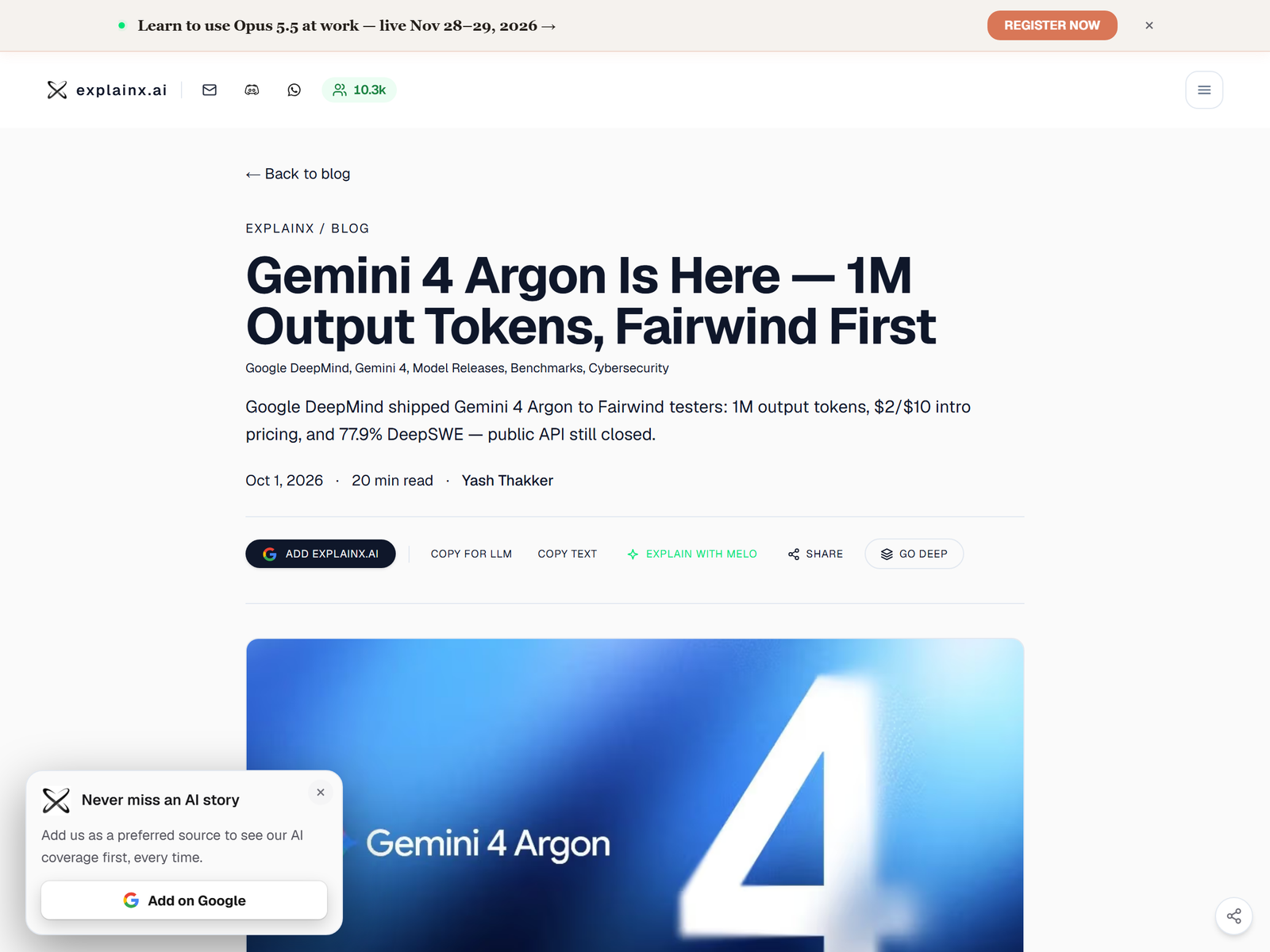
The core results are real. Argon took first place on the Vals Index — a GDP-weighted measure of finance, coding, legal, and tax work — at 68.9%, the first Gemini ever to top that ranking. It scored 77.9% on DeepSWE v1.1 (long-horizon software engineering), became the first model to clear 50% on Zapier's AutomationBench at 51.3%, hit 91.7% on the LVBench long-video test, and landed #1 on Arena.ai's Text Arena with 1,525 Elo, per the full launch benchmark matrix. On the Artificial Analysis Intelligence Index it scored 53, tying GPT-6 Astra (max) and trailing Claude Opus 5.5 at 58.
The honesty metric is the most interesting number. On AA-Omniscience, Argon's hallucination rate is 15% — the lowest of any model scoring 45 or higher, versus 51% for GPT-6 Astra. The trade-off: Argon answers 50% of questions correctly against Astra's 63%. It knows slightly less and admits ignorance far more often. Argon also loses on some fronts: FrontierSWE v2 (55.0% versus Astra's 65.5%), Terminal-Bench 4.0 (Opus 5.5 leads at 66.4%), and Terminal-Bench Science (Astra at 68.1%). Bloomberg reported internal Google skepticism that benchmark gains translate to real-world coding, especially front-end work; Google disputed the characterization.
What It Costs: The Table That Decides Everything
| Rate (per 1M tokens) | Gemini 4 Argon (intro) | GPT-6 Astra | Claude Opus 5.5 |
|---|---|---|---|
| Input | $2.00 | $10.00 | $4.00 |
| Output | $10.00 | $50.00 | $20.00 |
| Input (standard) | $4.00 | $10.00 | $4.00 |
| Output (standard) | $20.00 | $50.00 | $20.00 |
| Cached input | $0.10 | $1.00 | $0.20 |
The per-task math cuts the discount down to size. Artificial Analysis measured Argon at about 62,000 output tokens per Intelligence Index task — more than double Astra's 27,000. At intro pricing that is $1.99 per task (60% of Astra's $3.26); at the standard $4/$20 rate it rises to $3.98, about 1.2x Astra, per the most complete published rate-card analysis. Google has not said how long the introductory rate lasts. Budget on $4/$20 and treat $2/$10 as a promotion.
Inside Google: Where Argon Already Works
This is the part benchmarks cannot fake. Google says thousands of employees run Argon on real work: a quantum computing team cut a bottleneck subroutine's time-space cost by 40% versus the published baseline; memory-optimization agents freed over 300 TiB across Google's fleet, with total savings projected at 500 TiB to 1 PiB. Argon is migrating internal C/C++ to Rust, including more than 800,000 lines of the Fuchsia OS Zircon kernel, and rebuilt the libgav1 video decoder in 32,000 lines of safe Rust that runs 2.7x faster than the previous port. On security, cloud firm Wiz used Argon in its goodwill-scanning program and surfaced a critical vulnerability in hospital software that earlier frontier models missed. On Gray Swan's indirect prompt-injection test, Argon's attack success rate was 0.7% versus Opus 5.5's 1.0% and Astra's 8.5%.
Key Takeaways
- Gemini 4 Argon launched September 30, 2026: 1M output tokens, Fairwind testers first, public API access still gated.
- #1 on Vals Index (68.9%), DeepSWE v1.1 (77.9%), and Text Arena (1,525); AA Intelligence Index 53, tying GPT-6 Astra.
- 15% hallucination rate versus 51% for GPT-6 Astra — it declines rather than guesses.
- Intro pricing of $2/$10 moves to $4/$20 later; per-task cost flips from 60% of Astra to 1.2x.
My Take / The Bottom Line
Argon is the first Gemini in a year that deserves the word "frontier" without an asterisk, and Google priced it as a wedge: undercut OpenAI by 5x on paper, win the developer conversation, and fill the gap before public access opens. My read — the discount is a customer-acquisition cost, and the standard $4/$20 rate is the real product: priced exactly like Opus 5.5, judged on honesty and long-context work instead of raw knowledge. Who wins: teams doing audits, code migration, and document-heavy analysis, once an endpoint exists. Who loses: nobody today, because almost nobody can buy it. The practical move is to shortlist Argon for next quarter's planning, keep running current models, and re-check the rate card the week Google publishes a promotion end date. If you are choosing between frontier APIs meanwhile, our AI model comparisons track pricing and benchmark drift weekly, and our AI coding tools roundup covers the assistants these APIs power.
Frequently Asked Questions
Q: Can I use Gemini 4 Argon today?
A: No. As of October 7, 2026, there is no public model ID. Access runs through the Fairwind Program for trusted cyber defenders and a U.S. government pre-release process, with paid API and Google AI Ultra customers next in line.
Q: What is Gemini 4 Argon's best benchmark result?
A: It leads the Vals Index at 68.9% (first place among 43 models), scores 77.9% on DeepSWE v1.1, and tops Text Arena at 1,525 Elo. It also posts the lowest hallucination rate (15%) of any model scoring 45 or higher on the AA Intelligence Index.
Q: How does Argon's pricing compare to GPT-6 Astra?
A: Intro pricing is $2 input / $10 output per million tokens versus Astra's $10/$50. After the promotion, Argon moves to $4/$20 — one fifth of Astra's output price, but per-task cost lands about 1.2x Astra because Argon generates more than twice the tokens.
Q: Is Argon better than Claude Opus 5.5?
A: On knowledge-work benchmarks, yes — Vals Index and AutomationBench both favor Argon. Opus 5.5 keeps the higher Artificial Analysis score (58 versus 53) and leads Terminal-Bench 4.0. It depends on whether your workload is agentic knowledge work or terminal-heavy engineering.