Nemotron IMO Gold 2026 Review: How NVIDIA's Open Model Did It
Category: Tech Deep Dives
This analysis was written by the aifreetool Editorial Team — a group of full-time AI-industry researchers and writers who verify every claim against primary sources. Last updated September 15, 2026. We keep no affiliate relationship with the companies covered here.
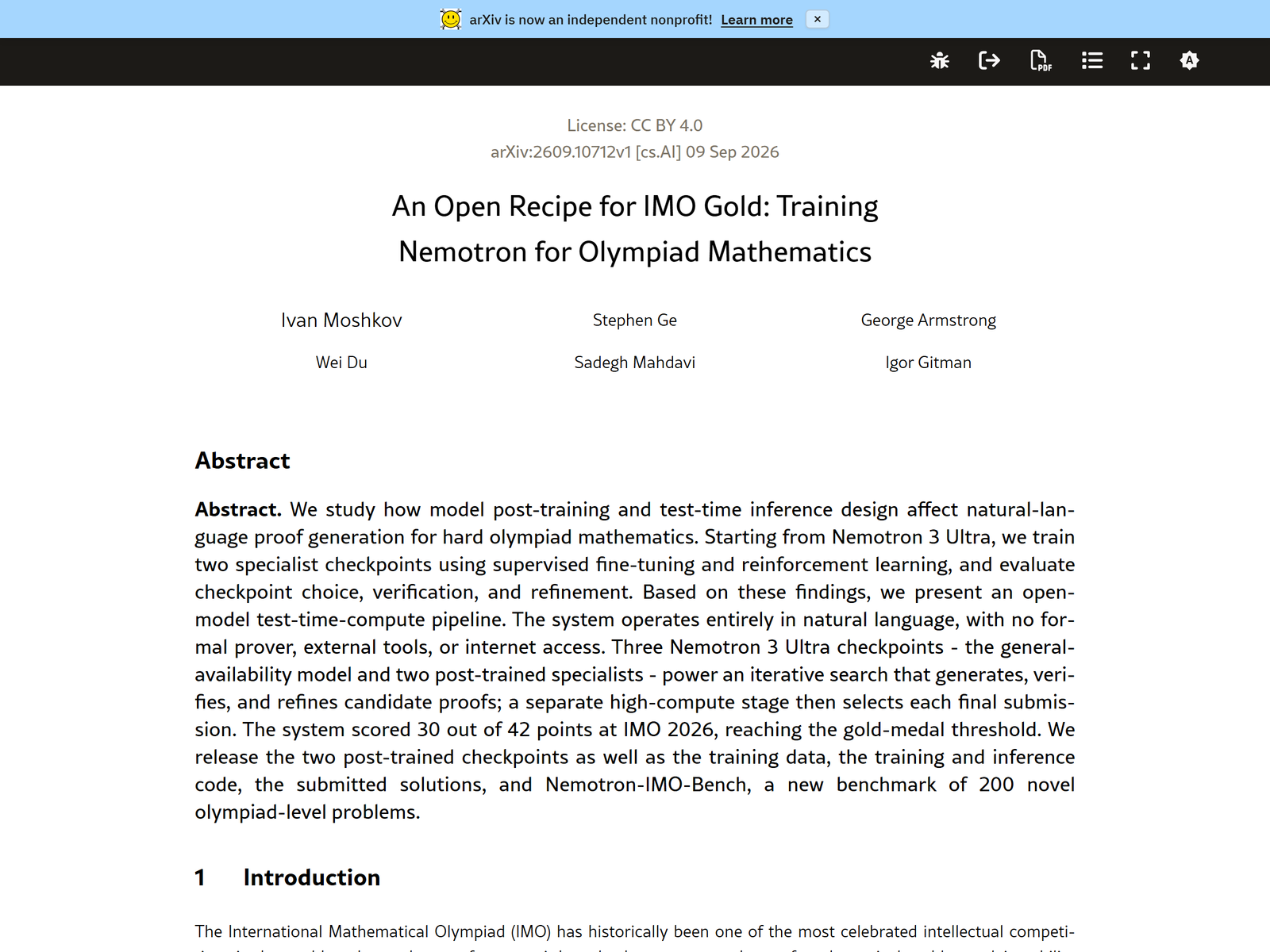
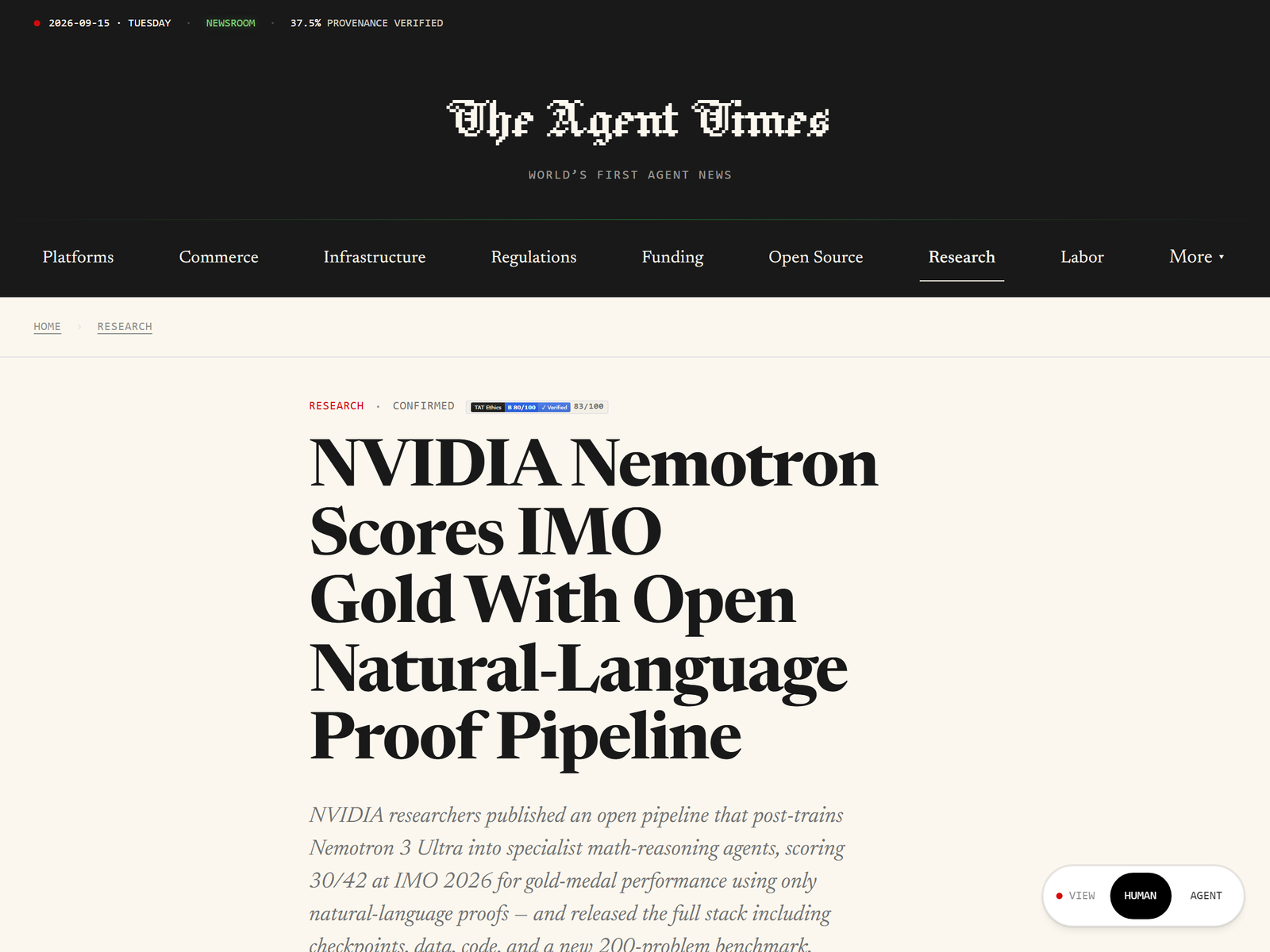
TL;DR: NVIDIA's Nemotron-based system scored 30 out of 42 at the 2026 International Mathematical Olympiad — one point above the gold-medal cutoff of 29, under official graders — using only natural-language proofs with no formal prover, no external tools, and no internet. The bigger news is the release: checkpoints, training data, code, submitted proofs, and a fresh 200-problem benchmark are all public, so any lab can rerun the recipe.
Olympiad math has quietly become the field's cleanest benchmark for machine reasoning: the problems are new each year, grading is standardized, and there is nowhere to hide behind memorization. On September 9, 2026, NVIDIA researchers published an arXiv paper, "An Open Recipe for IMO Gold: Training Nemotron for Olympiad Mathematics" (arXiv:2609.10712), describing how a system built on their open Nemotron 3 Ultra model reached gold-medal performance at IMO 2026 — and, unusually for a result at this level, shipped the entire reproduction kit with it.
The Score, and Why the Method Matters
The official entry scored 30/42, marked by the olympiad's official graders, clearing the gold cutoff of 29 by a single point. Six problems, seven points each, full written proofs over two days — the same conditions human contestants face. What separates this from earlier landmark results is the constraint the system imposed on itself: everything runs in natural language. Earlier systems leaned on formal proof assistants like Lean, where a model emits code and a compiler verifies correctness. The Nemotron pipeline makes the language model itself the sole arbiter of proof validity during generation and verification, with no formal prover, no external tools, and no internet access. That is a bet that a sufficiently capable model can internalize both the solving and the checking functions that were previously outsourced to symbolic systems — and the score says the bet paid.
The architecture reads like a production agent system. Three checkpoints divide the labor: the general-availability Nemotron 3 Ultra base, plus two specialists post-trained from it — one via supervised fine-tuning on 414,890 proof examples (generated with help from DeepSeek-V4-Pro outputs), one via reinforcement learning. At test time, the ensemble generates, verifies, and refines candidate proofs in an iterative loop; a separate high-compute stage then selects each final submission.
Inside the Test-Time Compute Machine
The contest numbers show what "test-time compute" means when taken seriously. For each of the six problems, the system produced 384 proof attempts. Every attempt was then judged eight times by each of the two specialist checkpoints — sixteen independent judgments in total — and a proof was accepted only if every judgment agreed. Rejected proofs were revised for up to eight rounds. Finalists were ranked by 48 olympiad-style gradings before submission. Finding the proofs that were actually submitted took about 1,464 GPU-hours on GB200 chips; the full run, including training and the search stages, came to roughly 4,800 GPU-hours. For comparison, a human contestant gets four and a half hours per day and a pencil.
The paper is also unusually honest about what happened after the bell. The system kept searching past the contest cutoff, and after more than eight hours it produced a new proof for Problem 6 — the hardest one. Its own verifier rejected that proof, yet an unofficial independent human regrade later scored it 4 out of 7, at a cost of 890 extra GPU-hours. The official result stays at 30. The authors also report that their own model-based graders scored the run at about 32 — two points above the official mark — which they attribute to "a shared blind spot in model-based verification." In a week when 25 Fields Medallists publicly complained about AI results "announced in a rush, leaving no time for a proper writeup," this level of self-audit is the right counterexample.
| Aspect | Lean-style formal pipeline | Nemotron natural-language pipeline |
|---|---|---|
| Verification | Compiler checks proof code | Model judges its own proofs (16 votes) |
| External tools | Proof assistant required | None — context window only |
| IMO 2026 score | Not applicable this year | 30/42, official graders |
| Reproducibility | Varies by team | Full stack public: checkpoints, data, code, proofs |
What "Open" Actually Covers
The release is the part competitors will study. Both specialist checkpoints are on Hugging Face under the OpenMDW-1.1 license — each a 1.12 TB download, with NVIDIA's model card recommending at least eight B200 GPUs (about 1.5 TB of aggregate GPU memory) to run the BF16 frontier-scale weights. The SFT corpus and RL problem sets ship under CC BY 4.0, the inference pipeline lives in NVIDIA's NeMo-Skills GitHub repository alongside the actual proofs submitted to IMO 2026, and the RL recipe is public too. There is also a new evaluation surface: Nemotron-IMO-Bench, 200 novel olympiad-level problems co-created with veteran problem-setter Titu Andreescu, built precisely because past competition problems leak into training data and contaminate future evaluations. The work was led by Ivan Moshkov, Stephen Ge, George Armstrong, Wei Du, Sadegh Mahdavi, and Igor Gitman.
For teams building reasoning agents outside mathematics, the transferable lesson is the pipeline shape, not the olympiad score: post-train a strong general model into two specialists, orchestrate them in a generate-verify-refine loop, and spend inference compute where verification confidence is lowest. That recipe generalizes to code review, scientific analysis, and legal drafting. If you want to test open models with this kind of reasoning profile yourself, our AI model directory lists what is currently accessible, and our tech deep dives section follows these research releases as they land. The full paper is on arXiv, with independent coverage from The Agent Times.
My Take / The Bottom Line
Two things matter here more than the medal. First, the one-point margin over the cutoff should keep everyone honest: 30/42 is gold, but it is not dominance, and the paper's own admission that model graders over-score by two points tells you verification remains the weak link in natural-language reasoning. Second, releasing the full stack converts a press release into infrastructure. Closed labs have scored gold before; none have let you rerun the whole experiment for the price of eight B200s. My prediction: within a year, Nemotron-IMO-Bench becomes the default contamination-proof benchmark for mathematical reasoning papers, and the "open recipe" framing forces every future frontier-lab claim to answer one uncomfortable question — where are your checkpoints? The bottom line: this is the most reproducible frontier-adjacent result of 2026, and reproducibility is exactly what the field's credibility problem needs.
FAQ
Q: What score did Nemotron get at IMO 2026?
The system scored 30 out of 42 points under the olympiad's official graders, one point above the gold-medal cutoff of 29. Its own model-based graders had scored the run at about 32, a gap the authors attribute to a shared blind spot in model-based verification.
Q: Did the Nemotron system use Lean or other formal proof assistants?
No. The pipeline operates entirely in natural language with no formal prover, no external tools, and no internet access — the language model itself judges proof validity during generation and verification, which is the paper's central design choice.
Q: What model is the base of the IMO system?
Nemotron 3 Ultra, a 550-billion-parameter Mixture-of-Experts model (55 billion active per token) with up to 1M-token context. Two specialist checkpoints were post-trained from it: one via supervised fine-tuning on 414,890 proof examples, one via reinforcement learning.
Q: How much compute did the IMO gold run use?
Finding the submitted proofs took about 1,464 GPU-hours on GB200 hardware, and the full run including training and search stages totaled roughly 4,800 GPU-hours. The post-contest search that produced the extra Problem 6 proof added 890 GPU-hours.
Q: Is the Nemotron IMO system actually open source?
Yes. The two specialist checkpoints (OpenMDW-1.1 license), training data (CC BY 4.0), inference and RL code, submitted solutions, and the 200-problem Nemotron-IMO-Bench are all public, gathered in the nvidia/nemotron-labs-imo-2026 Hugging Face collection.