Why AI Data Centers Want 100GW of Grid Space in 2026
Category: Tech Deep Dives
This analysis was written by the aifreetool Editorial Team — a group of full-time AI-industry researchers and writers who verify every claim against primary sources. Last updated September 18, 2026. We keep no affiliate relationship with the companies covered here.
Quick answer: Google, Nvidia and Anthropic have joined startup Emerald AI to launch the AI Energy Management Alliance, a coalition of about 20 organizations that wants AI data centers to cut power use during grid stress in exchange for faster interconnections. The group claims up to 100GW of headroom on a US grid that averages roughly 50 percent utilization — space for new data centers without waiting a decade for new power plants.
What the Alliance Actually Is
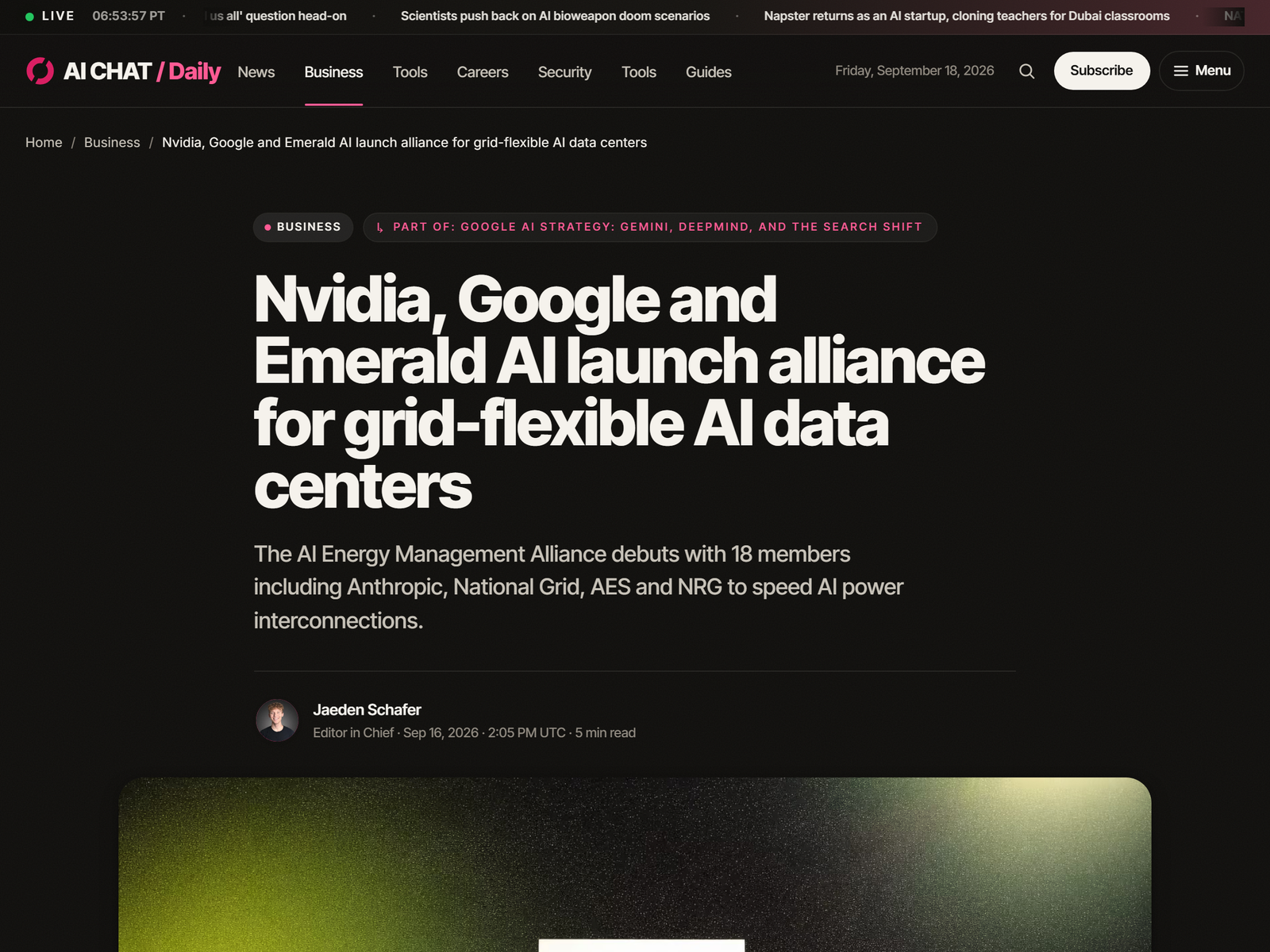
The AI Energy Management Alliance (AEMA), announced September 16, 2026, is effectively a revival of the dormant Advanced Energy Management Alliance, refocused on AI-era power demand and given a dedicated executive director (GenAI Daily). Its founders are grid-software startup Emerald AI, Google, and Nvidia. Launch partners include Anthropic, utilities National Grid and AES, power producers Constellation, NRG and RWE, chipmaker Analog Devices, and data-center operator Digital Realty. The company at the center, Emerald AI, builds the Emerald Conductor platform, which links utilities directly to data centers so facilities can pause non-critical tasks or shift workloads the way a battery responds to peak demand. It raised a $150 million Series A in August 2026 at a $1.05 billion valuation, led by Energize Capital and DCVC, with Nvidia's NVentures among its investors — more than $220 million raised in total.
The Math Behind the 100GW Claim

The US grid is built for the hottest afternoon of the year, which means most of its capacity sits idle most of the time — average utilization is roughly 50 percent. Demand response is the old utility practice of paying large users to trim consumption during peaks. The alliance's argument is that AI training and inference loads are unusually well suited to it: clusters can ramp down quickly and shift work to other regions. Goldman Sachs estimated last year that capping data-center peak draw at 90 percent for a few hours at a time would free 76GW. AEMA's own figure, up to 100GW, assumes flexibility is embedded in interconnection planning from the start. The Brattle Group adds a consumer angle: every 10 percent gain in grid utilization translates to about a 3.4 percent cut in electricity rates. Today the common fallback for data-center demand response is starting backup diesel generators — exactly the optics problem this coalition wants to retire.
| Number | What it means | Source |
|---|---|---|
| 100GW | Potential grid headroom from flexible data centers | AEMA, 2026 |
| 76GW | Headroom if peak draw is capped at 90 percent | Goldman Sachs, 2025 |
| 3.4% | Rate cut per 10% utilization gain | Brattle Group |
| ~1GW | Google's existing demand-response portfolio | |
| ~100MW | Power-flexible AI factory pilot in Virginia | Nvidia / Digital Realty / Emerald AI |
| 10+ years | Current wait for a new grid connection | AEMA |
Proof Points and Regulatory Tailwinds
The most concrete demonstration arrives later this year in Virginia, where Nvidia, Digital Realty and Emerald AI plan to switch on a nearly 100MW power-flexible AI facility, designed to prove a training site can behave as a controllable load rather than a fixed 24/7 draw (TechCrunch). The group has already run six global demonstrations, and Google brings roughly a gigawatt of committed flexible demand arranged through utility agreements across the country. Regulators are moving the same way: in June, the Federal Energy Regulatory Commission directed the six regional grid operators to accommodate large customers willing to limit draw in return for faster connections, Texas is finalizing rules for controllable data centers, and Silicon Valley Power launched the first flexible-load interconnection program in the country. The push is also defensive. New polling released the same week found a large majority of Americans worried about data centers pushing up local electricity bills, with unusually broad bipartisan agreement that builders should help pay for grid upgrades (AI Chat Daily).
Key Takeaways
- AEMA launched September 16, 2026 with Emerald AI, Google and Nvidia as founders and about 20 members including Anthropic, National Grid, AES, Constellation and NRG.
- The core trade: data centers that verifiably trim or shift power during peaks get faster, larger grid connections.
- The 100GW claim rests on a US grid averaging roughly 50 percent utilization; Goldman Sachs estimates 76GW from a 90 percent peak-draw cap alone.
- A nearly 100MW power-flexible AI facility in Virginia, run with Nvidia and Digital Realty, is the flagship proof point later this year.
- FERC, Texas regulators and Silicon Valley Power are already moving toward flexible interconnection rules.
My Take / The Bottom Line
Power, not chips, is now the binding constraint on AI, and this alliance is the first serious attempt to treat that constraint as an operations problem instead of a construction problem. I am skeptical of the headline number — 100GW assumes utilities trust verifiable flexibility at scale, and a paused training run is a delayed model release, which no lab wants. But the alternative is worse: developers who cannot get grid power are building behind-the-meter campuses with their own gas turbines, which raises costs and pushes rates up for everyone else. Amazon's private power plant in Texas is the cautionary tale. My advice to anyone siting compute in 2026: ask whether a facility can curtail on schedule, because within eighteen months that question will decide which projects get connected and which stall in the queue. We track the compute buildout closely in our Tech Deep Dives and AI Engine and Model sections.
FAQ
Q: What is the AI Energy Management Alliance?
A: A coalition founded by Emerald AI, Google and Nvidia on September 16, 2026, with about 20 members including Anthropic, National Grid, AES, Constellation and NRG, pushing for data centers to get faster grid connections in exchange for verifiable demand flexibility.
Q: How could data centers free up 100GW of grid capacity?
A: By trimming or shifting electricity use during the few peak hours the grid was sized for. Goldman Sachs estimates a 90 percent peak-draw cap alone would free 76GW; the alliance claims up to 100GW when flexibility is built into planning.
Q: Who is Emerald AI?
A: A grid-software startup whose Emerald Conductor platform orchestrates AI workloads and on-site energy so data centers can respond to utilities like a battery. It raised $150 million at a $1.05 billion valuation in August 2026.
Q: Will this mean fewer new power plants?
A: Some, not all. Emerald AI chief scientist Ayse Coskun told TechCrunch the technology dampens the industry's need for new generation but does not eliminate it.