DeepSeek Full App API Review 2026: Search, OCR, Voice Pricing
Category: Tool Dynamics
Excerpt:
DeepSeek's full app API opens search, OCR, ASR, TTS and file tools inside deepseek-flash. Full pricing, limits and what it means for small dev teams.
This analysis was written by the aifreetool Editorial Team — a group of full-time AI-industry researchers and writers who verify every claim against primary sources. Last updated November 17, 2026. We keep no affiliate relationship with the companies covered here.
TL;DR: DeepSeek opened its entire consumer app experience to developers on November 13, 2026, and in this review of the release we break down what it costs and who it hurts. The DeepSeek full app API puts search, file parsing, link reading and safety checks inside the deepseek-flash model endpoints, with standalone Search, Fetch, OCR, ASR and TTS APIs alongside — priced from $0.116 per hour of speech recognition to $0.75 per 1,000 search calls. One vendor now replaces three or four.
DeepSeek's product used to be a model you called. Now it is a product you can clone. A November 13 changelog entry quietly did something most AI labs still refuse to do: it handed developers every capability behind the DeepSeek app — the search engine, the document reader, the voice stack — as billable API building blocks. The pricing is aggressive, the bundling is deliberate, and the clearest casualties are the point-solution API vendors selling individual pieces of that stack.
What the Full App API Actually Contains
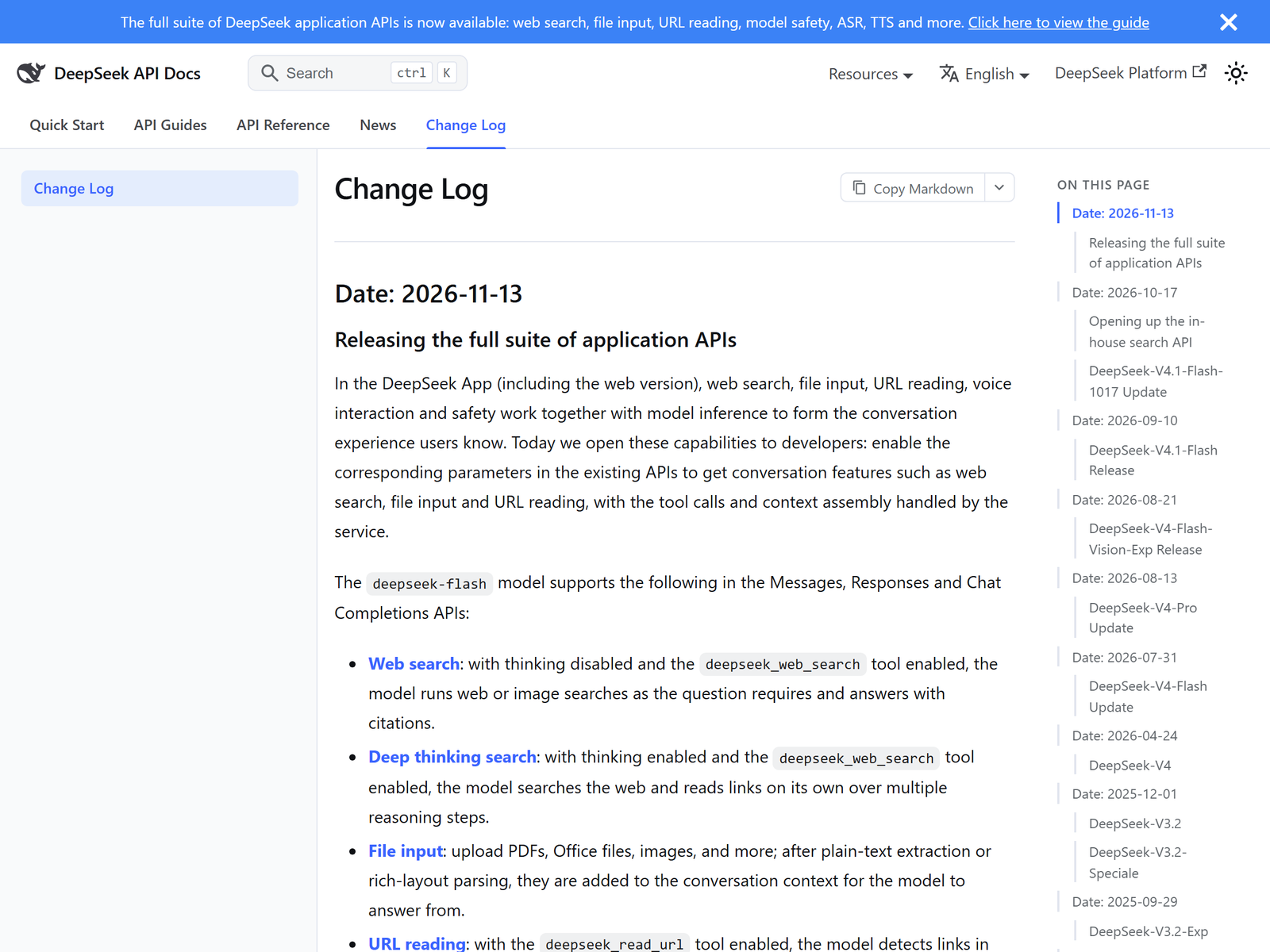
The serving model is deepseek-flash, currently backed by the DeepSeek-V4.1-Flash-1017 checkpoint, exposed through three existing endpoint families: Messages, Responses and Chat Completions. Developers flip capabilities on with parameters rather than wiring up external tools. In non-thinking mode, enabling the deepseek_web_search tool lets the model fire web or image searches and answer with citations. In thinking mode, the same tool lets the model search and read links across multiple reasoning steps. A separate deepseek_read_url tool grabs any link in a user message and folds the page content into the answer.
File input handles PDFs, Office documents and images, either extracting plain text or parsing mixed text-and-image layouts before joining the conversation context. A safety parameter adds server-side screening of both input and output, returning a refusal marker when something risky trips it. DeepSeek also released an open-source chat-demo client under the MIT license — it runs in a browser, keeps keys on-device, and can import a user's exported DeepSeek chat history, which is as close to a "1:1 replica of the app" as any vendor has shipped. This follows the October 17 release, when DeepSeek first opened standalone Search and Fetch APIs built on its own crawler-backed search engine.
The Standalone APIs and Their Real Prices
Alongside the in-chat tools, five standalone services can be called on their own. Search runs through DeepSeek's own index at up to 100 requests per second; Fetch returns pages as Markdown at up to 25 requests per second. OCR extracts text page by page, ASR transcribes audio in 21 languages, and TTS synthesizes speech in 10 languages with two voices — Stella and Tide — streaming over WebSocket. The context window reaches one million tokens with up to 384,000 output tokens per response.
The pricing structure is worth reading closely because each tool bills on its own meter, separate from model tokens:
| Service | DeepSeek price | Typical separate-vendor alternative |
|---|---|---|
| Search / Fetch | $0.75 per 1,000 successful calls (failed calls are not billed) | SerpAPI-style search APIs, scrapers — often $1-5 per 1,000 calls |
| OCR / file parsing | $0.225 per 1,000 pages | Dedicated OCR clouds frequently charge 5-10x that per page |
| ASR | $0.116 per hour of audio (currently 50% off) | Whisper-hosting or commercial STT at roughly $0.20-0.40 per hour |
| TTS | $0.45 per 10,000 characters (currently 50% off) | Popular TTS APIs charge $15-30 per million characters — similar or pricier |
| deepseek-flash model | $0.30 per 1M input tokens (cache miss), $0.006 cache hit, $1.20 per 1M output; off-peak rates halved | Frontier chat models commonly run $1-5 per 1M input |
For a small team shipping a research assistant, the arithmetic is blunt: retrieval, document understanding, transcription and speech generation land on one invoice, at prices that undercut most specialist providers.
Why the Tool-Stack Tax Just Collapsed
Until now, a chatbot with live search, document reading and voice meant stitching several vendors together — one for retrieval, one for OCR, one for speech — and eating the integration work plus three separate rate limits and three separate bills. That is exactly the friction this release removes. DeepSeek's own framing said the quiet part out loud: its conversational product is merely "a fairly basic form" of what human-model interaction can be, and developers should stop redoing the plumbing.
The competitive read matters more than the feature list. DeepSeek is not trying to out-frontier OpenAI or Anthropic on raw intelligence; it is competing on completeness per dollar. When ASR costs $0.116 per hour and the model underneath costs $0.30 per million input tokens, the practical floor for an AI voice assistant's marginal cost drops by an order of magnitude. Voice-first startups suddenly have a cheaper incumbent-shaped competitor — one that also happens to own the search index their product queries. Teams building speech products on standalone models like ElevenLabs' Scribe v3 speech-to-text or Block's on-device Dessa speech model now face a bundler, not just rival point products.
The Compliance Fine Print Most Coverage Skipped
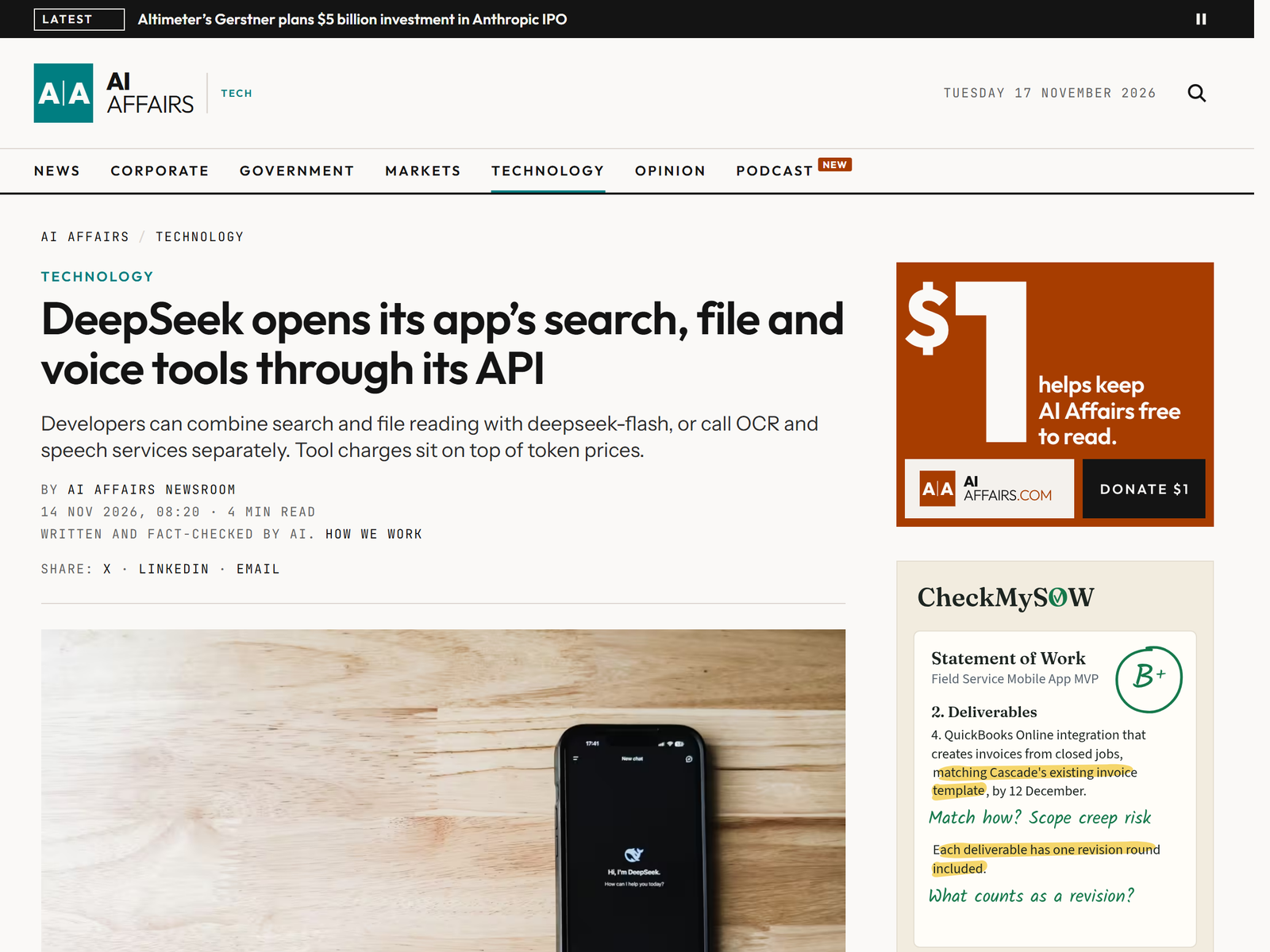
DeepSeek tells developers serving the public to enable the safety-check parameter — and to keep carrying their own obligations regardless, as AI Affairs reported. The changelog is explicit: enabling the parameter does not transfer responsibility. Developers must handle content security review, large-model registration, and AI labeling duties under Chinese generative-AI rules, with DeepSeek's check acting as a first-pass filter that returns a refusal marker rather than a compliance guarantee. Any team building consumer-facing products on this stack inherits a real regulatory workload, not just an API.
Two smaller additions round out the release: an automatic title option that names a conversation after the first response, and a latest_reminder option that passes current date, location, platform and language so the model can tailor answers. Neither is headline material, but both signal where this is going: DeepSeek is packaging the ambient context handling developers usually build themselves. More tool-level breakdowns like this one live in our Tool Dynamics section.
My Take / The Bottom Line
My take: this is a commoditization move aimed straight at the plumbing layer of the AI stack. The winners are indie developers and small startups who get a full research-and-voice toolkit at a fraction of assembled-stack cost. The losers are VC-funded single-function API vendors — OCR-as-a-service, search-API middlemen, transcription shops — who now compete against a company willing to price those functions as add-ons to a loss-leader model. The trade-offs shift to latency across multi-step tool calls and to keeping per-tool spend predictable, since each service meters independently. Bottom line: if your product's differentiator is "we bolted search onto a model," you no longer have one. If your differentiator is what you do with the retrieved material, DeepSeek just cut your infrastructure bill and your runway in half. Watch the voice discount expiry — 50%-off ASR and TTS is a customer-acquisition tool, not a permanent price.
Frequently Asked Questions
Q: What is DeepSeek's full app API?
Released November 13, 2026, it exposes the capabilities behind the DeepSeek consumer app — web search, file input, link reading, safety checks, and standalone Search, Fetch, OCR, ASR and TTS services — through the deepseek-flash model on the Messages, Responses and Chat Completions endpoints.
Q: How much does the DeepSeek full app API cost?
Search and Fetch cost $0.75 per 1,000 successful calls, OCR and file parsing $0.225 per 1,000 pages, ASR $0.116 per hour and TTS $0.45 per 10,000 characters (both voice services 50% off at launch). The deepseek-flash model itself is $0.30 per 1M input tokens on cache miss and $1.20 per 1M output, halved off-peak.
Q: Which model powers the new DeepSeek API features?
deepseek-flash, currently running the DeepSeek-V4.1-Flash-1017 checkpoint, with a one-million-token context window and up to 384,000 output tokens.
Q: Can developers replicate the DeepSeek app with these APIs?
Yes, in function. DeepSeek published an open-source MIT-licensed chat-demo that imports DeepSeek chat history and supports search, attachments, voice input and thinking mode, showing the full app experience rebuilt on the public APIs.