Inkling 2 Small Review 2026: Murati's 594B Open-Weight Bet
Category: Tool Dynamics
Excerpt:
Inkling 2 Small pairs 594B parameters with 17B active and a promised Apache 2.0 license. Here is what the open-weight bet costs on Tinker, and where it slips.
This review was written by the aifreetool Editorial Team, which reads model cards, pricing pages and third-party evaluations before publishing a verdict. Last updated November 10, 2026. We hold no affiliate relationship with Thinking Machines Lab or any lab named here.
Quick answer: Inkling 2 Small is Thinking Machines Lab's second-generation model, announced November 5, 2026: a 594B-parameter mixture-of-experts design with 17B active per token, image input, and an Artificial Analysis Intelligence Index score of 31. The open-weight promise is real but deferred — Apache 2.0 weights were slated for the following week, after external red-teaming. Until those files land, you rent it through Tinker, and Murati's team bills you on three separate token meters.

- 594B total parameters, 17B active, text and image in, text out, no audio.
- Index score 31 versus 13 for the first-generation Inkling-Small, per the vendor.
- Tinker charges prefill at $0.30 per million tokens, sampling at $1.00, training at $1.50.
- Weights, checkpoints and self-hosting arrive only after the safety review completes.
What Inkling 2 Small Actually Is
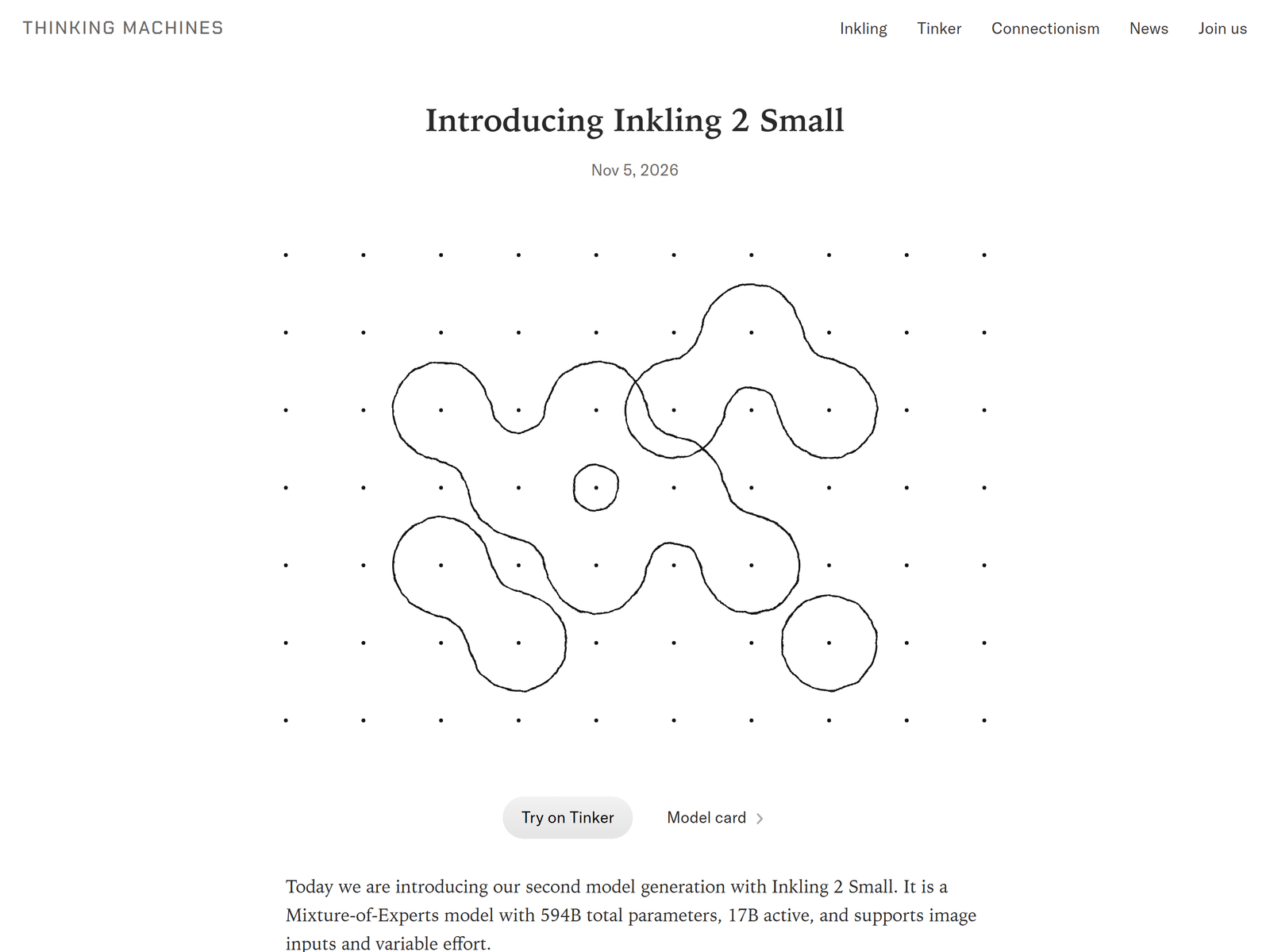
The architecture is a sparse mixture-of-experts transformer: 594 billion total parameters, but only 17 billion active per token, which is what makes serving it plausible. Vision comes from a 292M-parameter encoder built on Perception Encoder, using 20-by-20-pixel patches with 2x2 spatial pooling, interleaved with text tokens. Inputs are text and images; outputs are text only. Audio, which the first generation supported, is gone.
Thinking Machines describes four pretraining stages followed by a single nine-day reinforcement-learning run. The RL data was not just unit tests: the company says it trained on hundreds of thousands of long-horizon coding tasks across multiple agent harnesses and context-compaction strategies, with an agentic grader scoring how the model approached a problem rather than only whether its code passed. Early checkpoints were tested in public on OpenCode under the name Fledge-Alpha, a more honest setup than a curated demo reel.
There is also a genuine autoresearch result worth reading closely. In a demo built for an internal benchmark, Inkling 2 Small autonomously fine-tuned Qwen3.5-4B on Tinker to forecast time series such as weather and Wikipedia page views. It wrote its own evaluator, tested data recipes, debugged its own pipeline, and after 4.5 hours and $426 of Tinker spend had more than doubled the forecasting score. The full write-up sits in the Thinking Machines Lab announcement.
The Three-Meter Pricing on Tinker

Thinking Machines does not sell an endpoint. It sells post-training, and the meter design tells you what it wants you to do with the model. Prefill costs $0.30 per million tokens, or $0.03 when cached. Sampling costs $1.00 per million. Training costs $1.50 per million at 64K context and $3.00 at 256K. Checkpoint storage adds $0.10 per gigabyte per month.
| Operation | Inkling 2 Small, 64K | Inkling 2 Small, 256K |
|---|---|---|
| Prefill | $0.30 / M tokens | $0.30 / M tokens |
| Cached prefill | $0.03 / M tokens | $0.03 / M tokens |
| Sampling | $1.00 / M tokens | $1.00 / M tokens |
| Training | $1.50 / M tokens | $3.00 / M tokens |
Two things follow. First, a workload that reads a large, stable document set is cheap, because cached prefill is a tenth of normal prefill. Second, anything that generates a lot of tokens is not: the model is reported to emit roughly four times the output tokens of its predecessor, so a dollar of sampling buys you a quarter of the visible work. A $1.18-per-task figure from independent reviewers makes the same point.
The catalog is broader than one model. Tinker also fine-tunes other labs' open weights, including GLM-5.3, Kimi-K2.6, DeepSeek-V4.1-Flash, Nemotron 3.5, Qwen and GPT-OSS. That is the product thesis: one training surface, many base models, and no lock-in at inference because you eventually take the weights home.
Where the Model Wins and Where It Slips
Index 31 is the headline. On the Artificial Analysis Intelligence Index at version v5.0.1 that puts Inkling 2 Small level with Gemini 3.8 Flash, and roughly two and a half times the 13 scored by first-generation Inkling-Small. For an open-weights release that is a serious number, and it explains why the announcement led with long-horizon agentic work rather than chat quality.
The vision and agentic pairing is where the design pays off. The vendor's demos are interactive artifacts: a city simulator, a Linux desktop emulator, origami scenes, walkthroughs of apartment floor plans. Those are tasks where the model must look at what it built, notice the rendering is wrong, and iterate — exactly the loop the agentic grader was trained to reward.
The slips are equally concrete. Modal support shrank rather than grew, since audio is out. The model card advertises context up to one million tokens while the variants actually served on Tinker top out at 64K and 256K, so the number you plan around is the smaller one. And open weights were announced as a next-week event conditional on external safety testing, which makes the license a promise, not an artifact, until the files appear.
For comparison within the open-weights lane, our listing for the first-generation Inkling model shows how much the family changed in a single generation, and the Liquid AI LFM3 family represents the small-model end of the same trade.
What a 594B Model Costs You to Own
Downloading the weights is the easy part. Serving 594B parameters, even with 17B active, means multi-node inference with expert routing that misbehaves if your interconnect is slow. Teams budgeting for one eight-GPU node and expecting frontier output will be disappointed; the architecture assumes a cluster and someone who can shard it.
This is why the deferred release is more than safety theater. A week of external red-teaming buys Thinking Machines a week of ecosystem work: Tinker checkpoints become downloadable at the same moment, and fine-tuning results make the case for staying on the platform. The company frames the release as one rung on a ladder of model sizes, not a one-off.
Company context matters for anyone betting on the roadmap. Thinking Machines was founded by Mira Murati after she left OpenAI and raised a reported $2 billion seed round in 2025 at a $12 billion valuation. Business Insider reported on November 6 that it is negotiating roughly $5 billion led by Accel at about a $40 billion pre-money valuation — a lot of expected revenue for a company whose paid product is a fine-tuning meter.
My Take / The Bottom Line
Inkling 2 Small is the most interesting open-weights release since the last one shipped, and it is also the least convenient to adopt. The capability is real, the price per token is real, and the license will probably be real within days of publication.
But the product is deliberately unfinished at launch. Closed weights, waitlist inference, two context sizes and a four-times output-token bill add up to a model you should evaluate on Tinker this week and deploy only after the Apache 2.0 files are actually on Hugging Face. Signing a production plan around a promised license is vendor risk nobody priced.
The strongest signal is the autoresearch demo, not the index score. A model that can write its own evaluator, train a smaller model and double its accuracy for $426 is a different kind of tool from a model that answers questions well. If that behavior survives third-party testing, the fine-tuning meter becomes the cheapest R&D headcount in the market. Track the whole category at our tool dynamics hub.
FAQ: Inkling 2 Small and Tinker
Are the Inkling 2 Small weights open source? Not yet at launch. Thinking Machines said full weights would be released under Apache 2.0 the following week, after external safety testing and red-teaming completed.
How big is the model? 594 billion total parameters with 17 billion active per token, which makes it a sparse mixture-of-experts model rather than a dense one.
Can I run it on a single GPU? Not realistically. Serving it requires multi-node inference, and the served context variants are 64K and 256K tokens, not the one million the model card mentions.
What does it cost to use on Tinker? Prefill is $0.30 per million tokens, cached prefill $0.03, sampling $1.00, and training $1.50 at 64K context or $3.00 at 256K, plus $0.10 per gigabyte per month for checkpoint storage.