OpenAI Images 2.6 Explained (2026): Flare vs Sunburst Comparison
Category: Tool Dynamics
Excerpt:
OpenAI Images 2.6 explained: Flare vs Sunburst, pricing, GIF and SVG features, and which model to pick for fast drafts versus final edited assets in 2026.
This analysis was written by the aifreetool Editorial Team — a group of full-time AI-industry researchers and writers who verify every claim against primary sources. Last updated November 11, 2026. We keep no affiliate relationship with the companies covered here.
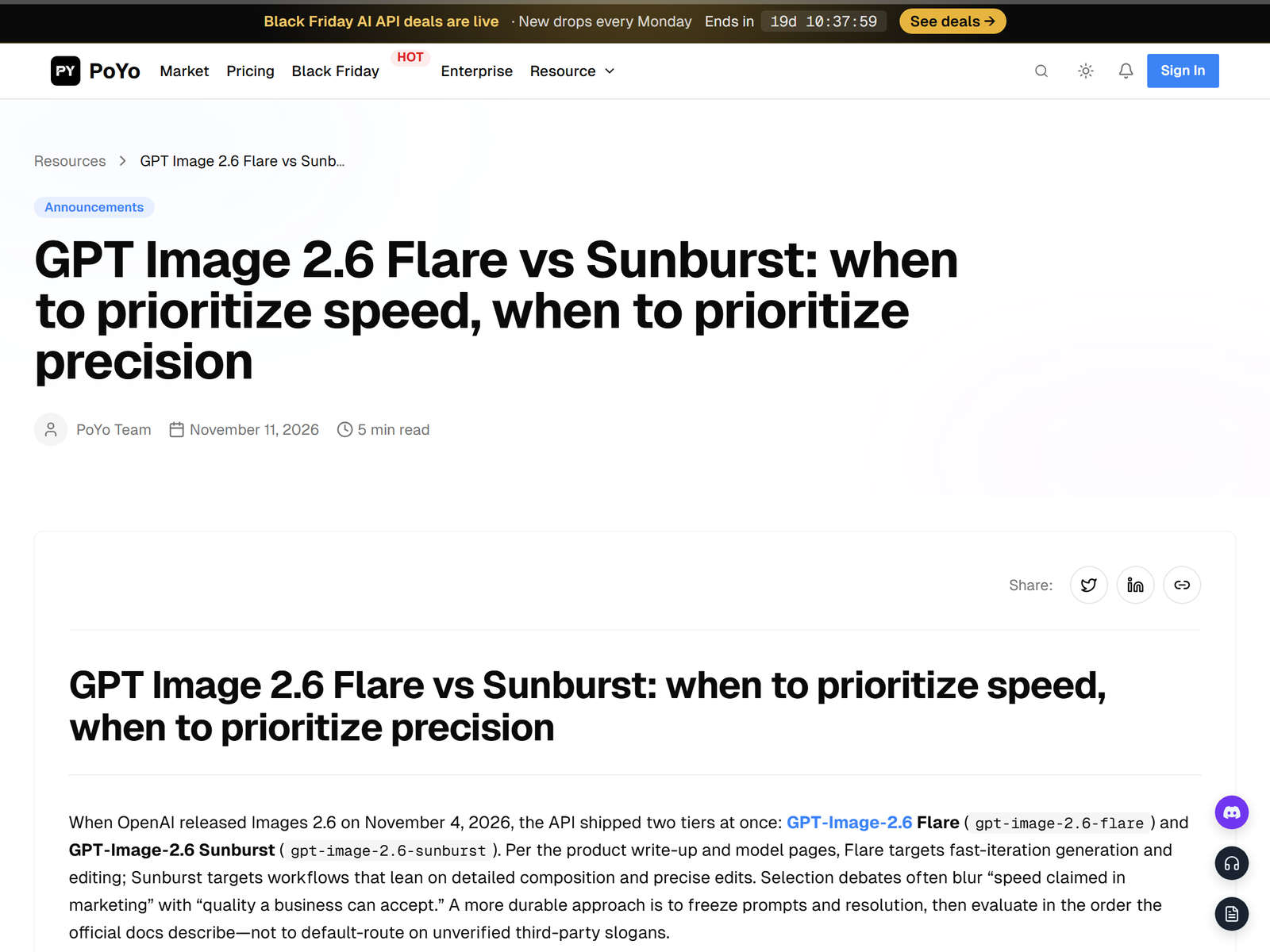
TL;DR: OpenAI Images 2.6, released November 4, 2026, ships two API models at the same price: OpenAI Images 2.6 Flare for fast drafts (as little as six seconds at low quality) and Sunburst for detail-heavy final edits with strong consistency across rounds. The comparison is simple, explained below: Flare while you iterate, Sunburst when the asset is final or edited more than once.

OpenAI did not release one image model this month — it released two, on the same day, at the same price. That split is the clearest signal yet that image generation has broken into two different jobs: exploratory generation where speed compounds, and finish work where edit consistency is the whole point. With people now creating 4 billion images per week across ChatGPT, Codex and the API — more than half a billion per day — the bottleneck is no longer raw quality. It is iteration economics.
What Shipped on November 4
Images 2.6 generates about 50% faster than the previous version, and the changes touch both ChatGPT and the API. In ChatGPT: GIF creation is rolling out, with adjustable playback speed and shareable loops; saved reference images let you reuse a photo in later chats — save your dog as "Pepper," then ask for a watercolor portrait of @Pepper without re-uploading. In the API, three features change how pipelines get built:
- Image markup — previously ChatGPT-only, now lets developers pinpoint exactly where to make a change instead of describing the region in prose.
- SVG export — vector output ready for websites, apps and print, editable rather than re-rasterized. It requires n=1 and supports no streaming, partial images, output compression or the prompt rewriter; the edit endpoint never returns SVG.
- A complexity parameter (low/medium/high) that controls how much planning the model does — lower settings suit quick edits, higher ones suit dense scenes.
As Pavitrams documents, OpenAI's own framing is that the release optimizes iteration speed rather than a new aesthetic. Both models accept text and image inputs, support quality settings from auto up through xhigh (Sunburst reaches max), and both run on the same rate card.
Flare vs Sunburst: The Actual Difference

| Dimension | GPT-Image-2.6 Flare | GPT-Image-2.6 Sunburst |
|---|---|---|
| Tuned for | Speed, drafts, fast iteration | Detail and edit consistency |
| Best at | Quick iteration, posters, ecommerce heroes, layout visuals | Complex composition, dense text, repeated edits that must preserve identity |
| Fastest reported | ~6 seconds at low quality | Not published |
| Edit consistency | Not its strength | The reason it exists — stronger consistency at medium/high quality |
| Price | $30 per million image output tokens | $30 per million image output tokens |
The six-second figure is a best case at low quality, but the gap is real and compounds across a session of drafts. Sunburst, per OpenAI's model pages, brings "higher-quality image generation and even greater image consistency across edits" at medium or high quality — the specific thing Flare is not tuned for. Per PoYo.ai, OpenAI's own migration guidance is engineering-minded: if your GPT Image 2 workflow already meets quality, test Flare first; if it falls short on complex tasks, test Sunburst first — and freeze prompts and resolution before comparing, rather than trusting third-party slogans.
Pricing Math: Why the Model Choice Does Not Change Your Bill
Both variants are billed identically: $5 per million text input tokens, $8 per million image input tokens ($2 cached), and $30 per million image output tokens. That output price undercuts the models it replaces — GPT Image 1.5 cost $32 and GPT Image 1 cost $40 per million output tokens. Complexity carries no separate charge, though higher settings add latency and can introduce unwanted changes. The cost lever that actually matters is iteration count: every edit re-uploads the source image at $8 per million image input tokens, so a workflow that burns five rounds per asset pays for the rounds, not the model. Markup-guided editing exists precisely to cut those rounds — pinning the change region beats describing it and hoping. If you are weighing this against other generators, our image generation tools directory lists the current alternatives with their pricing models.
Who Wins and Who Loses
Winners: e-commerce and social teams that produce volume. Flare's improved poster and product-imagery layout quality plus six-second turnaround makes a one-person shop viable for catalog-scale visuals, and SVG export removes the vectorization step for icon and logo workflows. Partners such as Figma Weave are already quoted in OpenAI's announcement for speed plus creative control in reusable templates. Losers: flat per-image stock generators and mid-tier design agencies whose value was fast, competent layout — that service is now a line item in an API call. The trade-off nobody escapes is stylistic range: for purely artistic work, the family remains narrower than Midjourney, and token billing makes per-image cost less predictable than flat pricing.
Key Takeaways
- Images 2.6 launched November 4, 2026: ~50% faster, native GIFs, saved @name reference images, SVG export and markup-guided editing in the API.
- Flare = iteration (6 seconds at low quality); Sunburst = finish work with consistency across repeated edits at medium/high quality.
- Both cost the same: $30/M image output tokens, $5/M text input, $8/M image input ($2 cached) — cheaper than GPT Image 1.5 at $32 and GPT Image 1 at $40.
- OpenAI reports 4 billion images created per week across ChatGPT, Codex and the API.
- SVG output is restricted: n=1 only, no streaming or partial images, and the edit endpoint never returns it.
My Take / The Bottom Line
The two-model split is OpenAI admitting something the industry has danced around: there is no single image model that is both the fastest and the most consistent, so stop pretending. The pricing makes the experiment cheap — same rate card either way, so the only cost of choosing wrong is a redo. My workflow rule: draft with Flare at low quality, and the moment an asset survives to a second round of edits, switch to Sunburst at medium or higher, because edit consistency is what stops a character's outfit drifting when the background changes. The strategic read matters more than the tactics, though: at half a billion images a day, OpenAI is competing on throughput and pipeline ergonomics (markup, SVG, references), not on prettier pictures. Whoever owns the edit loop owns the enterprise image budget — and with 2.6, OpenAI just priced itself squarely into it.
FAQ
What is the difference between OpenAI Images 2.6 Flare and Sunburst?
Both launched November 4, 2026 at the same price. Flare is tuned for speed — about six seconds per image at low quality — and improved poster and product layout. Sunburst is tuned for detail and consistency across repeated edits at medium or high quality, such as keeping a character or product identical across rounds.
How much does GPT-Image-2.6 cost?
$5 per million text input tokens, $8 per million image input tokens ($2 cached), and $30 per million image output tokens — the same for Flare and Sunburst, and cheaper than GPT Image 1.5 ($32) and GPT Image 1 ($40) output pricing.
Can Images 2.6 create GIFs and SVG files?
Yes. GIF creation is rolling out in ChatGPT with adjustable playback speed, and the API supports SVG export — but only with n=1, without streaming, partial images or compression, and the edit endpoint does not return SVG.
How many images does OpenAI generate per week?
OpenAI says people create 4 billion images per week across ChatGPT, Codex and the API — on average more than half a billion per day.